


OGSM Model Framework For 3 Year Strategic Growth Plan




Try Before you Buy Download Free Sample Product
 Impress Your
 Audience
 100%
100% Editable
 Save Hours
 of Time


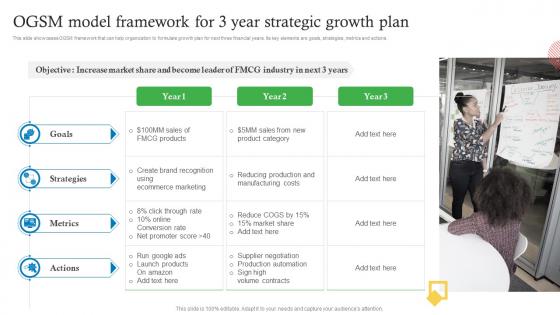
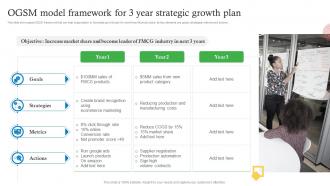
This slide showcases OGSM framework that can help organization to formulate growth plan for next three financial years. Its key elements are goals, strategies, metrics and actions.
People who downloaded this PowerPoint presentation also viewed the following :
OGSM Model Framework For 3 Year Strategic Growth Plan with all 6 slides:
Use our OGSM Model Framework For 3 Year Strategic Growth Plan to effectively help you save your valuable time. They are readymade to fit into any presentation structure.





FAQs for OGSM Model Framework For 3 Year
The OGSM model is a strategic planning framework that structures objectives, goals, strategies, and measures into a single-page visual format, emphasizing clarity and actionability over lengthy documentation. Unlike traditional planning models that often involve complex multi-document processes, OGSM streamlines decision-making by connecting high-level vision directly to measurable outcomes, with organizations in retail, manufacturing, and financial services finding that this approach accelerates implementation and enhances strategic alignment across teams.
Organizations effectively implement the OGSM model through cascading communication, regular review cycles, cross-functional collaboration, and clear accountability structures that connect individual roles to strategic objectives. Through systematic deployment across departments, companies like Toyota and Unilever streamline decision-making, enhance operational efficiency, and maintain strategic focus, with many finding that consistent OGSM application ultimately delivers measurable performance improvements and stronger competitive positioning.
The OGSM framework comprises four interconnected components: Objectives (broad aspirational goals), Goals (specific measurable targets), Strategies (approaches to achieve goals), and Measures (metrics to track progress). These elements work hierarchically, with objectives providing overarching direction, goals quantifying success, strategies outlining execution methods, and measures enabling continuous monitoring, ultimately delivering organizational alignment and strategic clarity across teams.
The OGSM model facilitates goal setting by creating a structured framework that connects high-level objectives to specific, measurable strategies and tactical actions. Through this systematic approach, organizations streamline strategic planning, enhance accountability across teams, and ensure measurable progress tracking, with many companies finding that OGSM delivers clearer focus, improved execution, and ultimately stronger competitive advantage in increasingly complex business environments.
The OGSM model adapts seamlessly across industries by maintaining its core structure while customizing objectives, goals, strategies, and measures to sector-specific requirements. Healthcare organizations focus on patient outcomes and regulatory compliance, financial services emphasize risk management and customer acquisition, while manufacturing prioritizes operational efficiency and quality control, with many organizations finding that industry-specific KPIs enhance strategic alignment.
Objectives in the OGSM framework serve as specific, measurable targets that translate broad goals into actionable outcomes, typically spanning 1-3 years and focusing on quantifiable results like revenue growth, market expansion, or operational efficiency improvements. These objectives drive success by providing clear direction and accountability metrics, with many organizations finding that well-formulated objectives enhance strategic alignment, accelerate decision-making, and ultimately deliver measurable competitive advantage across departments.
Organizations identify and prioritize OGSM goals by conducting comprehensive stakeholder consultations, analyzing market opportunities, and aligning initiatives with strategic vision and available resources. Through systematic evaluation of impact potential, feasibility, and timeline requirements, companies like retail chains and manufacturing firms streamline goal-setting processes, ultimately delivering focused execution and measurable competitive advantage in increasingly complex business environments.
Best practices for monitoring OGSM progress include establishing regular review cycles, creating visual dashboards that track key metrics, setting milestone checkpoints for each strategic goal, and implementing feedback loops for continuous improvement. These approaches enable organizations to maintain strategic alignment, quickly identify performance gaps, and make data-driven adjustments, with many companies finding that quarterly OGSM reviews enhance accountability and accelerate goal achievement across departments.
The OGSM model enhances communication by creating a unified framework where objectives, goals, strategies, and measures are clearly documented and accessible to all team members. This structured approach eliminates ambiguity, ensures everyone understands priorities and expectations, and enables departments to track progress transparently, ultimately fostering accountability and alignment across organizations while streamlining decision-making processes.
The OGSM model enhances performance management by establishing clear objectives, quantifiable goals, strategic initiatives, and measurable outcomes that create transparent accountability frameworks across organizational levels. Through systematic tracking and regular reviews, departments can monitor progress more effectively, identify performance gaps earlier, and align individual contributions with strategic priorities, ultimately delivering improved operational efficiency and stronger results-driven culture.
Common pitfalls include setting vague objectives, creating unrealistic goals, defining measures that don't align with outcomes, and developing overly complex strategies that lack clear priorities. Organizations often struggle with insufficient stakeholder buy-in, inadequate resource allocation, and failing to regularly review progress, with many finding that success requires dedicated change management and consistent leadership commitment throughout implementation.
Technology enhances OGSM implementation through cloud-based platforms, real-time analytics dashboards, automated tracking systems, collaborative project management tools, and integrated reporting software. These digital solutions streamline goal alignment, enable instant performance monitoring, and facilitate cross-departmental coordination, with many organizations finding that automated metrics tracking and visual progress displays significantly accelerate strategic execution and accountability.
Toyota, Procter & Gamble, and Unilever have successfully implemented the OGSM model to streamline their strategic planning processes across global operations. These companies leverage OGSM's structured framework to align objectives with measurable outcomes, enhance cross-departmental coordination, and accelerate decision-making, with many finding that this approach delivers improved operational efficiency and sustained competitive advantage in complex markets.
The OGSM model accommodates changes through its hierarchical structure, allowing organizations to adjust strategies and measures while maintaining core objectives, with regular review cycles enabling strategic pivots. Many businesses find that quarterly OGSM assessments help them respond to market shifts, competitive pressures, and internal changes while preserving strategic alignment, ultimately delivering organizational agility and sustained performance.
OGSM implementation training includes structured workshops, certification programs, executive coaching sessions, online learning platforms, and comprehensive implementation toolkits that guide teams through objective-setting, goal alignment, and strategy measurement. Through these resources, organizations streamline strategic planning processes, enhance cross-functional collaboration, and establish clear accountability frameworks, with many leadership teams finding that formal OGSM training accelerates strategic execution and delivers measurable performance improvements.
-
I want to express my gratitude to SlideTeam’s presentation design services team for helping me create the best presentation of my life!
-
The information is visually stunning and easy to understand, making it perfect for any business person. So I would highly recommend you purchase this PPT design now!