


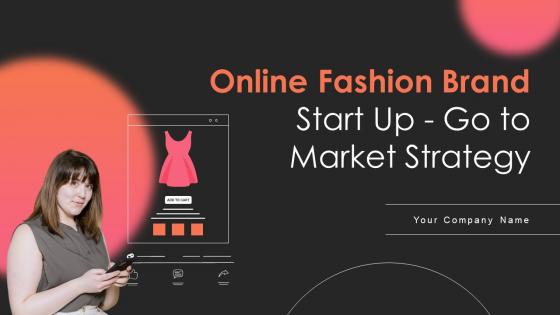
Online Fashion Brand Start Up Go To Market Strategy GTM CD




Try Before you Buy Download Free Sample Product
 Impress Your
 Audience
 100%
100% Editable
 Save Hours
 of Time


Our professionally designed Online fashion brand startup - Go to Market Strategy helps launch and ensures the startup is well-equipped to thrive in the dynamic professional services landscape. The PPT begins with an overview of the global fashion e-commerce market. After that, it highlights problems and solutions, showing how the startup business will resolve market problems. It then shows an industry overview, including the introduction, products or services offered, value proposition, and target audience. After that, it conducts competitor analyses of businesses that provide similar solutions. Then, it comes with various strategies, including pricing strategy, branding and positioning strategy, marketing strategy, content marketing strategy, sales strategy, distribution strategy, customer onboarding strategy, and customer retention strategy. Later, it outlines a timeline for market entry for the startup business. Lastly, it provides performance metrics, cost and investment, financial forecasts, legal consideration, and risk analysis. Get access now.
People who downloaded this PowerPoint presentation also viewed the following :
Content of this Powerpoint Presentation
Slide 1: This slide showcase title Online Fashion Brand Start Up - Go to Market Strategy. State Your Company Name.
Slide 2: This slide showcase Agenda Online fashion brand start up - Go to market strategy.
Slide 3: This slide exhibit Table of Content.
Slide 4: This slide presents an overview of fashion e-commerce market to gain valuable insights.
Slide 5: This slide showcases various gaps addressed in market along with desired state through the launch of online fashion brand startup.
Slide 6: This slide presents executive summary of go to market strategy of online fashion brand start-up business.
Slide 7: This slide outlines a business overview of a online fashion brand start-up. It highlights key components such as the business introduction, mission statement.
Slide 8: This slide presents products and services offered by online fashion brand startup business.
Slide 9: This slide outlines various factors that differentiate online fashion brand startup offerings from other businesses offering similar products.
Slide 10: This slide shows the ideal target audience for a online fashion brand start-up business.
Slide 11: The slide highlights comparative assessment of online fashion brand start-up business.
Slide 12: The slide highlights comparative assessment of online fashion brand start-up business.
Slide 13: This slide outlines the pricing strategy used by online fashion brand start-up businesses to offer products and services at costs customers are happily willing to pay.
Slide 14: This slide showcases the branding strategy to position online fashion brand among the target audience.
Slide 15: This slide highlights various promotional methods to be used by online fashion brand startup business to increase business presence.
Slide 16: This slide highlights various offline marketing strategies to be used by online fashion brand startup business to increase business presence.
Slide 17: This slide highlights various sales strategies to maximize sales and revenue.
Slide 18: This slide showcases distribution strategies for online fashion brand business start-up.
Slide 19: This slide outlines onboarding strategy to enhance customer experience.
Slide 20: The slide showcases various strategies to maximize customer retention rate and maximize business profitability.
Slide 21: This slide showcases a timeline showing time required for each task for successful market entry of a online fashion brand startup business.
Slide 22: This slide outlines various KPIs to track and measure business operational performance.
Slide 23: This slide presents financial analysis showing investment requirements to build and set up online fashion brand start-up business.
Slide 24: The slide outlines future projections showing the estimated growth of the online fashion brand startup business for five years after launch.
Slide 25: This slide showcases considerations of online fashion brand start-up business related to legal compliance and insurance requirements.
Slide 26: The slide outlines potential risks and challenges in online fashion brand start-up business.
Slide 27: This slide shows all the icons included in the presentation.
Slide 28: This slide is titled as Additional Slides for moving forward.
Slide 29: This slide presents Roadmap with additional textboxes. It can be used to present different series of events.
Slide 30: This slide depicts Venn diagram with text boxes.
Slide 31: This is Our Target slide. State your targets here.
Slide 32: This slide shows Post It Notes for reminders and deadlines. Post your important notes here.
Slide 33: This slide contains Puzzle with related icons and text.
Slide 34: This is a Thank You slide with address, contact numbers and email address.
Online Fashion Brand Start Up Go To Market Strategy GTM CD with all 42 slides:
Use our Online Fashion Brand Start Up Go To Market Strategy GTM CD to effectively help you save your valuable time. They are readymade to fit into any presentation structure.










FAQs for Online Fashion Brand Start Up Go To Market
Key market trends include sustainability consciousness, personalization demand, social commerce growth, mobile-first shopping, and influencer marketing dominance. These trends reshape customer expectations by driving eco-friendly product lines, AI-powered recommendations, and seamless social media integration, with many fashion brands finding that early adoption of these trends delivers enhanced customer loyalty and competitive differentiation.
Online fashion brands can leverage social media through influencer partnerships, user-generated content campaigns, interactive stories, live styling sessions, and targeted advertising based on fashion preferences and demographics. These strategies enhance brand visibility by showcasing products authentically, building community engagement, and driving conversions, with many fashion retailers finding that consistent social presence ultimately delivers increased customer loyalty and significantly higher sales growth.
Influencer marketing serves as a crucial brand awareness and credibility driver in fashion GTM strategies, enabling authentic product showcasing, targeted audience reach, social proof generation, and trend amplification. Through strategic partnerships with fashion influencers, micro-influencers, and style content creators, online fashion brands accelerate market penetration, build consumer trust, and drive conversions, while establishing authentic connections that traditional advertising often struggles to achieve.
Online fashion brands should customize messaging through demographic-specific language, cultural nuances, platform preferences, visual aesthetics, and value propositions that resonate with each target segment. This approach enables brands to connect authentically with diverse audiences, from Gen Z emphasizing sustainability and inclusivity to millennials focusing on lifestyle integration, ultimately driving higher engagement rates and conversion across multiple markets while building stronger brand loyalty.
Best practices for optimizing online shop UX include streamlined navigation, fast loading speeds, mobile responsiveness, simplified checkout processes, high-quality product imagery, and personalized recommendations. These enhancements work together by reducing friction points, building customer confidence, and creating intuitive shopping experiences, with many fashion retailers finding that strategic UX improvements deliver significantly higher conversion rates and customer satisfaction.
Data analytics transforms inventory management and pricing strategies by analyzing customer behavior patterns, seasonal trends, competitor pricing, and real-time demand signals across different demographics and regions. Through predictive modeling and market intelligence tools, fashion brands optimize stock levels, reduce overstock costs, and implement dynamic pricing strategies, while identifying high-performing products and emerging style preferences, ultimately delivering improved profit margins and faster inventory turnover rates.
International expansion challenges include cultural differences, regulatory compliance, logistics complexities, currency fluctuations, and local competition adaptation. Fashion brands can mitigate these through thorough market research, strategic local partnerships, phased market entry approaches, and leveraging digital-first strategies, with many retailers finding that localized marketing campaigns and flexible supply chain models ultimately deliver sustainable growth and competitive advantage.
Sustainable fashion has become critically important in modern online brand GTM strategies, driving customer acquisition, brand differentiation, and long-term market positioning. With younger consumers increasingly prioritizing environmental responsibility, brands leveraging sustainable practices see enhanced customer loyalty, premium pricing opportunities, and competitive advantage, while retailers like Patagonia and Everlane demonstrate how sustainability messaging accelerates market penetration and drives revenue growth.
Effective tactics include search engine optimization with fashion-specific keywords, social media marketing through Instagram and TikTok, influencer partnerships with fashion bloggers, email marketing campaigns, and targeted digital advertising. These approaches streamline customer acquisition by enhancing brand visibility, building authentic connections with style-conscious consumers, and creating compelling visual content, ultimately delivering increased website traffic and higher conversion rates.
Email marketing integrates into online fashion brand GTM strategies through personalized product recommendations, seasonal campaign automation, abandoned cart recovery sequences, and customer segmentation based on purchase behavior. These targeted approaches enable fashion retailers to deliver timely promotions, showcase new collections, and nurture customer relationships throughout the buying journey, ultimately driving higher conversion rates and customer lifetime value.
Seasonal trends significantly impact GTM strategy by influencing demand patterns, inventory planning, marketing timing, and customer purchasing behavior throughout different periods of the year. Fashion brands adapt by implementing flexible supply chains, launching targeted seasonal collections, adjusting pricing strategies for peak and off-peak periods, and leveraging predictive analytics to forecast demand, ultimately enabling them to maximize revenue opportunities while minimizing excess inventory costs.
Online fashion brands should measure GTM success through customer acquisition cost, conversion rates, brand awareness metrics, customer lifetime value, and revenue growth across channels. These metrics enable strategic optimization by tracking social media engagement, influencer campaign performance, and retention rates, with many fashion retailers finding that combining quantitative sales data with qualitative brand sentiment analysis ultimately delivers comprehensive insights into market penetration and competitive positioning.
Partnering with local fashion events and pop-ups offers online brands physical touchpoints for customers to experience products firsthand, increased brand visibility, and valuable community connections. These collaborations enable direct customer feedback, strengthen local market presence, and create authentic content opportunities, while many fashion retailers find that such partnerships drive both immediate sales and long-term brand loyalty through memorable in-person experiences.
Content marketing enhances storytelling in online fashion brand GTM strategies by creating authentic narratives around brand values, lifestyle aspirations, customer journeys, and seasonal collections through blogs, social media, and video content. These storytelling approaches enable fashion brands to build emotional connections, showcase product versatility in real-world contexts, and differentiate themselves in competitive markets, ultimately driving customer engagement and brand loyalty.
AR virtual try-ons, AI-powered personalization engines, computer vision for size recommendations, chatbots for styling advice, and predictive analytics for inventory management revolutionize online fashion retail. These technologies streamline shopping experiences by reducing return rates, enhancing product discovery, and delivering personalized recommendations, with many retailers finding that customers engage 40% longer and convert at significantly higher rates.
-
Based on my personal experience, I would recommend other people to subscribe to SlideTeam. No one can be disappointed here!
-
The best and engaging collection of PPTs I’ve seen so far. Great work!