


Online Food Restaurant Startup Go To Market Strategy Powerpoint Presentation Slides GTM CD




Try Before you Buy Download Free Sample Product
 Impress Your
 Audience
 100%
100% Editable
 Save Hours
 of Time


Virtual restaurants, or ghost kitchens, operate primarily through digital platforms such as websites and mobile apps. They also offer offline services. Our professionally designed Online Food Restaurant Startup Go to Market Strategy helps startups launch and ensures they are well equipped to thrive in the dynamic professional services landscape. The Virtual restaurant PPT begins with an overview of the global e learning market. After that, it highlights problems and solutions, showing how the startup business will resolve market problems. It then shows an overview of the business, including the introduction, products services offered, value proposition, and target audience. After that, it conducts competitor analysis of companies offering similar solutions. Then, it comes with various strategies, including pricing strategy, branding and positioning strategy, marketing strategy, content marketing strategy, sales strategy, distribution strategy, customer onboarding strategy, and customer retention strategy. Later, it outlines a timeline for market entry for the startup business. Lastly, food delivery PPT provides performance metrics, cost and investment, financial forecasts, legal consideration, and risk analysis. Download this meal delivery PPT right away.
People who downloaded this PowerPoint presentation also viewed the following :
Content of this Powerpoint Presentation
Slide 1: This slide showcase title Online Food Restaurant Startup – Go to Market Strategy. State Your Company Name.
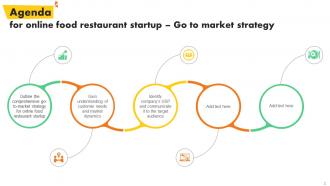
Slide 2: This slide showcase title Agenda.
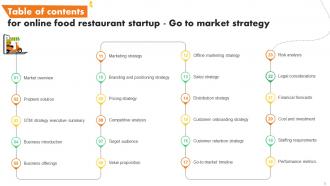
Slide 3: This slide exhibit Table of Content.
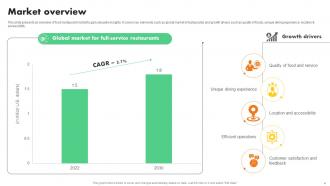
Slide 4: This slide presents an overview of food restaurant market to gain valuable insights.
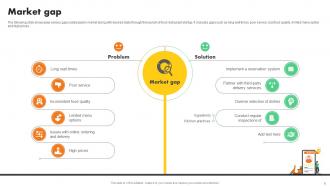
Slide 5: This slide showcases various gaps addressed in market along with desired state through the launch of food restaurant startup.
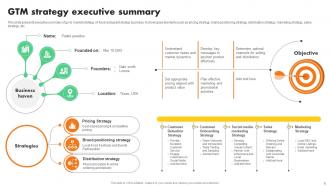
Slide 6: This slide presents executive summary of go to market strategy of food restaurant startup business.
Slide 7: This slide outlines a business overview of a food restaurant start-up.
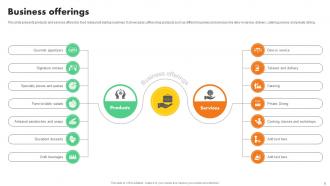
Slide 8: This slide presents products and services offered by food restaurant startup business.
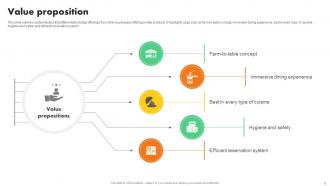
Slide 9: This slide outlines various factors that differentiate startup offerings from other businesses offering similar products.
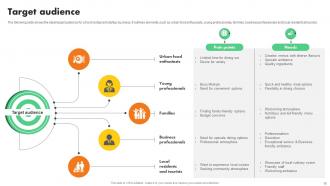
Slide 10: This slide shows the ideal target audience for a food restaurant startup business.
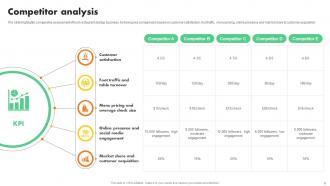
Slide 11: The slide highlights comparative assessment of food restaurant startup business.
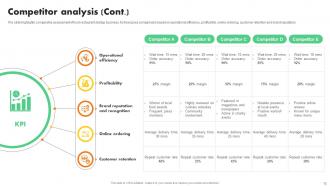
Slide 12: The slide highlights comparative assessment of food restaurant startup business.
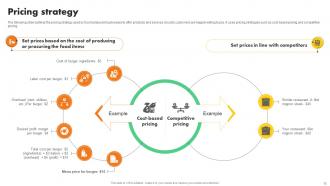
Slide 13: The following slide outlines the pricing strategy used by food restaurant businesses to offer products and services at costs customers are happily willing to pay.
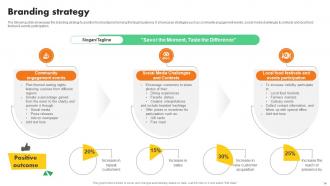
Slide 14: This slide showcases the branding strategy to position food restaurant among the target audience.
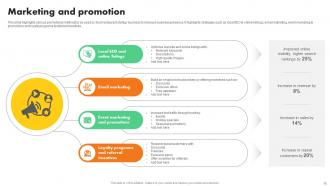
Slide 15: This slide highlights various promotional methods to be used by food restaurant startup business to increase business presence.
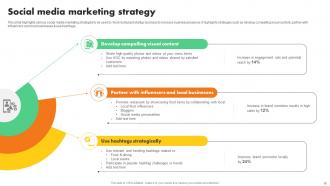
Slide 16: This slide highlights various social media marketing strategies to be used by food restaurant startup business to increase business presence.
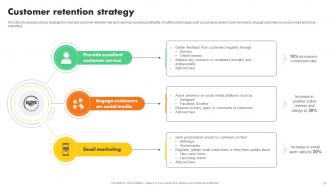
Slide 17: The slide showcases various strategies to maximize customer retention rate and maximize business profitability.
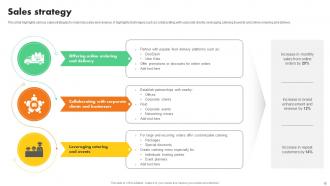
Slide 18: This slide highlights various sales strategies to maximize sales and revenue.
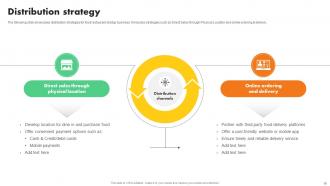
Slide 19: This slide showcases distribution strategies for food restaurant startup business.
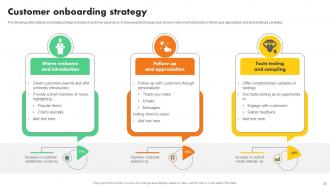
Slide 20: This slide outlines onboarding strategy to enhance customer experience.
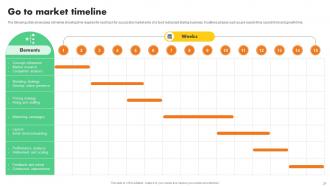
Slide 21: This slide showcases a timeline showing time required for each task for successful market entry of a food restaurant startup business.
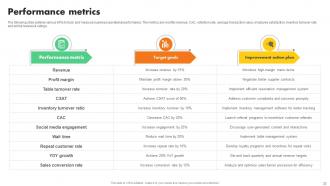
Slide 22: This slide outlines various KPIs to track and measure business operational performance.
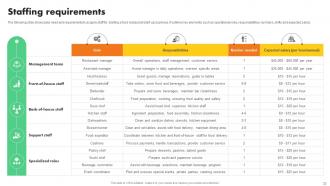
Slide 23: This slide showcases need and requirements to acquire staff for starting a food restaurant start-up business.
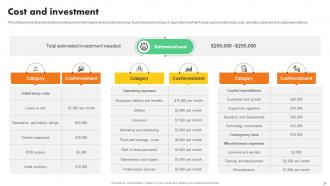
Slide 24: This slide presents financial analysis showing investment requirements to build and set up food restaurant business.
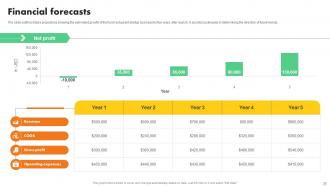
Slide 25: The slide outlines future projections showing the estimated growth of the food restaurant startup business for five years after launch.
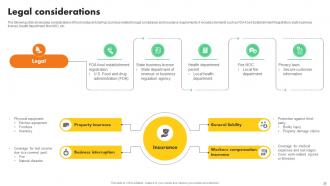
Slide 26: This slide showcases considerations of food restaurant start-up business related to legal compliance and insurance requirements.
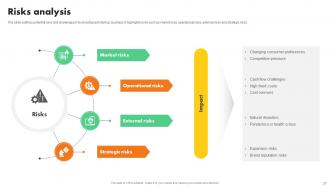
Slide 27: The slide outlines potential risks and challenges in food restaurant start-up business.
Slide 28: This slide shows all the icons included in the presentation.
Slide 29: This slide is titled as Additional Slides for moving forward.
Slide 30: This slide provides 30 60 90 Days Plan with text boxes.
Slide 31: This is Our Goal slide. State your firm's goals here.
Slide 32: This slide contains Puzzle with related icons and text.
Slide 33: This is a Timeline slide. Show data related to time intervals here.
Slide 34: This is a Thank You slide with address, contact numbers and email address
Online Food Restaurant Startup Go To Market Strategy Powerpoint Presentation Slides GTM CD with all 42 slides:
Use our Online Food Restaurant Startup Go To Market Strategy Powerpoint Presentation Slides GTM CD to effectively help you save your valuable time. They are readymade to fit into any presentation structure.











FAQs for Online Food Restaurant Startup Go To Market Strategy Powerpoint Presentation
Key factors include demographics, geographic location, dietary preferences, ordering behavior, and price sensitivity, along with lifestyle patterns and technology adoption rates. Successful startups often analyze local market data, competitor customer bases, and delivery logistics feasibility, while many finding that focusing on specific neighborhoods or dietary niches initially enables better resource allocation and customer acquisition before scaling operations.
Market research helps define your online food restaurant's USP by identifying competitor gaps, customer pain points, underserved dietary preferences, and pricing sensitivities through surveys, focus groups, and behavioral analysis. These insights enable restaurants to craft distinctive value propositions, whether emphasizing farm-to-table sourcing, 15-minute delivery guarantees, or specialized cuisines, ultimately delivering competitive differentiation and targeted customer acquisition in an increasingly crowded marketplace.
Branding establishes crucial differentiation, builds customer trust, and creates memorable identity through consistent visual elements, compelling messaging, and unique value propositions that resonate with target audiences. For online food startups, strategic branding enhances customer acquisition, drives repeat orders, and enables premium pricing, with many successful platforms finding that strong brand identity ultimately delivers competitive advantage and sustainable growth.
New online food restaurants should assess competition by analyzing delivery platforms, pricing strategies, menu positioning, customer reviews, and digital marketing approaches. Through competitor analysis tools and market research, startups can identify gaps in service areas, underserved cuisines, and pricing opportunities, while examining successful restaurants' social media engagement and promotional tactics, ultimately enabling strategic differentiation and competitive advantage in crowded markets.
Social media platforms, search engine advertising, influencer partnerships, local SEO optimization, and email marketing campaigns represent the most effective channels for promoting new food delivery services. These digital approaches streamline customer acquisition by targeting local demographics, leveraging food photography for engagement, and building repeat ordering habits, with many restaurant startups finding that integrated multi-channel strategies deliver faster market penetration and sustainable customer growth.
Partnerships with local suppliers enhance go-to-market strategies by reducing operational costs, ensuring fresher ingredients, and strengthening community connections that build customer loyalty. These strategic relationships enable faster delivery times, support local economic narratives that resonate with consumers, and create competitive advantages through unique menu offerings, with many restaurant startups finding that supplier partnerships significantly accelerate market penetration.
Best practices include intuitive navigation, high-quality food photography, streamlined ordering processes, mobile optimization, real-time order tracking, and integrated payment systems. These elements enhance customer experience by reducing friction, building appetite appeal, and ensuring seamless transactions, with many successful food startups finding that visual-first design combined with one-click ordering significantly increases conversion rates and customer retention.
Online food restaurants can leverage social media through targeted advertising, influencer partnerships, user-generated content campaigns, loyalty program integration, and real-time customer engagement across platforms like Instagram, TikTok, and Facebook. These strategies enhance brand visibility, build community connections, and drive repeat orders, with many restaurants finding that consistent social storytelling and interactive content ultimately delivers higher customer lifetime value and sustainable competitive advantage.
Online food restaurant startups face significant challenges including intense competition from established platforms, high customer acquisition costs, operational scaling difficulties, regulatory compliance complexities, and maintaining food quality consistency. While these obstacles present substantial hurdles, many startups find strategic partnerships with local restaurants, targeted marketing approaches, and robust logistics systems enable sustainable growth, ultimately delivering competitive advantage through specialized market positioning and enhanced customer experiences in an increasingly crowded marketplace.
Offering diverse payment options is crucial for online food restaurants, as it directly impacts conversion rates, customer satisfaction, and market reach across different demographic segments. Multiple payment methods including digital wallets, credit cards, buy-now-pay-later services, and mobile payments streamline the checkout process, reduce cart abandonment, and accommodate varying customer preferences, ultimately delivering enhanced user experiences and competitive advantage in the increasingly crowded food delivery market.
Online food restaurants should implement comprehensive feedback mechanisms including in-app ratings, post-delivery surveys, social media monitoring, direct customer support channels, and review platform analysis. These systems enable restaurants to identify service gaps, menu preferences, and delivery issues while enhancing customer satisfaction, with many establishments finding that integrated feedback loops significantly improve retention rates and operational efficiency.
Online food restaurants can utilize SEO through keyword optimization for local searches, creating content around popular dishes and dining trends, optimizing Google My Business profiles, building local citations, and encouraging customer reviews. These strategies enhance search rankings by targeting "food delivery near me" queries, improving local pack visibility, and establishing authority through recipe blogs, ultimately delivering increased organic traffic and customer acquisition in an increasingly competitive digital food service landscape.
Customer service plays a pivotal role by building trust, ensuring order accuracy, resolving delivery issues, and creating positive experiences that drive repeat business and referrals. Through responsive support channels, proactive communication about delays, and swift resolution of complaints, online food startups differentiate themselves in competitive markets, with many finding that exceptional service transforms first-time customers into loyal advocates who generate sustainable revenue growth.
Loyalty programs can be structured through points-based rewards, tiered membership levels, personalized offers, referral bonuses, and exclusive access to new menu items or priority delivery. These programs drive repeat business by creating emotional investment in the brand, incentivizing higher order values, and generating valuable customer data for targeted marketing, with many restaurants finding that members order 40% more frequently than non-members.
Key metrics include customer acquisition cost (CAC), average order value, customer lifetime value, monthly active users, and retention rates. These indicators help restaurants optimize marketing spend, pricing strategies, and operational efficiency across delivery platforms, with many food startups finding that tracking order frequency and geographic expansion rates ultimately delivers sustainable growth and competitive advantage.
-
SlideTeam never fails to surprise me with its amazing PPT designs. Thanks team for providing me with your constant support!
-
Extensive range of templates! Highly impressed with the quality of the designs.