

Open AI Chatbot For Enhanced Personalization And Improved Automation AI CD V




Try Before you Buy Download Free Sample Product
 Impress Your
 Audience
 100%
100% Editable
 Save Hours
 of Time


Our Open AI Chatbot For Enhanced Personalization And Improved Automation AI CD V are topically designed to provide an attractive backdrop to any subject. Use them to look like a presentation pro.
People who downloaded this PowerPoint presentation also viewed the following :
Content of this Powerpoint Presentation
Slide 1: This slide introduces Open AI chatbot for enhanced personalization and improved automation. State your company name and begin.
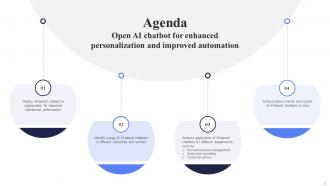
Slide 2: This is an Agenda slide. State your agendas here.
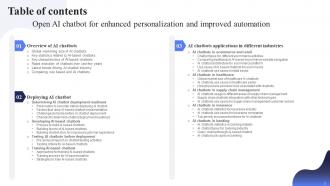
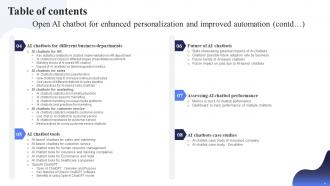
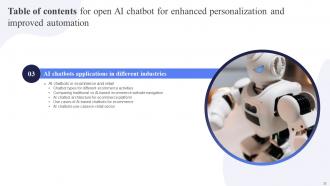
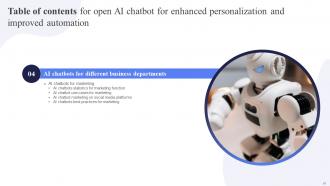
Slide 3: This slide shows Table of Content for the presentation.
Slide 4: This slide continues showing Table of Content for the presentation.
Slide 5: This slide shows title for topics that are to be covered next in the template.
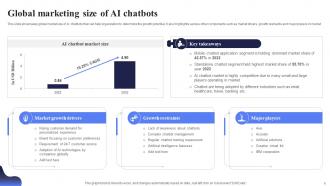
Slide 6: This slide showcases global market size of AI chatbots that can help organization to determine the growth potential.
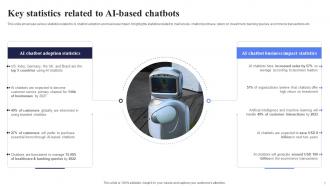
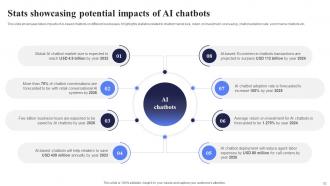
Slide 7: This slide presents various statistics related to AI chatbot adoption and business impact.
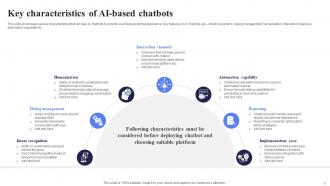
Slide 8: This slide describes various characteristics that can help AI chatbots to provide seamless customer experience.
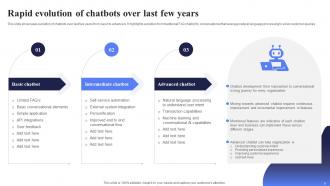
Slide 9: This slide showcases evolution of chatbots over last few years from basic to advanced.
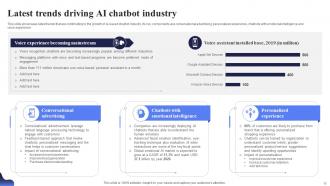
Slide 10: This slide displays latest trends that are contributing to the growth of AI-based chatbot industry.
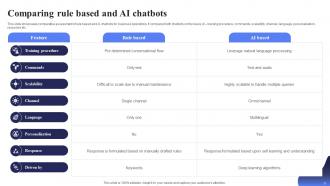
Slide 11: This slide showcases comparative assessment of rule based and AI chatbots for business operations.
Slide 12: This slide shows title for topics that are to be covered next in the template.
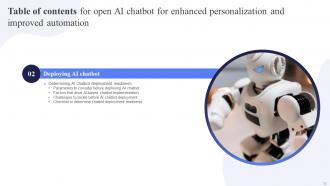
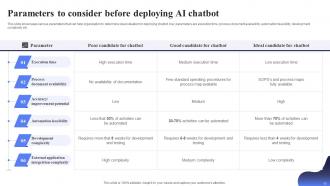
Slide 13: This slide showcases various parameters that can help organization to determine ideal situation for deploying chatbot.
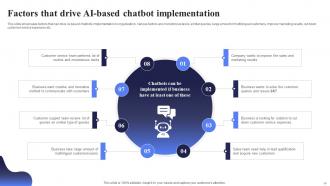
Slide 14: This slide presents factors that can drive AI-based chatbots implementation in organization.
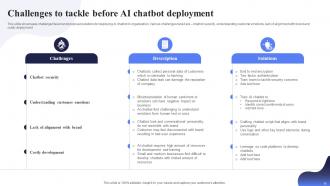
Slide 15: This slide displays challenged faced and proposed solutions for deploying AI chatbot in organization.
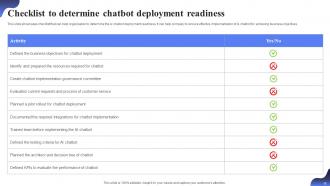
Slide 16: This slide showcases checklist that can help organization to determine the AI chatbot deployment readiness.
Slide 17: This slide shows title for topics that are to be covered next in the template.
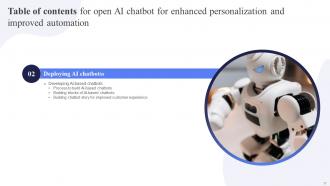
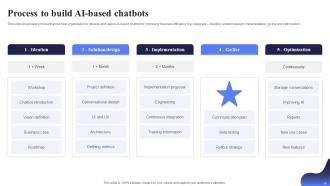
Slide 18: This slide describes a process that can help organization to develop and deploy AI-based chatbot for improving business efficiency.
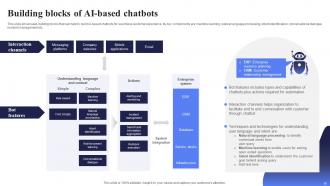
Slide 19: This slide showcases building blocks that can help to build AI-based chatbots for seamless customer experience.
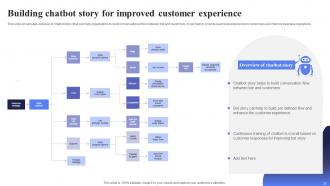
Slide 20: This slide presents an overview of chatbot story that can help organization to build conversational flow between bot and customers.
Slide 21: This slide shows title for topics that are to be covered next in the template.
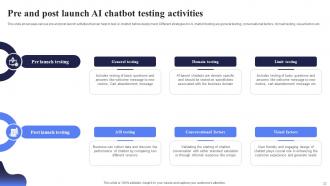
Slide 22: This slide showcases various pre and post launch activities that can help to test AI chatbot before deployment.
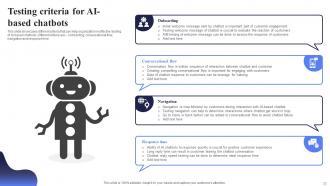
Slide 23: This slide presents different criteria that can help organization in effective testing of AI-based chatbots.
Slide 24: This slide shows title for topics that are to be covered next in the template.
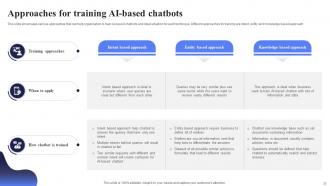
Slide 25: This slide showcases various approaches that can help organization to train AI-based chatbots and ideal situation for each technique.
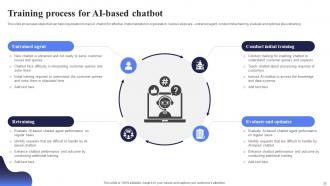
Slide 26: This slide presents steps that can help organization to train AI chatbot for effective implementation in organization.
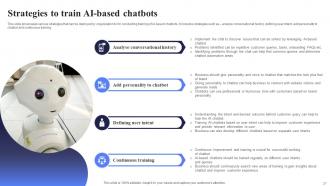
Slide 27: This slide showcases various strategies that can be deployed by organization to for conducting training of AI-based chatbots.
Slide 28: This slide shows title for topics that are to be covered next in the template.
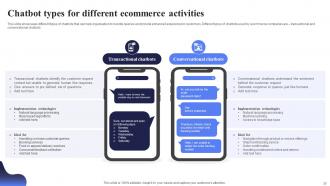
Slide 29: This slide showcases different types of chatbots that can help organization to handle queries and provide enhanced experience to customers.
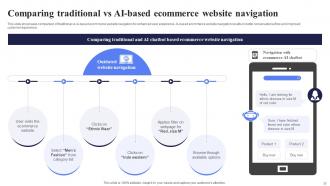
Slide 30: This slide displays comparison of traditional vs AI-based ecommerce website navigation for enhanced user experience.
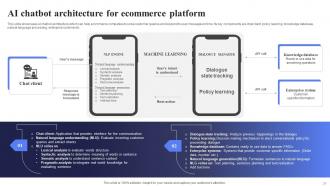
Slide 31: This slide showcases AI chatbot architecture which can help ecommerce companies to solve customer queries and respond to user messages in time.
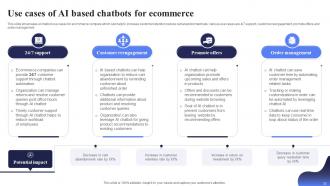
Slide 32: This slide presents AI chatbot use cases for ecommerce company which can help to increase customer retention reduce cart abandonment rate.
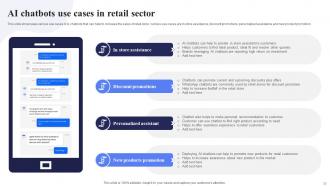
Slide 33: This slide showcases various use cases of AI chatbots that can help to increase the sales of retail store.
Slide 34: This slide shows title for topics that are to be covered next in the template.
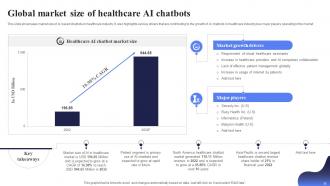
Slide 35: This slide displays global market size of AI chatbots that can help organization to determine the growth potential.
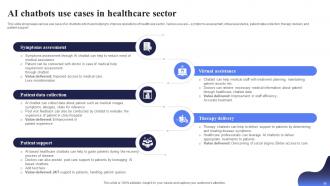
Slide 36: This slide showcases various use case of AI chatbots which are helping to improve operations of healthcare sector.
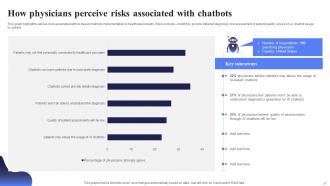
Slide 37: This slide displays graph which highlights various risks associated with AI based chatbots implementation in healthcare industry.
Slide 38: This slide shows title for topics that are to be covered next in the template.
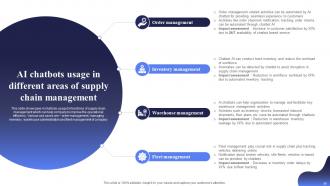
Slide 39: This slide showcases Ai chatbots usage for functions of supply chain management which can help company to improve the operational efficiency.
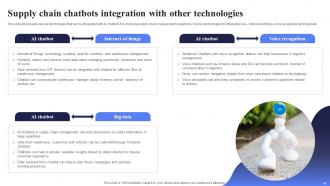
Slide 40: This slide presents various technologies that can be integrated with AI chatbots for improving supply chain management operations.
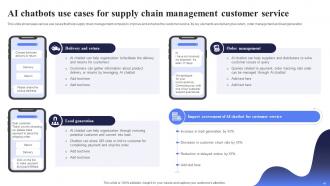
Slide 41: This slide showcases various use cases that help supply chain management company to improve and enhance the customer service.
Slide 42: This slide shows title for topics that are to be covered next in the template.
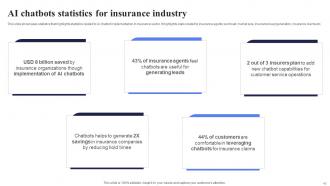
Slide 43: This slide displays statistics that highlights statistics related to AI chatbot implementation in insurance sector.
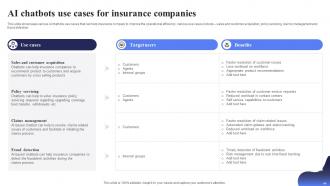
Slide 44: This slide showcases various AI chatbots use cases that can help insurance company to improve the operational efficiency.
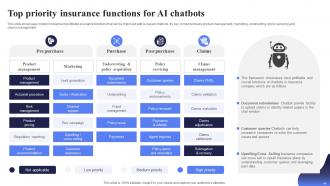
Slide 45: This slide presents most prominent and profitable insurance functions that can be improved with AI-based chatbots.
Slide 46: This slide shows title for topics that are to be covered next in the template.
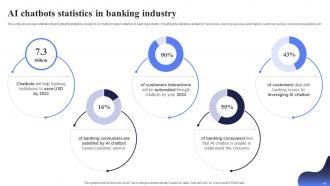
Slide 47: This slide showcases statistics that highlights statistics related to AI chatbot implementation in banking industry.
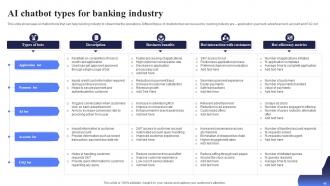
Slide 48: This slide presents AI chatbot tools that can help banking industry to streamline the operations.
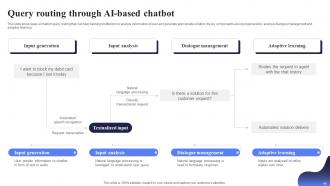
Slide 49: This slide showcases AI chatbot query routing that can help banking institutions to analyze information of user and generate appropriate solution.
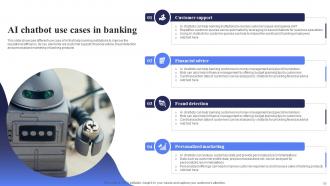
Slide 50: This slide presents different use case of AI that help banking institutions to improve the operational efficiency.
Slide 51: This slide shows title for topics that are to be covered next in the template.
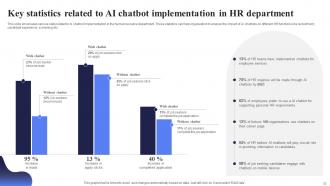
Slide 52: This slide showcases various stats related to AI chatbot implementation in the human resource department.
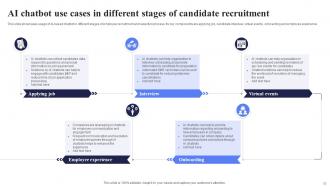
Slide 53: This slide presents usage of AI-based chatbot in different stages of employee recruitment and selection process.
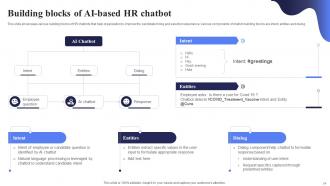
Slide 54: This slide showcases various building blocks of HR chatbots that help organization to improve the candidate hiring and selection experience.
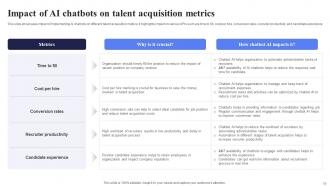
Slide 55: This slide displays impact of implementing AI chatbots on different talent acquisition metrics.
Slide 56: This slide shows title for topics that are to be covered next in the template.
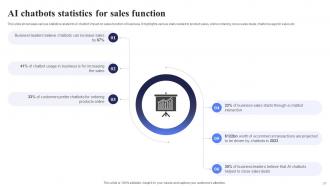
Slide 57: This slide showcases various statistics related to AI chatbot impact on sales function of business.
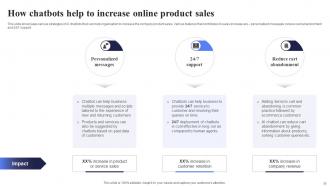
Slide 58: This slide presents various strategies of AI chatbots that can help organization to increase the company product sales.
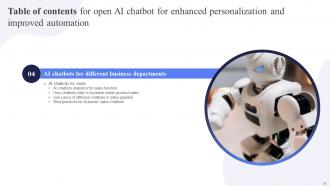
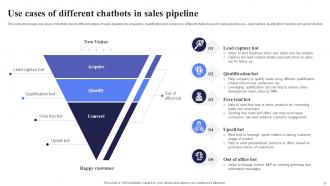
Slide 59: This slide showcases use cases of chatbots during different stages of sales pipeline like acquisition, qualification and conversion.
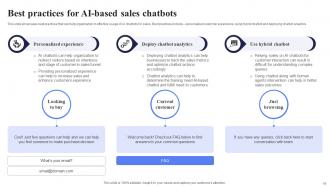
Slide 60: This slide presents best practices that can help organization in effective usage of AI chatbots for sales.
Slide 61: This slide shows title for topics that are to be covered next in the template.
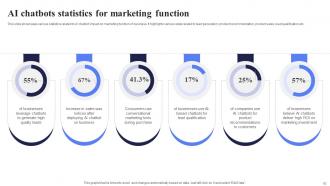
Slide 62: This slide showcases various statistics related to AI chatbot impact on marketing function of business.
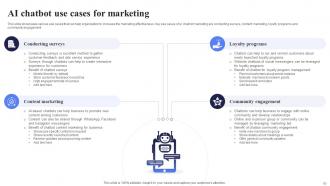
Slide 63: This slide presents various use cases that can help organization to increase the marketing effectiveness.
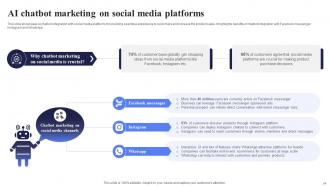
Slide 64: This slide showcases AI chatbot integration with social media platforms for providing seamless experience to customers and increase the product sales.
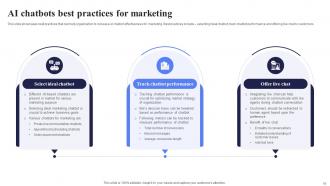
Slide 65: This slide describes best practices that can help organization to increase AI chatbot effectiveness for marketing.
Slide 66: This slide shows title for topics that are to be covered next in the template.
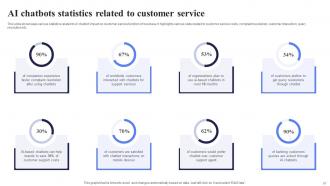
Slide 67: This slide showcases various statistics related to AI chatbot impact on customer service function of business.
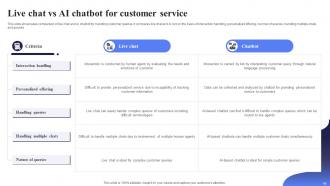
Slide 68: This slide presents comparison of live chat and AI chatbot for handling customer queries.
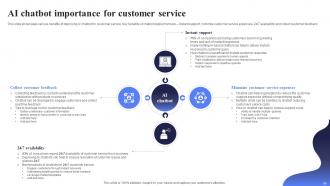
Slide 69: This slide showcases various benefits of deploying AI chatbot for customer service.
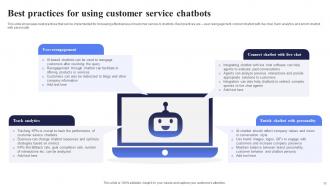
Slide 70: This slide presents best practices that can be implemented for increasing effectiveness of customer service AI chatbots.
Slide 71: This slide shows title for topics that are to be covered next in the template.
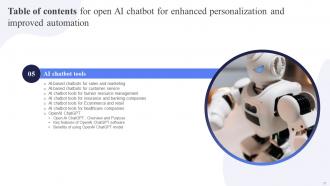
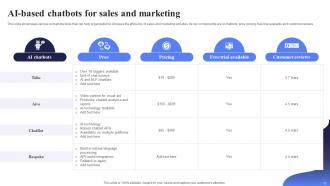
Slide 72: This slide showcases various AI chatbots tools that can help organization to increase the efficiency of sales and marketing activities.
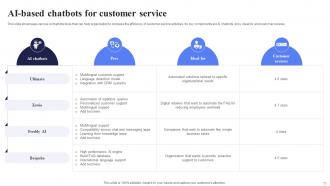
Slide 73: This slide describes various AI chatbots tools that can help organization to increase the efficiency of customer service activities.
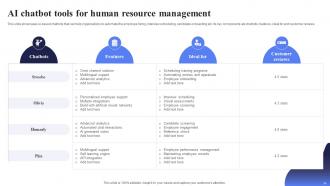
Slide 74: This slide showcases AI-based chatbots that can help organizations to automate the employee hiring, interview scheduling, candidate onboarding etc.
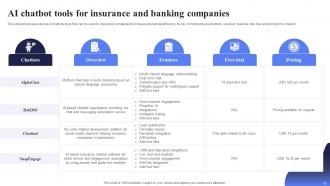
Slide 75: This slide presents various AI chatbots tools that can be used by insurance companies to increase operational efficiency.
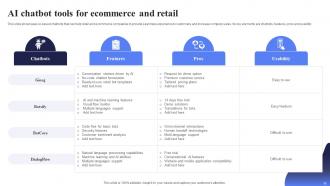
Slide 76: This slide showcases AI-based chatbots that can help retail and ecommerce companies to provide seamless experience to customers and increase company sales.
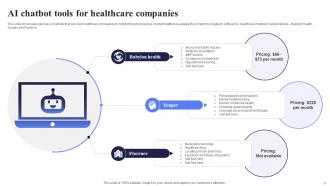
Slide 77: This slide presents various AI chatbots that can help healthcare companies to monitor the physical plus mental health plus assess the symptoms of patient.
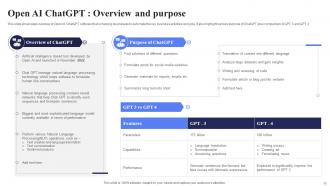
Slide 78: This slide showcases overview of Open AI ChatGPT software that is helping businesses to automate the key business activities and jobs.
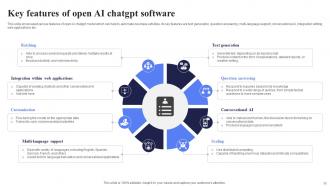
Slide 79: This slide displays various features of OpenAI ChatGPT model which can help to automate business activities.
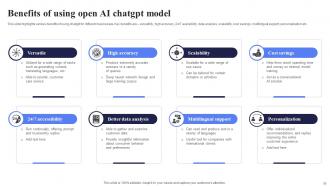
Slide 80: This slide highlights various benefits of using ChatGPT for different businesses.
Slide 81: This slide shows title for topics that are to be covered next in the template.
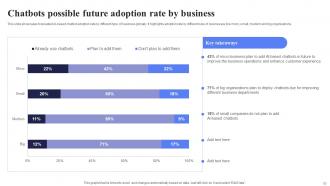
Slide 82: This slide showcases future impacts of AI-based chatbots on different businesses.
Slide 83: This slide displays a graph highlighting various risks associated with AI based chatbots implementation in healthcare industry.
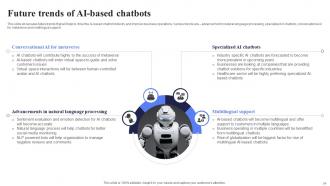
Slide 84: This slide showcases future trends that will help to drive the AI-based chatbot industry and improve business operations.
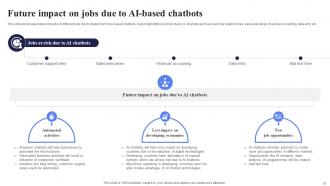
Slide 85: This slide presents future impacts on different jobs due to deployment of AI-based chatbots.
Slide 86: This slide shows title for topics that are to be covered next in the template.
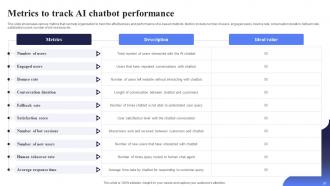
Slide 87: This slide showcases various metrics that can help organization to track the effectiveness and performance of AI-based chatbots.
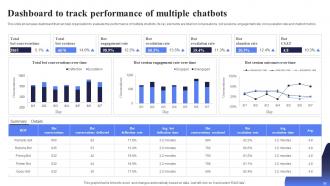
Slide 88: This slide presents a dashboard that can help organization to evaluate the performance of multiple chatbots.
Slide 89: This slide shows title for topics that are to be covered next in the template.
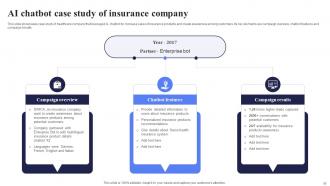
Slide 90: This slide showcases a case study of healthcare company that leveraged AI chatbot for increase sales of insurance products and create awareness among customers.
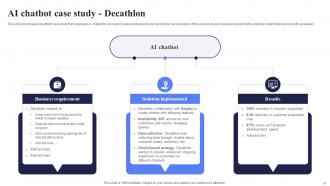
Slide 91: This slide presents Decathlon case study that leveraged AI chatbot for increasing sales and acquire new customers.
Slide 92: This slide shows all the icons included in the presentation.
Slide 93: This slide is titled as Additional Slides for moving forward.
Slide 94: This slide provides 30 60 90 Days Plan with text boxes.
Slide 95: This slide depicts Venn diagram with text boxes.
Slide 96: This is an Idea Generation slide to state a new idea or highlight information, specifications etc.
Slide 97: This slide shows Post It Notes for reminders and deadlines. Post your important notes here.
Slide 98: This is a Thank You slide with address, contact numbers and email address.
Open AI Chatbot For Enhanced Personalization And Improved Automation AI CD V with all 106 slides:
Use our Open AI Chatbot For Enhanced Personalization And Improved Automation AI CD V to effectively help you save your valuable time. They are readymade to fit into any presentation structure.










FAQs for Open AI Chatbot For Enhanced Personalization And Improved Automation
OpenAI chatbots feature advanced natural language processing, contextual understanding, multi-turn conversations, creative content generation, and complex reasoning capabilities that surpass traditional rule-based systems. These AI-powered technologies enhance customer interactions by delivering personalized responses, handling nuanced queries, and maintaining conversation flow, with many businesses finding that OpenAI chatbots significantly reduce support costs while improving customer satisfaction.
Businesses can leverage OpenAI chatbots to improve customer engagement by providing instant 24/7 support, personalizing interactions through conversation history, automating routine inquiries, and delivering consistent service quality across all touchpoints. These AI-powered solutions enable companies in retail, banking, and healthcare to reduce response times, increase customer satisfaction, and scale support operations efficiently, ultimately delivering enhanced experiences while minimizing operational costs.
Ethical considerations surrounding OpenAI chatbots include data privacy protection, algorithmic bias mitigation, transparency in AI decision-making, user consent protocols, and responsible content generation safeguards. These frameworks enable organizations to build trust through transparent practices, minimize discriminatory outcomes, and ensure user safety, with many financial services and healthcare institutions finding that proactive ethical guidelines ultimately deliver stronger customer relationships and competitive advantage.
OpenAI's natural language processing enhances user interaction by understanding context, interpreting complex queries, and generating human-like responses that feel conversational and intuitive. Through advanced language models, businesses streamline customer support, automate content creation, and deliver personalized experiences, with many organizations finding that these capabilities significantly reduce response times while improving user satisfaction and engagement.
OpenAI chatbots can be customized through industry-specific training data, specialized knowledge bases, custom workflows, API integrations, and tailored response frameworks. Financial services leverage these customizations for compliance-aware interactions, while healthcare organizations integrate medical terminology and patient care protocols, ultimately delivering more relevant customer experiences and operational efficiency across diverse business environments.
Common challenges include integration complexity with existing systems, ensuring data security and privacy compliance, managing training costs and computational resources, maintaining conversation quality, and addressing employee resistance to automation. Organizations often find that while these hurdles require strategic planning and investment, successful implementation ultimately delivers enhanced customer experiences, operational efficiency, and competitive advantage in increasingly digital business environments.
Machine learning improves OpenAI chatbots by analyzing conversation patterns, identifying user intent more accurately, and refining response generation through continuous data processing. Through neural network optimization and reinforcement learning, these systems enhance contextual understanding, reduce response errors, and deliver increasingly personalized interactions, with many organizations finding that performance significantly improves across customer service and automated support applications.
User feedback plays a crucial role in refining OpenAI chatbots by identifying response gaps, improving accuracy, enhancing conversational flow, and optimizing user experience across diverse applications. Through continuous feedback analysis, organizations in healthcare, finance, and customer service can streamline interactions, reduce operational costs, and deliver increasingly personalized experiences, ultimately enabling competitive advantage in automated customer engagement.
OpenAI chatbots automate routine tasks by handling customer inquiries, scheduling appointments, processing basic transactions, generating reports, and managing data entry workflows. Through natural language processing capabilities, businesses streamline operations while reducing manual workload, with many organizations finding that these chatbots enhance productivity, minimize response times, and ultimately deliver cost savings across departments.
Successful OpenAI chatbot implementations include Shopify's customer service automation, Khan Academy's AI tutor Khanmigo, Morgan Stanley's financial advisor assistant, Duolingo's conversation practice bot, and Microsoft's GitHub Copilot integration. These deployments streamline customer interactions, enhance educational experiences, and accelerate professional workflows, with many organizations finding that strategic AI integration delivers faster response times, reduced operational costs, and significantly improved user engagement across diverse industries.
OpenAI chatbots ensure data privacy through encryption protocols, access controls, anonymization techniques, regular security audits, and compliance frameworks like SOC 2 and GDPR. These measures work together by securing data transmission, limiting unauthorized access, and maintaining user anonymity, with many organizations finding that proper implementation delivers both regulatory compliance and enhanced customer trust.
Emerging trends in OpenAI chatbot development for healthcare include symptom assessment tools, medication management systems, mental health support platforms, appointment scheduling automation, and patient education interfaces. These applications enhance healthcare delivery by streamlining administrative tasks, providing 24/7 patient support, and reducing clinical workloads, with many hospitals finding that intelligent chatbots ultimately improve patient experiences while lowering operational costs.
Organizations measure Open AI chatbot ROI by tracking cost savings from reduced human support needs, improved response times, increased customer satisfaction scores, and conversion rate improvements. Through analytics dashboards, companies monitor metrics like resolution rates, average handling time, and customer retention, with many financial services and retail businesses finding 30-40% operational cost reductions within six months.
**INPUT**: What skills are essential for developers to create effective Open AI chatbots? **OUTPUT**: Essential skills include natural language processing, API integration, prompt engineering, conversation design, and machine learning fundamentals. These competencies enable developers to create chatbots that deliver personalized customer experiences, streamline operational workflows, and enhance user engagement across industries like healthcare, finance, and retail, ultimately providing competitive advantages through intelligent automation. **Word count: 52 words**
OpenAI chatbots enhance online learning by providing personalized tutoring, instant feedback on assignments, adaptive curriculum recommendations, and 24/7 student support across multiple subjects. Educational institutions leverage these AI systems to streamline administrative tasks, deliver interactive content, and create engaging learning experiences, ultimately enabling faster knowledge acquisition and improved student outcomes while reducing instructional costs.
-
SlideTeam just saved my project! Thank you so much. The variety of templates helped me showcase multiple perspectives easily.
-
Impressive templates. Designing a presentation is fun now!