


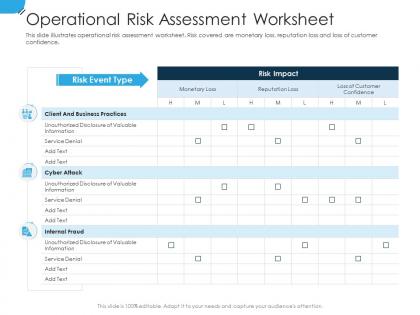
Operational risk assessment worksheet establishing operational risk framework organization




Try Before you Buy Download Free Sample Product
 Impress Your
 Audience
 100%
100% Editable
 Save Hours
 of Time


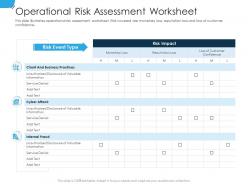
This slide illustrates operational risk assessment worksheet. Risk covered are monetary loss, reputation loss and loss of customer confidence.
People who downloaded this PowerPoint presentation also viewed the following :
Operational risk assessment worksheet establishing operational risk framework organization with all 2 slides:
Use our Operational Risk Assessment Worksheet Establishing Operational Risk Framework Organization to effectively help you save your valuable time. They are readymade to fit into any presentation structure.
FAQs for Operational risk assessment worksheet establishing operational
Look, start by mapping your processes - yeah it's boring but you gotta do it. Risk identification and assessment come first, then figure out how you'll actually measure probability and impact. Set up some monitoring systems with key indicators so you're not flying blind. Make sure someone owns each risk though, that's where a lot of companies mess up. You'll need incident reporting too, plus regular updates for the bosses. Honestly, just tackle your biggest processes first instead of trying to do everything at once. Oh, and don't forget a solid governance structure to tie it all together.
Start with what's already blown up in your industry - check out your competitors' disasters from the last couple years. Trade publications and regulatory stuff are honestly your best bet here. Your ops teams will tell you way more than executives about daily headaches, so definitely talk to them. Industry associations usually have sector-specific risk reports too, which is handy. Throw it all in a basic spreadsheet and rank by how often things happen vs. how bad they'd be. I know it sounds boring, but the data actually tells a pretty clear story once you map it out.
Tech seriously changes everything with risk assessment. You'll get automated data collection instead of doing it all by hand - which honestly used to be such a pain. Real-time monitoring catches issues before they blow up. Analytics tools spot patterns you'd totally miss otherwise, and the dashboards actually make sense of all that data. Machine learning can even predict failures based on what happened before. I'd start small though - just get some automated data feeds running first. Even basic analytics will make your assessments way more accurate and you won't be drowning in manual reports anymore.
Historical incident data is your best friend here - seriously, mine that stuff for patterns. What failed before? How often? Group everything by business line or risk type so you can actually see the trends. Short bursts work better than long analysis sessions, trust me on that. Update it regularly though, otherwise you're working with stale info. Most companies just file these reports and forget about them, but you gotta feed those insights back into your risk frameworks. It's basically using your rearview mirror to avoid future disasters, even if you can't predict everything.
Monte Carlo sims plus scenario analysis are your best bet - they actually give you real numbers instead of those useless traffic light systems. If you've got solid historical data, loss distribution modeling works great too. KRIs are honestly way better than most people think for tracking stuff day-to-day. Bayesian networks are solid when risks connect to each other. But here's the thing - you kinda need multiple approaches since operational risk is just inherently messy. I'd start with scenario analysis though. Gets people thinking about what could realistically blow up, and it's pretty straightforward to implement.
Honestly, regulators pretty much run the show when it comes to your risk framework. Banking? You're stuck with Basel III. Public company? SOX compliance is your new best friend. They tell you exactly how to identify risks, measure them, document everything - even how often you need to review stuff. It's super rigid but I get why they do it. The smart move is staying on top of regulatory changes before they hit, not playing catch-up later. Trust me, scrambling when new requirements drop is the worst. During examinations, they want to see you followed their playbook to the letter.
Honestly, the hardest part is getting everyone on board - different departments just don't want to cooperate half the time. Your data's gonna be a mess too since it's coming from all over the place. Nobody wants to fill out those boring risk forms, so you get garbage responses or people skip stuff entirely. Plus figuring out what even counts as "operational risk" for your company is trickier than it sounds. Could be anything from servers crashing to your supplier flaking out. My advice? Pick one department first. Show them it actually works, then use that success to convince everyone else.
Look, when you get different people involved in spotting risks, you're gonna catch way more stuff. Front-line workers see the daily operational mess-ups that executives completely miss. Meanwhile, leadership picks up on bigger strategic threats. Don't forget about outside voices either - customers, suppliers, regulators all have insights you'd never think of on your own. It's basically like having extra pairs of eyes scanning for problems. Honestly, I've seen too many companies skip this step and regret it later. Map out everyone who's connected to your processes, then just interview them or run some workshops to get their take.
Track both leading and lagging stuff - percentage of risks with actual mitigation plans, how fast you close action items, and whether incidents are actually dropping over time. Risk register completeness matters too (are you catching everything or just the obvious ones?). Stakeholder engagement is critical because honestly, an assessment that sits unread is pretty much worthless. Don't forget your false positive rate - nobody likes constant false alarms. Oh, and pick maybe 3-5 metrics that actually matter to your specific situation. Review quarterly and tweak as needed.
Start with the nightmare scenarios that actually make your leadership team sweat - cyber attacks, key people quitting, systems crashing. Pick 3-5 of those. Then run each one through your risk framework and map out the financial damage plus operational chaos they'd cause. Honestly, most companies just look at what happened before, but this gets you thinking about what could happen next. Short punchy scenarios work better than these elaborate 20-page things nobody reads. You'll want to assign impact levels and probability to each one so you can actually stress-test whether your current controls would hold up.
Honestly, the biggest game-changer is having solid templates that capture the same stuff every time - risk description, likelihood, impact, root causes, and who's actually gonna fix it. I've seen way too many assessments that are basically fancy nonsense with zero concrete details. Timeline and ownership need to be crystal clear. For reports, give executives the highlight reel with key metrics upfront. Bury the detailed findings in appendices where they belong. Here's the thing though - if you don't connect risks directly to business goals, leadership won't give a damn. Start by fixing your current templates first.
Honestly, once a year is the absolute minimum - but don't just stick to that. Big changes like new software or regulations? Update immediately. I've watched teams get blindsided waiting for their annual review cycle. Quarterly works better for most places. Makes it feel less overwhelming too, since you're not cramming everything into one massive yearly project. The trick is building it into your regular routine instead of treating it like this huge deal. Set some calendar reminders and actually assign people to own different pieces. Otherwise it just... doesn't happen.
Look, your company culture is everything when it comes to risk assessments. People need to feel safe speaking up about problems without getting thrown under the bus. Otherwise you're just getting sugar-coated reports that miss half the actual issues. I've seen this play out badly before - toxic environments where everyone's scared to be honest? Their risk data is basically useless. You want folks proactively flagging new problems, not just going through the motions on some form. Build that psychological safety first. Even the slickest risk management system falls apart if your team's too scared to actually use it properly.
Totally doable without spending a fortune. I'd start by just sketching out your main processes - even Google Sheets works fine for this. Walk through each step and think "what breaks here?" Cash flow issues, losing key people, supplier problems - the obvious stuff that'd actually hurt. Your team will spot things you miss, so get them involved. Honestly, most problems become pretty clear once you map everything out. I do this review thing maybe once a quarter (should be monthly but who has time?). Takes a few hours but catches so much before it becomes expensive.
So there's tons of good stuff out there to help with this. MetricStream and ServiceNow are solid GRC platforms that keep everything in one place. For workflows, check out Resolver or LogicGate - they're pretty slick. Tableau's great for visualizing all your data trends. Oh, and Lucidchart is awesome for process mapping - you can actually see where the risk points are instead of just guessing. Basic automated surveys work too, nothing fancy needed. Honestly though? Pick whatever plays nice with your current systems first. The shiniest tool isn't always the right one.
-
Good research work and creative work done on every template.