


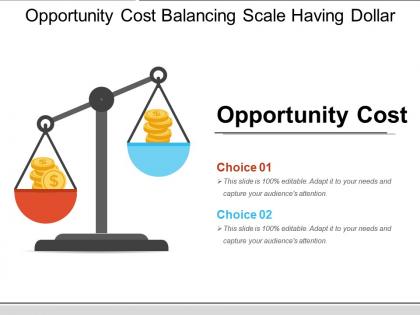
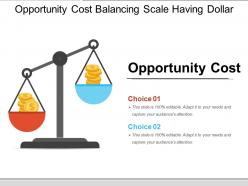
Opportunity cost balancing scale having dollar




Try Before you Buy Download Free Sample Product
 Impress Your
 Audience
 100%
100% Editable
 Save Hours
 of Time


Identify inhuman conditions with our Opportunity Cost Balancing Scale Having Dollar. Initiate action to improve the environment.
People who downloaded this PowerPoint presentation also viewed the following :
Opportunity cost balancing scale having dollar with all 5 slides:
Handle the insecure with our Opportunity Cost Balancing Scale Having Dollar. Address expressed concerns in a convincing fashion.



FAQs for Opportunity cost balancing
Opportunity cost is the value of the best alternative foregone when making a decision, representing what businesses sacrifice to pursue a chosen option. It significantly affects decision-making by forcing organizations to weigh trade-offs, with companies in manufacturing, retail, and financial services using this framework to optimize resource allocation, evaluate investment priorities, and ultimately enhance strategic planning efficiency.
Understanding opportunity cost helps startups evaluate trade-offs between investment options, resource allocation decisions, and strategic priorities, enabling more informed capital deployment and budget optimization. By systematically comparing potential returns from different initiatives, whether hiring developers versus marketing spend or product development versus market expansion, startups can maximize their limited resources and accelerate growth trajectories.
Opportunity cost can be illustrated through comparative scenarios, decision trees, visual timelines, cost-benefit matrices, and before-and-after case studies that show potential returns from alternative investments. These presentation techniques engage stakeholders by quantifying trade-offs, demonstrating strategic choices through real examples like market expansion versus product development, ultimately enabling data-driven decisions that maximize competitive advantage.
Common examples of opportunity cost in marketing strategies include choosing social media advertising over traditional print campaigns, allocating budget to influencer partnerships instead of content creation, prioritizing email marketing over SEO investments, and selecting brand awareness campaigns over direct response initiatives. These strategic decisions enable marketers to maximize ROI by streamlining resource allocation, with many organizations finding that focused approaches deliver better customer engagement and measurable results than spreading budgets across multiple channels.
Opportunity cost influences resource allocation by forcing project managers to evaluate trade-offs between competing initiatives, assess potential returns from alternative investments, and prioritize projects with highest strategic value. Through systematic cost-benefit analysis, organizations streamline resource distribution across portfolios, minimize waste on lower-impact activities, and maximize returns, with many finding that structured opportunity cost evaluation delivers significantly improved project outcomes and competitive advantage.
Opportunity cost can be quantified through financial modeling, comparative analysis, ROI calculations, and scenario planning that assigns monetary values to foregone alternatives. Visual presentations should utilize side-by-side comparison charts, decision trees, cost-benefit matrices, and waterfall diagrams, with many organizations finding that clear visual frameworks enhance strategic decision-making and stakeholder alignment.
Opportunity cost serves as a critical benchmark in investment evaluation by comparing potential returns from chosen investments against foregone alternatives, enabling investors to assess true value and make strategic resource allocation decisions. Through systematic comparison of expected returns, risk profiles, and time horizons, investors can identify optimal opportunities while minimizing regret, ultimately delivering superior portfolio performance and competitive advantage.
Businesses can use opportunity cost by evaluating potential returns from alternative investments, comparing resource allocation outcomes, and analyzing time-sensitive project impacts before making decisions. This strategic approach enables organizations to prioritize high-value initiatives over lower-return activities, streamline resource distribution across departments, and ultimately maximize profitability while minimizing regret from missed opportunities.
Ignoring opportunity cost in strategic planning can lead to resource misallocation, suboptimal investment decisions, and missed competitive advantages that compromise long-term growth. Organizations often find themselves overcommitting to low-return initiatives while overlooking high-value alternatives, ultimately reducing operational efficiency and market positioning in an increasingly competitive business landscape.
Opportunity cost can be integrated into employee training through scenario-based workshops, cost-benefit analysis exercises, resource allocation simulations, and real-world case studies from different departments. These training methods enhance decision-making by teaching employees to evaluate trade-offs, prioritize strategic initiatives, and assess competing project investments, ultimately delivering improved resource efficiency and more informed business choices across organizations.
Leaders can communicate opportunity cost through scenario-based examples, visual decision matrices, resource allocation workshops, and regular team discussions about trade-offs in project prioritization. These methods help teams understand that choosing one initiative means forgoing potential benefits from alternatives, with many organizations finding that transparent communication about opportunity costs enhances strategic decision-making and resource efficiency.
**INPUT**: How does opportunity cost differ when considering short-term versus long-term decisions? **OUTPUT**: Opportunity cost in short-term decisions involves immediate trade-offs with quantifiable alternatives, while long-term decisions encompass broader strategic sacrifices including market positioning, competitive advantage, and growth potential. Short-term opportunity costs are often financial and measurable, whereas long-term costs include intangible factors like brand equity, innovation capacity, and market share, ultimately requiring organizations to balance immediate returns against sustained strategic value. **Word count: 60 words**
Cultural attitudes toward time, risk tolerance, and collective versus individual decision-making significantly influence opportunity cost perceptions across global markets. In relationship-focused cultures like Japan or Middle Eastern countries, businesses often prioritize long-term partnerships over immediate financial gains, while individualistic Western markets emphasize quantifiable short-term returns, ultimately affecting strategic resource allocation and competitive positioning in international expansion.
Case studies effectively demonstrate opportunity cost impact by presenting real-world scenarios where businesses chose one investment over another, quantifying the foregone benefits through financial metrics, timelines, and strategic outcomes. Industries like manufacturing, healthcare, and technology leverage these documented examples to illustrate resource allocation decisions, with many organizations finding that detailed case studies enhance strategic planning and minimize costly missteps.
Technology enhances opportunity cost understanding in presentations through interactive calculators, real-time scenario modeling, data visualization tools, and automated comparison frameworks. These digital solutions streamline complex trade-off analysis by enabling dynamic "what-if" scenarios, visual cost-benefit matrices, and instant ROI calculations, ultimately delivering clearer decision-making insights and more compelling stakeholder presentations.
-
Best Representation of topics, really appreciable.
-
Easily Understandable slides.