


Optimizing business operations and logistics on world map ppt slide




Try Before you Buy Download Free Sample Product
 Impress Your
 Audience
 100%
100% Editable
 Save Hours
 of Time


Advertise your ideas in an improved fashion with our Optimizing Business Operations And Logistics On World Map Ppt Slide. Be able to create a fresh jingle.
People who downloaded this PowerPoint presentation also viewed the following :
Content of this Powerpoint Presentation
Description:
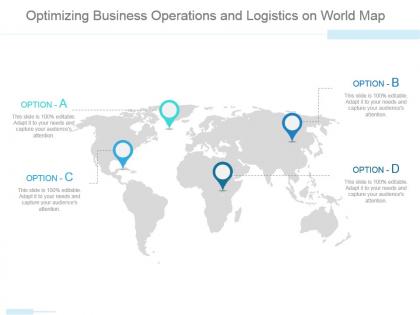
The image depicts a PowerPoint slide titled "Optimizing Business Operations and Logistics on World Map." It features a global map with four location markers labeled as Option-A, Option-B, Option-C, and Option-D.
Text Elements:
1. Title:
Introduces the slide's focus on global business operations and logistics optimization.
2. Option Labels:
Each option is likely representing a strategic location for business operations or logistics centers.
Use Cases:
These slides are versatile and could be useful in various industries for global strategic planning, including:
1. E-commerce:
Use: Planning global distribution centers.
Presenter: Global Supply Chain Manager.
Audience: Company executives, logistics teams.
2. Manufacturing:
Use: Locating international manufacturing sites.
Presenter: Operations Director.
Audience: Board members, operations staff.
3. Technology:
Use: Establishing data centers and service hubs.
Presenter: IT Infrastructure Manager.
Audience: IT department, stakeholders.
4. Pharmaceuticals:
Use: Setting up global supply chains for drug distribution.
Presenter: Head of Global Distribution.
Audience: Health regulators, company partners.
5. Retail:
Use: Identifying locations for new stores or warehouses.
Presenter: Retail Expansion Strategist.
Audience: Investors, regional managers.
6. Consulting:
Use: Analyzing market entry strategies for clients.
Presenter: Senior Consultant.
Audience: Clients, consulting team.
7. Logistics and Shipping:
Use: Optimizing shipping routes and hub locations.
Presenter: Chief Logistics Officer.
Audience: Logistics partners, operational teams.
Optimizing business operations and logistics on world map ppt slide with all 5 slides:
Our Optimizing Business Operations And Logistics On World Map Ppt Slide don't allow any deception. They ensure you never feel had.




FAQs for Optimizing business operations and logistics on world
**INPUT**: What are the top strategies for identifying inefficiencies in business operations? **OUTPUT**: Top strategies for identifying operational inefficiencies include process mapping, data analytics, employee feedback systems, performance benchmarking, and workflow auditing. These approaches streamline operations by revealing bottlenecks, redundancies, and resource gaps, with many organizations finding that combining multiple assessment methods delivers comprehensive insights, ultimately enabling targeted improvements and competitive advantage. **Word count: 54 words**
Technology streamlines business processes through automation, cloud-based integration, AI-powered analytics, and real-time monitoring systems that eliminate manual inefficiencies and reduce operational costs. These solutions enable organizations to accelerate workflows, enhance data accuracy, and improve resource allocation, with many companies finding that strategic technology adoption delivers faster decision-making and significant competitive advantages.
Employee training and development enhance operational efficiency by improving skill sets, reducing errors, streamlining workflows, and accelerating task completion across departments. Through strategic development programs, organizations deliver faster customer service, minimize costly mistakes, and boost productivity, with many companies finding that well-trained employees ultimately drive competitive advantage and sustainable growth.
Data analytics contributes to continuous improvement by identifying performance bottlenecks, predicting maintenance needs, and optimizing resource allocation across workflows. Through advanced analytics platforms, organizations streamline inventory management, enhance production scheduling, and minimize operational costs, with many manufacturing and retail companies finding that data-driven insights ultimately deliver measurable efficiency gains and competitive advantage.
Common pitfalls include insufficient change management, lack of employee buy-in, over-automation without human oversight, inadequate data analysis, and unrealistic timeline expectations. Organizations often find success by involving stakeholders early, implementing phased rollouts, and maintaining flexibility, while retail and manufacturing companies increasingly emphasize training alongside technology deployment to ensure sustainable operational improvements.
Organizations can measure optimization ROI through key performance indicators like cost reduction percentages, process cycle time improvements, productivity gains, and customer satisfaction scores. Financial services and manufacturing companies increasingly track metrics such as operational cost savings, revenue per employee increases, and error rate reductions, with many finding that comprehensive measurement frameworks deliver clearer strategic insights and sustained competitive advantages.
Customer feedback significantly impacts business operations by identifying inefficiencies, revealing service gaps, and highlighting areas for process improvement across departments like customer service, product development, and logistics. Through systematic feedback analysis, organizations streamline workflows, enhance product quality, and optimize resource allocation, with many companies finding that customer-driven operational refinements ultimately deliver faster response times and improved customer satisfaction.
Lean management principles integrate into everyday business practices through standardized workflows, continuous improvement processes, waste elimination strategies, employee empowerment initiatives, and value stream mapping. These methodologies streamline operations by reducing inefficiencies, enhancing quality control, and accelerating decision-making, with many organizations finding that systematic implementation ultimately delivers significant cost reductions and improved customer experiences.
Supply chain management significantly influences business operations optimization by streamlining procurement processes, reducing inventory costs, and enhancing delivery timelines across all organizational functions. Through strategic supplier relationships and automated logistics systems, companies in manufacturing, retail, and healthcare minimize operational bottlenecks, accelerate product availability, and improve customer satisfaction, ultimately delivering competitive advantage and sustainable growth.
Effective operational performance monitoring tools include enterprise resource planning (ERP) systems, business intelligence dashboards, process mining software, performance management platforms, and real-time analytics solutions. These technologies streamline oversight by automating data collection, identifying bottlenecks, and providing actionable insights, with many organizations finding that integrated monitoring delivers enhanced efficiency and faster decision-making across departments.
Cross-departmental collaboration enhances business process efficiency by breaking down silos, streamlining communication workflows, and enabling shared resource optimization across teams. Through integrated project management systems and regular cross-functional meetings, organizations achieve faster decision-making, reduced duplicate efforts, and improved customer experiences, with many companies finding that collaborative approaches deliver significant operational cost reductions.
Best practices for maintaining operational agility include flexible resource allocation, cross-functional team structures, real-time data analytics, scenario planning capabilities, and streamlined decision-making processes. These approaches enable organizations to pivot quickly during market shifts, with many companies in retail and financial services finding that agile operations deliver faster response times, reduced costs, and sustained competitive advantage in increasingly volatile environments.
Companies foster continuous improvement cultures by encouraging employee feedback, implementing suggestion systems, providing regular training opportunities, recognizing innovation efforts, and establishing clear improvement metrics. Through cross-functional collaboration and structured programs like Kaizen workshops, organizations streamline processes while empowering teams to identify inefficiencies, ultimately delivering enhanced productivity and competitive advantage with employees becoming active contributors to operational excellence.
Businesses should focus on key performance indicators including operational efficiency ratios, cost per transaction, cycle time reduction, resource utilization rates, and customer satisfaction scores. These metrics enable organizations to track productivity gains, identify bottlenecks, and measure ROI from optimization initiatives, with many companies finding that monitoring these indicators delivers measurable competitive advantages and sustained growth.
Responsible automation maintains quality through strategic human oversight, continuous monitoring protocols, and phased implementation approaches that preserve critical decision points. Financial services and healthcare organizations achieve this balance by automating routine processes while retaining human expertise for complex judgments, ultimately delivering faster services and cost reductions without compromising accuracy or customer experience.
-
Awesomely designed templates, Easy to understand.
-
Awesomely designed templates, Easy to understand.