


Organization IT Transformation Roadmap Powerpoint Presentation Slides




Try Before you Buy Download Free Sample Product
 Impress Your
 Audience
 100%
100% Editable
 Save Hours
 of Time


Every business needs to change and evolve with modern times. Thus upgrading organizational technology to improve business processes is a critical practice that many Industry leaders and innovators follow. Here is a competently designed Organization IT Transformation Roadmap template that is helpful for IT Managers intending to improve upon their existing business practices. The digital transformation roadmap has multiple pre determined steps that serve as a blueprint for the organization. The roadmap can be divided into 4 key phases performing internal analysis for assessing organization change readiness, carefully analyzing each step of the roadmap, etc. For efficient delivery, the implementation process can be divided into 3 key stages. Thus, various data sources are identified to migrate data successfully, and a migration timeline is developed. Upskilling the employees also serves as a crucial point in the transformational process as the employees skills need to match the ever changing technology. In the end, a framework is developed that will help in successful implementation. Multiple KPIs or Key Performance Indicators are used with the help of a dashboard to track the transformational process. Get access now.
People who downloaded this PowerPoint presentation also viewed the following :
Content of this Powerpoint Presentation
Slide 1: This slide introduces Organization IT Transformation Roadmap. State Your Company Name and begin.
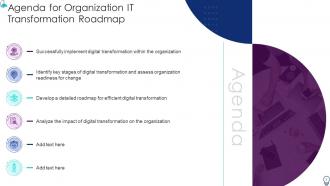
Slide 2: This slide states Agenda of the presentation.
Slide 3: This slide presents Table of Content for the presentation.
Slide 4: This slide highlights title for topics that are to be covered next in the template.
Slide 5: This slide presents need for digital transformation in the organization.
Slide 6: The following slide defines the ambitions and goals of the organization.
Slide 7: This slide represents Need of developing and implementing digital transformation strategy within the organization.
Slide 8: This slide shows title for topics that are to be covered next in the template.
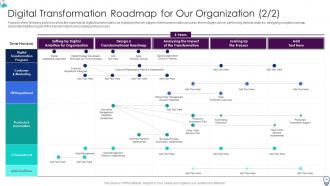
Slide 9: This slide showcases Digital Transformation Roadmap for our Organization.
Slide 10: This is another slide continuing Digital Transformation Roadmap for our Organization.
Slide 11: This slide shows title for topics that are to be covered next in the template.
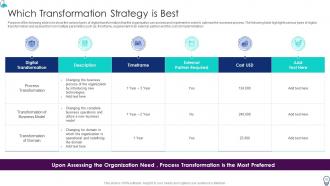
Slide 12: This slide presents various types of digital transformation that the organization can assess.
Slide 13: The following slide analysis the readiness of the organization for digital transformation.
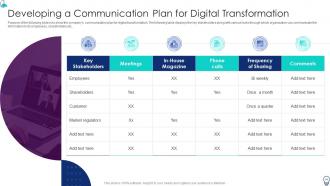
Slide 14: This slide displays Developing a Communication Plan for Digital Transformation.
Slide 15: This slide shows title for topics that are to be covered next in the template.
Slide 16: This slide illustrates market scenario and business disruption for digital transformation industry.
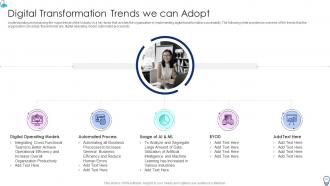
Slide 17: This slide presents Digital Transformation Trends we can Adopt.
Slide 18: This slide displays new business model of the organization based.
Slide 19: This slide shows title for topics that are to be covered next in the template.
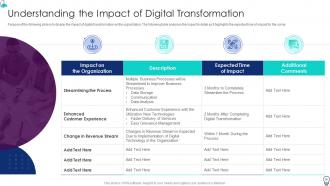
Slide 20: This slide represents Understanding the Impact of Digital Transformation.
Slide 21: This slide showcases Tools for Successfully Implementing Digital Transformation.
Slide 22: This slide shows key measurements areas of digital transformation along with the key KPIs.
Slide 23: This slide shows title for topics that are to be covered next in the template.
Slide 24: This slide presents Scaling Up the Process with Governance Framework.
Slide 25: This slide displays process for optimizing digital transformation strategy in the future.
Slide 26: This slide represents Team Members for Delivering Digital Transformation.
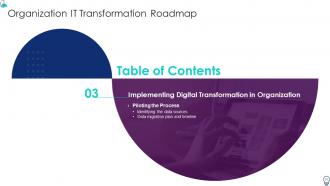
Slide 27: This slide shows Table of Content for the presentation.
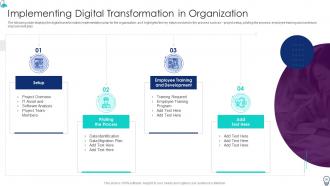
Slide 28: The following slide displays the digital transformation implementation plan for the organization.
Slide 29: This slide shows title for topics that are to be covered next in the template.
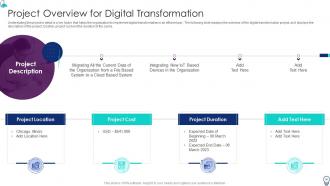
Slide 30: This slide presents Project Overview for Digital Transformation.
Slide 31: This slide displays key software's that the organization is using currently.
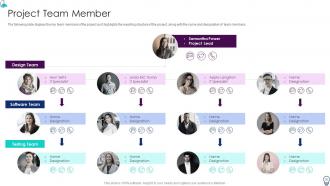
Slide 32: This slide represents key team members of the project as it highlights the reporting structure of the project.
Slide 33: This slide shows title for topics that are to be covered next in the template.
Slide 34: This slide presents key sources through which the data is selected.
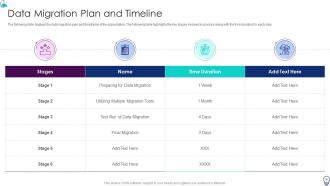
Slide 35: This slide displays data migration plan and timeframe of the organization.
Slide 36: This slide shows title for topics that are to be covered next in the template.
Slide 37: This slide represents training required for successfully implementing digital transformation.
Slide 38: This slide showcases employee training program and schedule for digital transformation.
Slide 39: This slide shows title for topics that are to be covered next in the template.
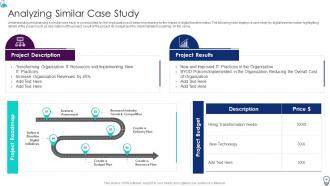
Slide 40: This slide presents case study for digital transformation as it highlights details of the project.
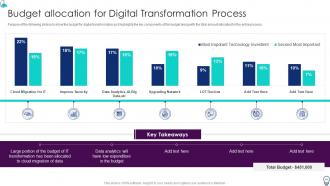
Slide 41: This slide displays Budget Allocation for Digital Transformation Process.
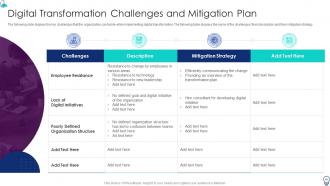
Slide 42: This slide represents Digital Transformation Challenges and Mitigation Plan.
Slide 43: This slide shows title for topics that are to be covered next in the template.
Slide 44: This slide showcases Defining a Framework For Digital Transformation.
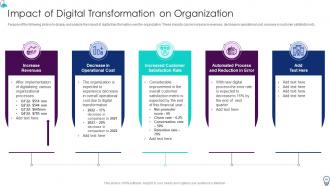
Slide 45: This slide presents impact of digital transformation over the organization.
Slide 46: This slide shows title for topics that are to be covered next in the template.
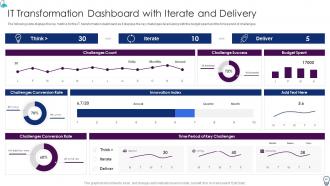
Slide 47: This slide displays IT Transformation Dashboard with Iterate and Delivery.
Slide 48: This slide represents Digital Transformation Change Management Dashboard.
Slide 49: This slide showcases Icons for Organization IT Transformation Roadmap.
Slide 50: This slide is titled as Additional Slides for moving forward.
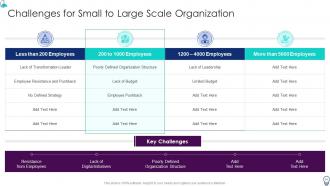
Slide 51: This slide shows Challenges for Small to Large Scale Organization.
Slide 52: This is Our Mission slide with related imagery and text.
Slide 53: This is About Us slide to show company specifications etc.
Slide 54: This is Our Team slide with names and designation.
Slide 55: This slide shows Post It Notes. Post your important notes here.
Slide 56: This is a Timeline slide. Show data related to time intervals here.
Slide 57: This slide depicts Area chart with two products comparison.
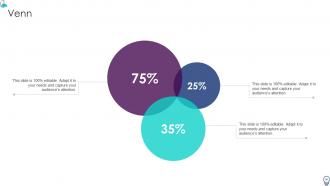
Slide 58: This slide depicts Venn diagram with text boxes.
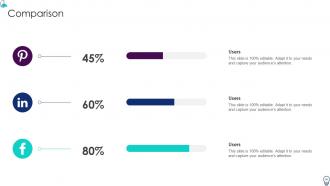
Slide 59: This is a Comparison slide to state comparison between commodities, entities etc.
Slide 60: This slide showcases Magnifying Glass to highlight information, specifications, etc.
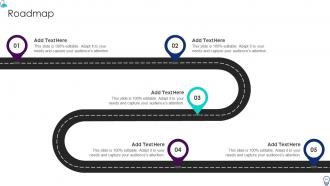
Slide 61: This slide presents Roadmap with additional textboxes.
Slide 62: This slide displays Custom Combination chart with two products comparison.
Slide 63: This is a Thank You slide with address, contact numbers and email address.
Organization IT Transformation Roadmap Powerpoint Presentation Slides with all 68 slides:
Use our Organization IT Transformation Roadmap Powerpoint Presentation Slides to effectively help you save your valuable time. They are readymade to fit into any presentation structure.


























FAQs for Organization IT Transformation Roadmap
Honestly, start by figuring out where you actually are right now, then get clear on where you want to be. Gap analysis comes next - what's missing? Break it into phases with real deadlines, not fantasy ones. Getting leadership on board is probably harder than the actual work, but you need their buy-in first. Throw in some early wins so people see progress quickly. Oh, and don't forget to plan for when things go sideways - they always do. Track everything with actual metrics you can measure. Realistic timelines are your friend here.
Honestly, just do a full IT audit first - figure out what you're actually working with. Map everything: your infrastructure, apps, processes, the whole mess. Check for technical debt, performance issues, security holes. Test if your systems even communicate properly (they probably don't, let's be real). But here's the thing - don't ignore the human element. Survey your team about their workflows and biggest headaches. Compare yourself to competitors too, see where you stack up. The brutal truth? You need to know exactly what's broken before throwing money at solutions.
Dude, stakeholder engagement will make or break your whole project. I've seen too many transformations crash because nobody got the right people on board early. Leadership needs to back you with budget and direction, but don't forget the actual users - they're the ones who'll either embrace or sabotage your new systems. Map out everyone from executives down to front-line staff. Set up regular check-ins before you dive deep into planning. Trust me, it's way better than dealing with resistance and scope creep later when people feel left out of the process.
So here's what actually works - get your stakeholders to pick their top 3-5 business priorities first. Then score how much each tech project actually helps those goals. Most companies totally skip this part, which is crazy to me. After that, make a simple impact vs effort matrix. Go for the high-impact stuff that won't take forever to implement. Those quick wins build momentum and show leadership you're not just burning money. Oh, and definitely prioritize anything that either brings in revenue fast or fixes those annoying operational headaches everyone complains about.
Track both tech stuff and business impact - you need the whole story. System uptime, performance boosts, fewer security headaches on one side. User satisfaction, productivity gains, cost savings on the other. Honestly, some benefits won't show for months, so don't freak if things look boring at first. Monthly stakeholder check-ins work way better than obsessing over daily numbers (learned that the hard way). Oh, and start with maybe 3-5 key metrics max. Trying to measure everything just creates noise you don't need.
So cloud computing is basically gonna drive your whole IT transformation - most companies are moving that direction anyway. First thing is to look at what you've got now and figure out which stuff can move first. I'd start with the non-critical applications honestly. Migration should happen in phases or you'll lose your mind. The tricky part is it affects literally everything - security, training your team, how you spend money. Yeah it's pretty overwhelming initially, but the flexibility you get is insane compared to old-school setups. Map out your apps first and rank them by how complicated they'll be to move.
Honestly, the biggest pain is getting your team on board - nobody wants to learn new stuff when the old way works fine. Integration with existing systems is a nightmare too. Your new shiny tech will probably hate talking to whatever ancient database you're running. Budget always spirals because someone decides they need three extra features halfway through. Oh, and data migration? Good luck with that mess. Downtime during the switch is pretty much guaranteed. Start small though - pick one department to test everything first. Way easier to fix problems with like 10 people than your entire company freaking out.
Honestly, first thing I'd do is figure out what old systems you actually need - most companies are hoarding way too much outdated stuff. Start by mapping your critical processes, then see which legacy systems can't be easily replaced. Three ways to tackle integration: use APIs to connect old and new systems, migrate data gradually while running both in parallel, or containerize legacy apps for cloud compatibility. Don't try doing everything at once though - that's a recipe for disaster. Begin with your least important systems as test runs. Way less stressful that way.
Look, you've gotta get people involved from day one - that's like 90% of the battle right there. Most pushback isn't even about the tech itself, it's because folks feel blindsided by changes they had zero say in. Set up feedback loops early so concerns don't turn into full revolt later. Also, don't rush the training part - give your team actual time to figure out the new systems. Oh, and find yourself some internal champions first. Those pilot group people who get excited about new stuff? They'll do half your selling for you once they're on board.
Honestly, focus on real problems first - where can AI actually help your business instead of just being shiny and new? I've watched too many companies add AI just because everyone else is doing it. Look for stuff like automating boring repetitive work or maybe chatbots for customer support. Your data situation matters way more than people realize though - garbage in, garbage out, you know? Start with small pilot projects in your roadmap so you can mess up without it being expensive. Once something actually works and shows results, then you can think bigger. Map it to whatever infrastructure plans you already have going.
Look, don't make the mistake I've seen a million times - build security into your IT transformation right from the start. Companies always think they can slap it on later and then wonder why hackers are having a field day. Every time you modernize or move stuff to the cloud, you're basically rolling out the red carpet for new threats. Get your security folks involved early when you're still planning everything out. Do a solid risk assessment comparing where you are now to where you want to be. Trust me, treating security like an afterthought will bite you later.
Do a skills gap analysis first - figure out where your team is now vs what they'll need. Then build training around those specific gaps, both technical and change management. The people stuff is honestly way trickier than teaching someone new software. Find your early adopters early - they're gold for coaching everyone else through it. Give yourself realistic timelines too, people need time to actually learn this stuff before launch day hits. Oh and train continuously, not just once. Being ahead of it beats scrambling later when things go sideways.
Mix data analysis with talking to people - that's your best bet. Capacity planning tools help you spot usage patterns and growth trends. Even basic spreadsheets work great if you don't have fancy software. Interview folks across departments about their upcoming projects and what's bugging them. Your IT roadmap needs to match where the company's actually going strategically. Technology refreshes are inevitable, so plan for those cycles. Emerging tech adoption should be on your radar too - though don't chase every shiny new thing. Quarterly reviews keep you on track since plans always shift.
Look, regulations are basically your roadmap - they tell you what can't wait. Healthcare? HIPAA's watching everything. Finance deals with SOX and where data lives. I know it feels like red tape slowing you down, but honestly these deadlines should set your priorities. Map those regulatory dates to your rollout phases right away. Start with a compliance audit first - sounds boring but it shows which systems are actually broken and need fixing ASAP. The gaps you find will basically build your timeline for you.
Oh man, communication is everything during IT transformations. Weekly email updates are your baseline. Monthly all-hands meetings for the big picture stuff. Slack channels work great for quick questions - honestly, people will bombard you with them. Different groups need different info though. Executives want metrics and timelines, regular employees just want to know "how does this affect my daily work?" Set up actual feedback channels too, not just one-way broadcasts. I'd grab a communication template to start with and then stick to whatever schedule you pick. Consistency matters more than perfection here.
-
I was able to find the right choice of PPT template for my thesis with SlideTeam. Thank you for existing.
-
Loved the collection. Editing the presentation was seamless with their templates.