


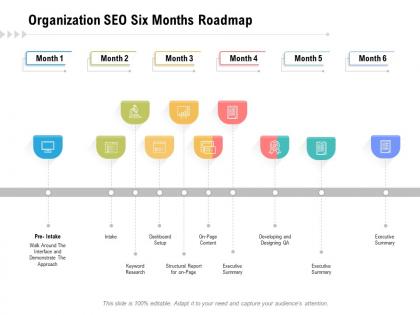
Organization seo six months roadmap




Try Before you Buy Download Free Sample Product
 Impress Your
 Audience
 100%
100% Editable
 Save Hours
 of Time


A well thought out action plan makes execution easier and increases the possibility of success significantly. Ensure hitting all the milestones within the deadlines by introducing our fully customizable Organization SEO Six Months Roadmap. Streamline the work related information, budget, timeframe, key deliverable, landmarks, and major steps involved, all in one place to give an organized overview of the project by utilizing our PowerPoint theme. Minimize time lag and increase work efficiency by providing insight into the process with our comprehensively researched roadmap PowerPoint layout. Color coding helps in highlighting the process and grabs the attention of the audience. Download our handy Organization SEO Six Months Roadmap to identify the possible problem areas in a much shorter time and propose solutions. Have a productive brainstorming session with your workforce by utilizing our action plan visualization tool.
People who downloaded this PowerPoint presentation also viewed the following :
Organization seo six months roadmap with all 2 slides:
Use our Organization SEO Six Months Roadmap to effectively help you save your valuable time. They are readymade to fit into any presentation structure.

FAQs for Organization seo
Okay so there's basically five things you need to nail down. First, audit your site for any broken stuff or technical issues. Keyword research is next - figure out what people are actually typing into Google. Then map out your content strategy based on what searchers want at different stages. Oh and the technical SEO part? That's where most people mess up honestly. Site speed, mobile stuff, schema markup - all that boring backend work actually matters way more than you'd think. Track your performance regularly and keep an eye on what competitors are doing. Don't just build this thing once though - update it every few months or it'll get stale fast.
Look, just connect your SEO stuff to what actually makes you money. Lead gen business? Focus on keywords your prospects are typing in when they're ready to buy. Brand awareness is more about broader topics and showing you know your shit. E-commerce is different - fix your product pages first, then worry about local SEO. I swear, companies mess this order up constantly. Here's what works: score each SEO project against real business goals, not just search numbers. Pick maybe 3-5 things and do them right. Way better than half-assing ten different projects.
Track your organic traffic and keyword rankings first - that's the bread and butter stuff. Then dig into conversions because rankings don't mean much if nobody's buying. Page speed is huge now (Google's obsessed), so watch that plus crawl errors and mobile scores. Your backlink profile matters too for long-term growth. Honestly, the hardest part is making reports leadership actually wants to read. Pull everything monthly and build a simple dashboard - like 3-4 key numbers max. Trust me, nobody's scrolling through spreadsheets to find the wins.
Start with competitor analysis - it's like scoping out the scene before jumping in. Figure out who's ranking for your keywords and what they're doing content-wise. Also check their technical setup. Honestly, most people skip this step but it's huge for setting realistic goals. Pick your top 3-5 competitors and really dig into their strategies. You'll spot gaps you can capitalize on pretty quickly. The restaurant analogy works - you wouldn't open without checking the neighborhood first, right? Set up monthly reviews after that to see how you're stacking up.
So content strategy is like your SEO game plan - it shows you what pages to build, which keywords to go after, and how to organize everything. Trust me, without one you're just randomly posting blogs and crossing your fingers (total waste of time). Map it to what your audience actually searches for and your business goals. This guides your topic clusters, internal links, the works. Plus it helps you figure out which content gaps matter most. I'd start with auditing what you've got already. Then dig into the high-impact topics people are genuinely looking for - that's where the magic happens.
Honestly, you've gotta bake technical SEO right into your dev sprints instead of treating it like some quarterly chore. Have your developers tackle crawl errors and page speed stuff alongside their regular feature work. I've watched companies completely ignore this integration and then act shocked when their rankings nosedive after updates - it's wild. Set up automated alerts for core web vitals so you know immediately when something breaks. But here's the real key: your dev and marketing teams need to actually talk to each other. Developers should understand how their code changes mess with search performance.
First thing - map out your main products and what problems you actually solve for customers. Then hit up Google Keyword Planner or SEMrush to see what people are really searching for (don't just wing it here). Your sales team is honestly gold for this since they hear how customers actually talk. Check what keywords competitors rank for and spot the gaps. Oh, and think about intent too - are they ready to buy or just browsing? Group keywords by topics instead of going one by one. Prioritize based on search volume vs. whether you can realistically rank for them.
Get your local SEO sorted early, trust me on this. Claim your Google Business Profile first - I can't believe how many people skip this basic step. Make sure your business name, address, and phone number match everywhere online. If you're covering multiple areas, build separate pages for each location. Reviews matter too, so start asking customers to leave them. Oh, and don't forget about getting listed in local directories. I used to think this stuff could wait, but honestly? It's way more important than I realized. People search for businesses "near me" constantly, so you'll miss out if you treat this as an afterthought.
Honestly, start with Google Analytics and Search Console since they're free and you need them anyway. Then grab either SEMrush or Ahrefs for keyword research - both are solid but pricey. Screaming Frog is a lifesaver for finding broken stuff on your site. I used to skip technical audits and regretted it every time. For content optimization, Clearscope works well but there are cheaper alternatives if you're bootstrapping. Oh, and get some kind of project manager like Asana or you'll lose track of everything. Better to master 3-4 tools than collect a bunch you never touch.
Get your teams actually talking to each other - seriously, this fixes like 90% of coordination issues. Monthly meetings where SEO, PPC, content and social can sync up on what's coming. Share that keyword research with paid search too, otherwise you'll be competing against yourself (learned that one the hard way). Shared content calendars help a ton. Don't let SEO live in its own little bubble - it works way better when it's woven into everything else you're doing. Honestly? Just start with one joint planning session next month and see how it goes.
Honestly, most companies try to tackle everything at once - huge mistake. Pick your battles and go for quick wins first. You absolutely need buy-in from other teams because SEO affects everyone, and trust me, that coordination gets messy without it. Also, your leadership probably expects results way too fast. SEO takes months, not weeks, so manage those expectations early. Oh and actually assign people to own this stuff - can't tell you how many initiatives just... die because nobody's accountable. Start small, get a few victories, then expand from there.
Dude, you absolutely need ongoing training for SEO - it's honestly make or break. Google changes their algorithm like every other week, and tactics from last year can actually tank your rankings now. Super frustrating but that's the reality. I'd block out 2-3 hours monthly per person for courses, blogs, whatever keeps them current. My old team skipped this step and spent months wondering why nothing worked. Don't be those guys. Make the training time non-negotiable, even when deadlines are crazy.
Here's what I'd focus on for mobile SEO - three main things. Make sure your site loads fast and looks good on phones since Google basically only cares about your mobile version now. Local search optimization is clutch because everyone's searching for stuff near them on mobile. Voice search matters too since people ask questions differently when they're talking vs typing. Oh and test your buttons yourself - I can't tell you how many sites I've been on where you need eagle vision to actually click anything. Honestly just run Google Search Console's mobile test first to see what's broken.
Don't panic when updates roll out - I've watched so many people freak out and make terrible decisions. Wait at least 2-3 weeks before doing anything drastic. Rankings bounce around all the time anyway. Most algorithm changes reward the same boring stuff: decent content, good UX, solid technical foundation. Honestly? Sites that obsess over fundamentals instead of chasing every shiny update usually come out fine. If you're still seeing drops after a few weeks, then yeah - dig into what actually changed. But the "quick fix" crowd always gets burned eventually. Focus on long-term quality and you'll sleep better.
First thing - do a full site crawl to catch any technical mess-ups. Check your keyword rankings and traffic from the last 6-12 months too. Most roadmaps honestly go off the rails (mine definitely have), so don't stress if yours did. Look at what you actually finished vs what you planned, then figure out if those projects were worth it. Also audit your content against what competitors are doing. Sometimes business priorities shift and your original roadmap doesn't make sense anymore. The real trick? Be harsh about what's actually working. Reprioritize based on current data, not whatever assumptions you made months ago.
No Reviews