


Organizational Structure For Information Security Management Committee




Try Before you Buy Download Free Sample Product
 Impress Your
 Audience
 100%
100% Editable
 Save Hours
 of Time


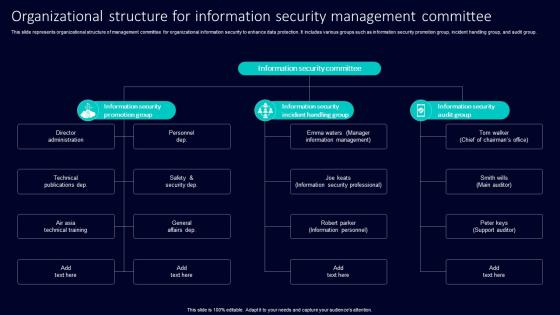
This slide represents organizational structure of management committee for organizational information security to enhance data protection. It includes various groups such as information security promotion group, incident handling group, and audit group.
People who downloaded this PowerPoint presentation also viewed the following :
Organizational Structure For Information Security Management Committee with all 9 slides:
Use our Organizational Structure For Information Security Management Committee to effectively help you save your valuable time. They are readymade to fit into any presentation structure.








FAQs for Organizational Structure For Information
Key components include security policies and procedures, risk management processes, compliance monitoring systems, incident response protocols, and executive oversight structures. These frameworks enhance organizational resilience by establishing clear accountability, streamlining threat detection and response, and ensuring regulatory compliance, with many enterprises finding that comprehensive governance ultimately delivers reduced security incidents and stronger stakeholder confidence.
Organizational culture significantly impacts information security governance by influencing employee behavior, compliance attitudes, and leadership commitment to security initiatives. Organizations with strong security-conscious cultures experience higher policy adherence, faster incident reporting, and more effective risk management, while those lacking cultural alignment often face implementation challenges, ultimately finding that cultural transformation enhances overall security posture and governance effectiveness.
Risk management serves as the foundation of information security governance by identifying vulnerabilities, assessing threats, and prioritizing security investments based on business impact. Through comprehensive risk assessments, organizations across sectors like banking, healthcare, and retail can strategically allocate resources, implement targeted controls, and demonstrate compliance requirements, ultimately enabling data protection while supporting business objectives and competitive advantage.
Organizations align information security governance with business objectives by integrating security planning into strategic business processes, establishing cross-functional governance committees, and implementing risk-based security frameworks that prioritize business-critical assets. Through executive sponsorship and regular alignment reviews, companies in sectors like financial services and healthcare streamline compliance requirements, enhance operational efficiency, and ultimately deliver competitive advantage while protecting revenue-generating activities and customer trust.
Essential metrics for measuring information security governance success include incident response times, compliance audit scores, security awareness training completion rates, risk assessment coverage, and budget allocation efficiency. These metrics enable organizations to track operational effectiveness, regulatory adherence, and strategic alignment, with many enterprises finding that comprehensive measurement frameworks ultimately deliver enhanced security posture and demonstrable ROI on security investments.
Regulatory compliance significantly shapes information security governance by establishing mandatory frameworks, audit requirements, data protection standards, and breach notification protocols that organizations must integrate into their policies. Industries like healthcare with HIPAA, financial services with SOX, and retail with PCI DSS find that compliance-driven governance ultimately delivers enhanced risk management, stakeholder trust, and competitive advantage while streamlining operational security processes.
Organizations face challenges including inconsistent policy implementation, limited budget allocation, employee resistance to security protocols, complex regulatory compliance requirements, and inadequate executive support. These obstacles often stem from siloed departments, insufficient security awareness training, and rapidly evolving cyber threats, with many companies finding that successful governance requires ongoing cultural transformation and strategic alignment between IT security teams and business leadership.
Leadership plays a critical role in driving information security governance by establishing clear policies, allocating adequate resources, and fostering organization-wide security culture. Through executive sponsorship and strategic oversight, leaders ensure comprehensive risk management frameworks, regulatory compliance, and incident response capabilities, with many organizations finding that strong leadership commitment significantly reduces security breaches while enhancing operational resilience.
Organizations can adopt best practices including establishing clear security policies, implementing risk assessment frameworks, defining roles and responsibilities, conducting regular security audits, and ensuring continuous monitoring protocols. These governance approaches enhance operational efficiency by streamlining compliance processes, minimizing security vulnerabilities, and delivering strategic oversight, with many financial services and healthcare institutions finding that structured governance frameworks ultimately provide competitive advantage through enhanced customer trust and regulatory compliance.
Information security governance varies significantly across sectors due to regulatory requirements, risk profiles, and operational needs. Healthcare organizations prioritize patient data protection under HIPAA with extensive audit trails and access controls, while financial institutions focus on transaction security, fraud prevention, and compliance with regulations like SOX and PCI-DSS, ultimately delivering sector-specific risk management strategies.
Common pitfalls include inadequate executive buy-in, siloed security responsibilities, insufficient risk assessment frameworks, poor policy communication, and lack of regular governance reviews. These challenges often stem from treating security governance as a compliance checkbox rather than strategic enablement, with many organizations finding that fragmented approaches ultimately compromise both operational efficiency and comprehensive protection across their digital infrastructure.
Emerging technologies present both challenges and opportunities for information security governance, requiring updated frameworks, enhanced risk assessments, and adaptive compliance strategies. Organizations increasingly find that technologies like AI, IoT, and cloud computing demand new governance models that balance innovation with security, ultimately enabling competitive advantages while maintaining robust data protection and regulatory compliance.
Essential training programs include security policy education, incident response procedures, data classification protocols, access control management, and regulatory compliance requirements. These programs enhance organizational security posture by building employee awareness, reducing human error risks, and ensuring consistent governance practices across departments, with many organizations finding that comprehensive training significantly strengthens their overall security culture.
Information security governance integrates with IT governance through shared policy frameworks, risk management processes, and compliance oversight structures that align security objectives with broader technology strategies. This strategic combination enables organizations to streamline decision-making, enhance resource allocation, and maintain consistent security standards across all IT operations, ultimately delivering improved operational efficiency and stronger competitive advantage in an increasingly complex digital landscape.
Incident response holds critical significance within information security governance by providing structured frameworks for threat detection, containment protocols, and organizational recovery procedures. Through comprehensive incident management, organizations minimize operational disruptions, protect sensitive data assets, and maintain regulatory compliance, while ultimately strengthening their security posture and delivering enhanced stakeholder confidence in an increasingly complex threat landscape.
-
Very well designed and informative templates.
-
Appreciate the research and its presentable format.