


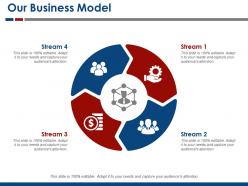
Our business model ppt infographic template





Try Before you Buy Download Free Sample Product
 Impress Your
 Audience
 100%
100% Editable
 Save Hours
 of Time


Experience goodwill with our Our Business Model Ppt Infographic Template. Everyone will express friendship.
People who downloaded this PowerPoint presentation also viewed the following :
Our business model ppt infographic template with all 5 slides:
Do not let the dust settle on your ideas. Swipe it clean with our Our Business Model Ppt Infographic Template.



FAQs for Our business model
Key components of an effective business model include value proposition, target customer segments, revenue streams, cost structure, key resources, and distribution channels. These elements work together by defining how organizations create, deliver, and capture value, with successful companies like Amazon and Netflix demonstrating how strategic alignment of these components drives sustainable competitive advantage and scalable growth.
Business models can be adapted through diversifying revenue streams, pivoting target markets, embracing digital transformation, adjusting pricing strategies, and forming strategic partnerships. Companies like restaurants shifting to delivery services or retailers expanding online demonstrate how organizations streamline operations while capturing new opportunities, ultimately delivering enhanced customer experiences and competitive advantage in increasingly dynamic markets.
Customer feedback serves as a critical compass for business model refinement, revealing gaps in value propositions, pricing strategies, delivery methods, and customer experience touchpoints. Through systematic feedback collection and analysis, companies can pivot their revenue streams, adjust target segments, and enhance service offerings, with many successful businesses finding that customer-driven iterations ultimately deliver stronger market fit and sustainable competitive advantage.
Businesses can leverage technology to enhance their business models through automation, data analytics, digital platforms, AI-driven insights, and cloud solutions. These technologies streamline operations by reducing manual processes, improving customer experiences, and enabling scalable growth, with many organizations finding that strategic technology integration ultimately delivers competitive advantages and increased operational efficiency.
B2B models focus on selling products or services to other businesses, involving longer sales cycles, relationship-based selling, and higher transaction values. B2C models target individual consumers, emphasizing brand marketing, shorter purchase decisions, and volume sales, with many companies finding that B2B requires specialized expertise while B2C demands broader market appeal and streamlined customer experiences.
Subscription-based models create predictable, recurring revenue streams while reducing dependence on one-time sales volatility, enabling better financial forecasting and strategic planning. These models enhance customer lifetime value, streamline cash flow management, and deliver sustained growth opportunities, with many businesses finding that subscription approaches ultimately provide greater revenue stability and competitive advantage in increasingly dynamic markets.
Companies should track revenue growth, customer acquisition cost, customer lifetime value, profit margins, market share, and customer retention rates to evaluate business model success. These metrics work together to reveal operational efficiency and strategic positioning, with many organizations finding that monitoring churn rates, recurring revenue streams, and return on investment ultimately delivers comprehensive insights into long-term viability and competitive advantage.
A business model creates competitive advantage through unique value propositions, cost optimization strategies, customer relationship management, and operational efficiency improvements. Companies like Amazon leverage subscription models for customer loyalty, while manufacturers use direct-to-consumer approaches to reduce costs, ultimately delivering superior customer experiences and market positioning advantages.
Partnerships and collaborations can fundamentally reshape business models by expanding market reach, sharing resources and risks, creating new revenue streams, and enabling access to complementary technologies or expertise. Through strategic alliances, companies streamline operations, reduce costs, and accelerate innovation, with many organizations finding that collaborative approaches deliver competitive advantages and enhanced customer value propositions.
Potential risks include market acceptance uncertainty, revenue stream instability, operational challenges, competitive response, and resource allocation misalignment. While these challenges present obstacles, many organizations find that thorough market research, phased implementation, and strategic flexibility help mitigate risks, ultimately delivering competitive advantage and sustainable growth in increasingly dynamic business environments.
Businesses can validate their business model through customer interviews, prototype testing, pilot programs, market surveys, and financial modeling to assess demand and viability. These validation methods enable organizations to identify potential challenges, refine value propositions, and minimize risks, with many companies finding that early testing ultimately delivers cost savings and competitive advantages.
A business model significantly impacts funding opportunities by demonstrating revenue potential, scalability, and market viability to investors through clear value propositions, customer acquisition strategies, and profit mechanisms. Investors increasingly favor models with recurring revenue streams, proven market traction, and sustainable competitive advantages, with many startups finding that subscription-based or platform models attract higher valuations than traditional one-time transaction approaches.
Businesses can incorporate sustainability by integrating environmental considerations into operations, supply chains, product development, resource management, and stakeholder engagement strategies. Through circular economy principles, renewable energy adoption, and sustainable sourcing practices, companies streamline costs, enhance brand reputation, and meet consumer demands, while delivering competitive advantage in an increasingly environmentally-conscious marketplace.
Innovation serves as the primary catalyst for business model evolution, driving new revenue streams, operational efficiencies, customer engagement methods, and competitive differentiation strategies. Through digital transformation and strategic pivots, companies across retail, healthcare, and financial services streamline processes, reduce costs, and deliver enhanced customer experiences, ultimately securing market leadership in increasingly dynamic business environments.
Small businesses can design scalable business models by focusing on standardized processes, technology automation, recurring revenue streams, and strategic partnerships that reduce dependency on manual operations. Through cloud-based systems and subscription models, companies streamline customer acquisition, minimize operational complexity, and enable rapid expansion while maintaining service quality, ultimately delivering sustainable growth and competitive advantage in increasingly dynamic markets.
-
It saves your time and decrease your efforts in half.
-
Professional and unique presentations.