


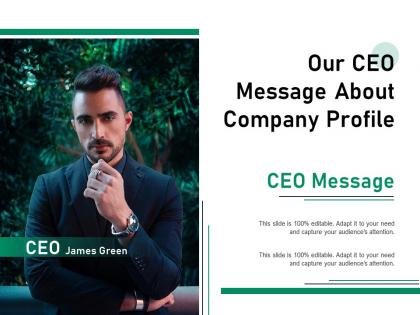
Our ceo message about company profile




Try Before you Buy Download Free Sample Product
 Impress Your
 Audience
 100%
100% Editable
 Save Hours
 of Time


Our Our CEO Message About Company Profile are topically designed to provide an attractive backdrop to any subject. Use them to look like a presentation pro.
People who downloaded this PowerPoint presentation also viewed the following :
Our ceo message about company profile with all 2 slides:
Use our Our CEO Message About Company Profile to effectively help you save your valuable time. They are readymade to fit into any presentation structure.
FAQs for Our ceo message
Honestly, focus on being real with them about where you're going and why it matters to *them*. Don't just rattle off your wins - though throw in a couple good ones. People want to know what's driving your decisions and how they benefit. I'd say the trick is sounding confident without being a total know-it-all, you know? Be honest about challenges but don't make it depressing. Oh, and definitely end with something concrete they can actually expect or do next. Nobody wants just feel-good nonsense with no substance.
So the CEO message basically shows how we're actually living our mission instead of just having it posted on the wall somewhere. They call out specific projects that tie back to our core purpose and connect what we do daily to the bigger picture. Throughout the whole thing, you'll see references to our key values - honestly, it reads like a roadmap of where we're headed. The vision part really comes through when they talk about future opportunities. I'd definitely read it next to our official mission statement so you can spot those connections easier.
Pick the stuff that actually moved the business forward - revenue bumps, new markets, big partnerships, operational wins. Financial results are your best friend here. Strategic moves that worked out? Definitely include those. Honestly, skip the soft stuff like "culture improvements" unless you've got real numbers to prove it made a difference. I'd go with 3-4 solid wins that show you're building momentum. Each one should tie back to whatever strategy you promised shareholders - that way they can see you're not just talking, you're delivering on what you said you'd do.
Dude, get your CEO to share some real stuff they've been through. Like actual struggles or failures - not just the glossy success stories. People eat that up because it feels genuine instead of corporate BS. I swear, one vulnerable story about starting from nothing or screwing up big time connects way better than any polished pitch. You want your audience thinking "oh shit, they actually understand what I'm going through." Ask them about those pivotal moments that changed everything for them. The messier and more human, the better honestly.
So the CEO basically called out three big issues we had this year. Supply chain problems messed up our product launches - honestly that whole thing was such a mess for everyone. Competition's been brutal too, cutting into our market share. Plus we're bleeding talent left and right. Leadership's gonna focus on finding new suppliers, pumping more money into R&D, and improving benefits to keep people around. Oh, and heads up - your department budgets will probably get shuffled around to cover these priorities. Might want to start thinking about how that'll mess with your team's plans for next year.
Don't just tack goals onto the end - weave them throughout by linking current wins to what's next. Like "Q3's retention numbers perfectly position us for European expansion." Makes goals feel inevitable, not random wishlist items. Honestly, nothing's worse than CEOs who dump bullet points without context! Connect each goal to capabilities you're already building. Be specific with timing and paint the picture of what winning actually looks like. Then give people one clear thing they can act on right now.
Honestly, you want that "confident but not arrogant" vibe - like someone who knows their stuff but won't talk down to you. Speak how your audience actually talks, just maybe a bit more polished. God, nothing's worse than when executives try way too hard with the slang though. Mix up your sentences. Some short and punchy. Others can flow a bit longer when you're explaining the trickier concepts. Don't fake emotions, but if you genuinely care about something, let it show. Oh, and cut anything that doesn't actually move things forward - people's attention spans are shot anyway.
Oh absolutely, throw in some data when you can! Numbers make everything way more believable. Like, there's a huge difference between saying "we're doing great" and "revenue jumped 23%" - people actually pay attention to the second one. Just don't dump a ton of stats everywhere or it'll feel like reading a boring quarterly report (been there, done that). Pick maybe 2-3 solid numbers that back up your main points. Honestly, stakeholders eat that stuff up because it shows you're not just talking - you've got the receipts to prove it.
Honestly, storytelling makes CEO messages way more engaging than the usual corporate fluff. Nobody wants to read "we're committed to innovation" for the hundredth time. But tell them how your team actually solved a crazy problem? Now you've got their attention. Stories help people connect emotionally and see how their work fits into something bigger. Plus they're just way more memorable - I can't remember most exec emails, but I still think about this one story our CEO told about a customer call. Next time you're writing something, start with a real example instead of boring bullet points. Works every time.
Don't dance around whatever's really bothering everyone - just say it upfront. Layoffs, budget mess, whatever. People already know, so pretending otherwise just makes you look out of touch. Connect the problem to actual steps you're taking, not vague "we're committed to excellence" garbage. Most CEO emails sound like robots wrote them anyway. Be honest about how long fixes will take - nobody believes the "we'll turn this around immediately" stuff. Give them something small they'll actually see change in the next month or two. That's what builds trust back.
Look, authenticity and transparency are everything here - people will absolutely call you out if you're being fake. Don't sugarcoat the messy stuff. Show you actually give a damn about your team and customers, own up when you screw things up, and make sure your decisions actually match what you say you believe in. Honestly, the "forward-thinking resilience" angle works too, but skip all that corporate buzzword garbage. Write like you're sitting across from your team at lunch, then just clean it up slightly. They'll respect the realness way more than some polished PR nonsense.
Honestly, I'd check it every quarter at minimum. But if you're launching stuff or dealing with crazy industry changes, maybe monthly? The worst is when CEOs still have messages about "new initiatives" from like 2022 - so awkward. Three months is usually good timing, but sometimes you gotta be faster if big news drops. I always set calendar reminders or I'll totally forget. Really though, just ask yourself if it still sounds like where you're actually going, not where you were six months ago.
Honestly, go with a good headshot that doesn't look super corporate - you know those scary ones where they look like they're about to lay off half the company? Skip those. Work in your brand colors somewhere, maybe the background or around the text. Don't forget the logo but keep everything pretty clean with white space. Oh, and if your CEO's decent on video, that's even better than photos. The whole point is making them seem like an actual person, not some polished robot. Test a couple versions - you might be surprised which one people respond to.
Hey! So blast that CEO message everywhere - intranet, email, internal social if you've got it. Make sure there's captions on videos and alt text for images. Honestly, half your people won't read a long corporate email anyway (I know I don't lol), so maybe do some quick infographics or break the main points into shorter posts. Oh and translate it if you have non-English speakers. The trick is putting it where people already hang out instead of making them hunt for it. Multi-channel is your friend here.
Honestly, pulse surveys right after work best - you'll catch immediate reactions before people forget. Check your Slack or Teams channels too, that's where the real talk happens (and where you'll spot if anyone's confused). Email opens, intranet clicks, town hall turnout - all decent metrics to watch. Focus groups help, but sometimes just grabbing coffee with team leads gives you better insights anyway. The tricky part? You need both the quick feedback and the longer-term stuff to see if behavior actually shifts.
-
Use of different colors is good. It's simple and attractive.