


Overall Equipment Effectiveness Oee Technique To Enhance Production Process




Try Before you Buy Download Free Sample Product
 Impress Your
 Audience
 100%
100% Editable
 Save Hours
 of Time


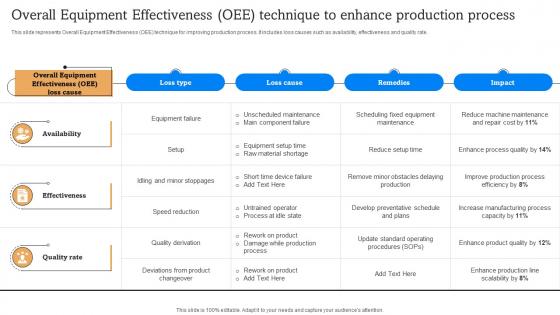
This slide represents Overall Equipment Effectiveness OEE technique for improving production process. It includes loss causes such as availability, effectiveness and quality rate.
People who downloaded this PowerPoint presentation also viewed the following :
Overall Equipment Effectiveness Oee Technique To Enhance Production Process with all 6 slides:
Use our Overall Equipment Effectiveness Oee Technique To Enhance Production Process to effectively help you save your valuable time. They are readymade to fit into any presentation structure.





FAQs for Overall Equipment Effectiveness Oee Technique To
OEE comprises three key components: Availability (actual operating time versus planned production time), Performance (actual production rate versus ideal rate), and Quality (good parts produced versus total parts produced). These interrelated metrics multiply together to calculate overall effectiveness, with manufacturing facilities finding that improving one component often positively impacts the others, ultimately delivering comprehensive operational insights and competitive advantage.
OEE measurement adapts through automated data collection systems, real-time monitoring dashboards, mobile reporting platforms, and standardized calculation frameworks across diverse manufacturing settings. While discrete manufacturers track cycle times and downtime events, process industries focus on throughput rates and quality metrics, with many organizations finding that integrated systems deliver consistent visibility, faster response times, and ultimately enhanced operational performance.
OEE serves as a foundational metric for continuous improvement initiatives by providing measurable data on availability, performance, and quality that identifies specific areas requiring enhancement. Through systematic OEE monitoring, organizations streamline production processes, reduce downtime, and optimize resource allocation, with many manufacturing companies finding that regular OEE analysis drives strategic decisions, ultimately delivering increased operational efficiency and competitive advantage.
Companies identify OEE losses by analyzing the six big losses: equipment breakdowns, setup/changeover delays, minor stops, reduced speed, startup rejects, and production rejects through real-time monitoring and data collection. By implementing predictive maintenance, standardizing procedures, and conducting root cause analysis, organizations streamline operations, minimize downtime, and enhance productivity, ultimately delivering improved efficiency and competitive advantage.
Strategies to improve OEE include preventive maintenance scheduling, real-time performance monitoring, operator training programs, standardized work procedures, and equipment optimization initiatives. These approaches enhance shop floor efficiency by minimizing unplanned downtime, reducing defect rates, and maximizing throughput, with many manufacturing organizations finding that integrated digital monitoring systems deliver measurable productivity gains and competitive advantage.
Downtime directly reduces OEE by decreasing availability, which multiplies through performance and quality losses, creating compounding operational inefficiency. Manufacturing organizations minimize downtime through predictive maintenance programs, real-time equipment monitoring, cross-trained technician teams, and strategic spare parts inventory, with many finding that proactive maintenance strategies reduce unplanned downtime by 30-50% while enhancing overall productivity.
Common misconceptions about OEE include believing it's solely a maintenance metric, that 100% is always the goal, that it applies uniformly across all equipment types, and that software alone drives improvement. Organizations often discover that OEE requires cross-functional collaboration between operations, maintenance, and quality teams, with realistic benchmarks varying by industry, ultimately delivering sustainable performance gains when properly contextualized.
Technology and data analytics enhance OEE tracking through real-time monitoring systems, predictive maintenance algorithms, automated data collection sensors, cloud-based reporting platforms, and machine learning analytics. These technologies streamline operations by eliminating manual calculations, identifying performance patterns before issues arise, and delivering comprehensive dashboards, with many manufacturing organizations finding that automated systems reduce downtime by 15-25% while significantly improving decision-making speed.
OEE benchmarks are established through industry associations, manufacturing databases, equipment vendor specifications, and peer networking within similar production environments. Manufacturing sectors like automotive, pharmaceuticals, and food processing typically maintain specific benchmark ranges, with organizations comparing their performance against industry standards while considering their unique operational constraints, ultimately enabling targeted improvement strategies and competitive positioning.
Integrating OEE with Six Sigma and Lean Manufacturing creates a comprehensive performance framework that enhances operational visibility, accelerates problem identification, and streamlines continuous improvement initiatives across manufacturing operations. This strategic combination enables organizations to reduce waste, minimize defects, and optimize equipment utilization simultaneously, with many manufacturers finding that integrated metrics deliver faster root cause analysis and sustained productivity gains.
Employee involvement and training significantly enhance OEE outcomes by improving equipment knowledge, reducing operator errors, and fostering proactive maintenance practices. Through comprehensive training programs and engagement initiatives, manufacturing organizations streamline operations, minimize unplanned downtime, and accelerate problem-solving capabilities, with many facilities finding that empowered workers ultimately deliver measurable improvements in availability, performance, and quality metrics.
Organizations face challenges including inconsistent data collection, resistance to change from operators, lack of standardized measurement processes, insufficient training on OEE concepts, and integration difficulties with existing systems. These obstacles can be overcome by implementing comprehensive training programs, establishing clear data collection protocols, securing leadership buy-in, and gradually phasing in OEE systems across departments, ultimately delivering improved operational visibility and enhanced manufacturing efficiency.
OEE varies significantly between equipment types due to different operational characteristics, with continuous process industries like chemicals achieving 75-85%, while discrete manufacturing like automotive typically reaches 60-75%. Complex production lines with multiple interdependencies generally show lower OEE than single-machine operations, though strategic maintenance and automation increasingly enable manufacturers to optimize performance across diverse equipment configurations, ultimately delivering more consistent productivity metrics.
Maintenance practices significantly impact Overall Equipment Effectiveness by reducing unplanned downtime, extending equipment lifespan, and optimizing performance reliability through preventive scheduling, condition monitoring, and systematic inspections. Manufacturing facilities implementing strategic maintenance programs achieve 15-25% higher OEE scores, with automotive and pharmaceutical companies finding that proactive maintenance delivers enhanced throughput, reduced costs, and sustained competitive advantage.
Visual management techniques improve OEE awareness through real-time dashboards, color-coded status boards, performance trend charts, and digital displays showing availability, performance, and quality metrics. These visual tools enable operators and supervisors to quickly identify bottlenecks, track downtime patterns, and monitor equipment efficiency, with many manufacturing facilities finding that enhanced visibility drives faster response times and improved operational decision-making.
-
It’s really cool, and you can find pretty much everything you could need for your work or school.
-
Topic best represented with attractive design.