


Overview Of Define Phase In Six Sigma Process Improvement Ppt Icon Graphics Download




Try Before you Buy Download Free Sample Product
 Impress Your
 Audience
 100%
100% Editable
 Save Hours
 of Time


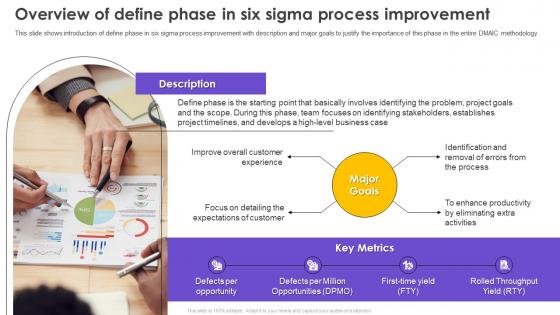
This slide shows introduction of define phase in six sigma process improvement with description and major goals to justify the importance of this phase in the entire DMAIC methodology.
People who downloaded this PowerPoint presentation also viewed the following :
Overview Of Define Phase In Six Sigma Process Improvement Ppt Icon Graphics Download with all 9 slides:
Use our Overview Of Define Phase In Six Sigma Process Improvement Ppt Icon Graphics Download to effectively help you save your valuable time. They are readymade to fit into any presentation structure.








FAQs for Overview Of Define Phase In Six Sigma Process Improvement Ppt
The primary objective of the Define phase is establishing project scope, identifying customer requirements, and articulating specific problem statements with measurable goals. This foundational phase enables organizations to align stakeholder expectations, quantify performance gaps, and create project charters that guide improvement initiatives, with many companies finding that thorough definition work significantly increases project success rates and delivers faster ROI.
The Define phase establishes project scope, identifies specific problems, defines measurable goals, and secures stakeholder alignment, creating a strategic roadmap for improvement initiatives. Through clear problem statements and success metrics, organizations streamline subsequent phases while ensuring resources focus on high-impact opportunities, ultimately delivering targeted improvements and measurable business outcomes.
Key deliverables during the Define phase include project charter, problem statement, SIPOC diagram, voice of customer analysis, and team roles definition. These foundational documents streamline project scope, establish clear objectives, and align stakeholder expectations, with many organizations finding that comprehensive Define phase deliverables significantly reduce project timeline delays and enhance overall Six Sigma initiative success rates.
Effectively identifying stakeholders involves mapping all process owners, customers, suppliers, and decision-makers who impact or are affected by the project scope. Begin with process mapping sessions, customer interviews, and organizational charts to ensure comprehensive representation, while conducting stakeholder analysis to prioritize involvement levels based on influence and interest, ultimately ensuring project success through proper buy-in and expertise alignment.
Problem definition in Six Sigma relies on Voice of the Customer (VOC) analysis, SIPOC diagrams, process mapping, stakeholder analysis, and problem statements using the SMART criteria. These tools work together by capturing customer requirements, mapping process boundaries, and identifying key stakeholders, with many organizations finding that comprehensive problem definition ultimately reduces project timelines and enhances solution effectiveness.
**INPUT**: How do you capture the Voice of the Customer (VoC) during the Define phase? **OUTPUT**: Voice of the Customer is captured through surveys, interviews, focus groups, observation studies, and complaint analysis during the Define phase. These methods enable organizations to identify specific customer pain points, requirements, and expectations, with many companies finding that combining multiple VoC techniques delivers more comprehensive insights, ultimately ensuring Six Sigma projects address real customer needs and deliver measurable satisfaction improvements. [Word count: 60 words]
Projects should be prioritized using criteria including strategic alignment with business goals, financial impact potential, resource requirements, timeline feasibility, and stakeholder support levels. Organizations typically evaluate these factors through scoring matrices, with manufacturing and healthcare sectors finding that projects addressing customer pain points, operational bottlenecks, and regulatory compliance deliver the strongest ROI and sustainable improvements.
An effective project charter includes clear problem statements, measurable objectives, project scope boundaries, stakeholder roles, and realistic timelines with resource requirements. Through collaborative development with key stakeholders, organizations ensure alignment on deliverables, success metrics, and constraints, while establishing executive sponsorship and team accountability, ultimately creating the strategic foundation for successful Six Sigma project execution.
The problem statement serves as the foundational anchor for the entire Six Sigma project, clearly articulating what specific issue needs solving, its business impact, and measurable success criteria. It provides essential direction for project teams by defining scope boundaries, establishing baseline metrics, and ensuring all stakeholders align on objectives, ultimately preventing scope creep while maintaining focus on delivering quantifiable improvements and strategic business value.
Team dynamics significantly influence Define phase outcomes by affecting stakeholder alignment, problem definition clarity, and project scope establishment. Diverse, collaborative teams enhance problem identification through varied perspectives, while poor communication or conflicting priorities can derail project charter development, with many organizations finding that cross-functional teams deliver more comprehensive project definitions and stronger executive buy-in.
Common pitfalls include defining problems too broadly or vaguely, selecting projects without clear business impact, failing to engage key stakeholders early, and inadequate customer voice integration. These missteps often lead to scope creep, resource misallocation, and project failure, with many organizations finding that structured problem statements, stakeholder mapping, and customer-focused metrics ultimately deliver clearer project direction and stronger business outcomes.
The Define phase establishes clear project boundaries by identifying specific problems, defining measurable goals, determining affected processes, and outlining stakeholder requirements and constraints. Through detailed project charters and SIPOC diagrams, organizations can eliminate scope creep, align team expectations, and focus resources on high-impact areas, ultimately delivering targeted improvements with measurable business outcomes.
Establishing a clear project goal in the Define phase ensures focused resource allocation, measurable outcomes, and stakeholder alignment throughout the Six Sigma initiative. This foundational clarity enables teams to avoid scope creep, prioritize high-impact improvements, and deliver quantifiable results, with many organizations finding that well-defined goals accelerate project timelines and enhance overall success rates.
A SIPOC diagram aids process understanding by mapping suppliers, inputs, process steps, outputs, and customers in a single visual framework, clarifying boundaries and key stakeholders. This systematic approach enables Six Sigma teams to identify critical relationships, potential failure points, and improvement opportunities more effectively, ultimately streamlining analysis and ensuring comprehensive process evaluation across organizational functions.
Key metrics for Define phase success include project charter completion rates, stakeholder alignment scores, problem statement clarity assessments, timeline adherence, and resource allocation accuracy. These metrics help organizations ensure comprehensive project scoping, effective team engagement, and clear success criteria establishment, with many companies finding that well-defined projects deliver 40% better outcomes and faster implementation cycles.
-
I have just started downloading templates for my presentations and I must say this is a great design. It helped accelerate my presentation design process and made it more visually appealing.
-
Mesmerized with the fantastic collection! Super sleek, relevant infographics.