

Parallel Processing Applications Overview Of Parallel Processing Ppt Slides Example




Try Before you Buy Download Free Sample Product
 Impress Your
 Audience
 100%
100% Editable
 Save Hours
 of Time


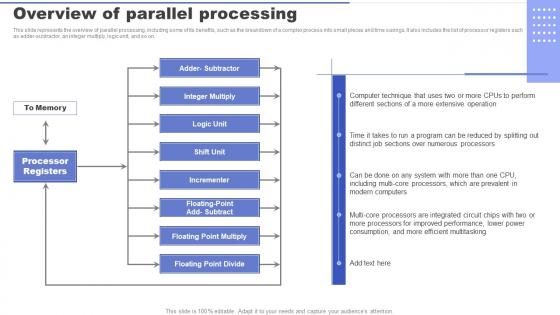
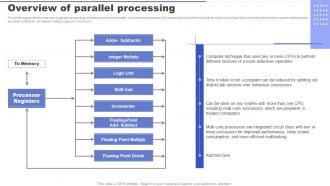
This slide represents the overview of parallel processing, including some of its benefits, such as the breakdown of a complex process into small pieces and time savings. It also includes the list of processor registers such as adder subtractor, an integer multiply, logic unit, and so on.
People who downloaded this PowerPoint presentation also viewed the following :
Parallel Processing Applications Overview Of Parallel Processing Ppt Slides Example with all 6 slides:
Use our Parallel Processing Applications Overview Of Parallel Processing Ppt Slides Example to effectively help you save your valuable time. They are readymade to fit into any presentation structure.





FAQs for Parallel Processing Applications Overview Of Parallel Processing
Parallel processing divides computational tasks across multiple processors simultaneously, enabling concurrent execution, load distribution, shared memory access, and synchronized coordination. Unlike sequential processing where tasks execute one after another, parallel processing dramatically reduces computation time, enhances system throughput, and improves resource utilization, with industries like financial modeling and scientific research finding significantly faster data analysis and decision-making capabilities.
Parallel processing significantly enhances high-performance computing by distributing computational tasks across multiple processors simultaneously, reducing execution time, increasing throughput, and enabling complex problem-solving at scale. Organizations in scientific research, financial modeling, and weather forecasting leverage these capabilities to process massive datasets faster, ultimately delivering more accurate simulations and competitive analytical advantages.
The most common parallel programming models include shared memory, message passing, data parallelism, task parallelism, and pipeline processing. These approaches streamline complex computations by distributing workloads across multiple processors, enabling faster data analysis and real-time processing, with organizations in scientific computing, financial modeling, and machine learning finding significantly enhanced performance and operational efficiency.
Data dependency significantly impacts parallel processing efficiency by creating bottlenecks where tasks must wait for prerequisite computations to complete, limiting simultaneous execution capabilities. These dependencies force sequential processing chains within parallel frameworks, with industries like financial modeling and scientific computing finding that strategic task scheduling and dependency mapping ultimately streamline workflows while maintaining computational accuracy.
Parallel processing frameworks like MPI and OpenMP optimize performance by distributing computational tasks across multiple processors, enabling simultaneous execution, reducing processing time, and maximizing resource utilization. These frameworks streamline complex calculations in scientific research, financial modeling, and data analytics, with organizations finding that parallel processing delivers faster simulations, enhanced computational throughput, and significant competitive advantages in data-intensive operations.
Parallel processing proves more beneficial than distributed computing when tasks require high-speed, low-latency execution within single systems, such as real-time financial trading algorithms, scientific simulations, and image processing applications. While distributed computing excels for large-scale data processing across networks, parallel processing delivers superior performance for compute-intensive operations requiring immediate results, with many financial institutions finding faster transaction processing and reduced operational overhead.
Modern CPU and GPU architectures significantly enhance parallel processing through distinct design philosophies, with CPUs featuring fewer, powerful cores optimized for complex sequential tasks, while GPUs contain thousands of simpler cores designed for massive parallel workloads. This strategic combination enables organizations across industries like financial services, healthcare, and manufacturing to accelerate data analysis, machine learning, and computational tasks, ultimately delivering faster processing times and competitive advantages in increasingly data-intensive business environments.
Load balancing challenges in parallel processing include workload distribution imbalances, resource contention, communication overhead, synchronization bottlenecks, and dynamic scaling complexities. While these obstacles can impact system performance, modern enterprises increasingly leverage sophisticated algorithms and monitoring tools to optimize resource allocation, minimize processing delays, and ultimately deliver enhanced computational efficiency across distributed computing environments.
Measuring scalability involves evaluating speedup ratios, efficiency percentages, throughput improvements, and resource utilization across increasing processor counts and data volumes. Organizations track these metrics through performance benchmarking and load testing, with many financial services and manufacturing companies finding that strong linear scaling indicates optimal parallel algorithm design and strategic competitive advantage.
**INPUT**: What strategies can be employed to minimize communication overhead in parallel processing environments? **OUTPUT**: Strategies include data locality optimization, message batching, asynchronous communication protocols, cache-coherent architectures, and load balancing algorithms. These approaches streamline performance by reducing network latency, minimizing data transfers, and optimizing resource allocation, with many organizations in financial services and manufacturing finding that strategic implementation ultimately delivers faster processing speeds and enhanced computational efficiency.
Fault tolerance in parallel processing works through redundancy mechanisms, checkpointing, error detection algorithms, and automatic recovery protocols that maintain system operation when individual components fail. This capability proves essential for large-scale operations like banking transactions, medical research computations, and manufacturing systems, where downtime costs thousands per minute, ultimately ensuring continuous service delivery and protecting critical business processes.
Emerging trends include quantum-parallel computing, neuromorphic processors, edge-distributed processing, AI-accelerated architectures, and heterogeneous multi-core systems. These technologies revolutionize computational capabilities by enabling real-time analytics, autonomous systems, and complex simulations, with industries like healthcare, finance, and manufacturing finding that parallel processing delivers faster insights, reduced latency, and significant competitive advantages in increasingly data-driven markets.
Parallel processing accelerates machine learning by distributing training across multiple processors, enabling faster model convergence, handling larger datasets, and supporting real-time inference at scale. Through GPU clusters and distributed computing frameworks, organizations in healthcare, finance, and autonomous vehicles achieve significantly reduced training times, enhanced model accuracy, and improved customer experiences, ultimately delivering competitive advantages in increasingly data-driven markets.
**INPUT**: What methods can be used to effectively parallelize existing sequential algorithms? **OUTPUT**: Effective parallelization methods include task decomposition, data partitioning, pipeline processing, shared memory threading, and distributed computing frameworks. These approaches streamline computational workflows by dividing workloads across multiple processors, minimizing bottlenecks, and maximizing resource utilization, with many organizations finding that strategic parallelization delivers significantly faster processing times and enhanced operational efficiency.
Python uses threading and multiprocessing libraries but faces GIL limitations, Java offers robust built-in threading with synchronized blocks and concurrent utilities, while C++ provides low-level thread control through std::thread and OpenMP. These languages enable developers to optimize performance differently, with Java excelling in enterprise applications, C++ in high-performance computing, and Python in data processing workflows, ultimately delivering faster execution and improved resource utilization.
-
A perfect platform for all your presentation needs. Unlimited products at an affordable price.
-
I’m not a design person, so I couldn’t make a presentation to save my life. Thankfully, they have all kinds of templates that I regularly use for my work.