


New partnership agreement proposal powerpoint presentation slides





Try Before you Buy Download Free Sample Product
 Impress Your
 Audience
 100%
100% Editable
 Save Hours
 of Time


The contract that is made between the business parties to support each other in advancing their mutual interests is referred to as a partnership agreement. In this agreement, both parties assist each other in establishing their new ventures with modern technology and services. The main objective of the partnership is to grow the business together and make profitable deals. The partners involved in this agreement work together and in compliance with each other. Choose the best business partner and nurture your progress efficiently by using our content ready New Partnership Agreement Proposal PowerPoint Presentation Slides. Create a great-looking proposal and move a step forward from your competitors with the help of this outwardly engaging partnership agreement proposal PPT layout. The slide contains a table of contents that consists of the introduction part, collaboration areas, roles and responsibilities of partners, project termination, funds transfer, dispute resolution, etc. In the introduction section, you can mention the goals such as to identify the scope of services, establish an authorized individual or agency as a decision-maker, and to identify the responsibilities of each party. Take advantage of this partnership agreement proposal PowerPoint theme to showcase the online system tool that performs specific services used by multiple agencies with similar requirements. You can also explain how it can reduce the burden on customer agencies for duplicating the same tool purchase. Employ this creatively designed new partnership agreement proposal PPT slide and briefly explain the terms & conditions of the contract. With the aid of this impressive partnership agreement proposal PowerPoint slide, you can explain in detail why the client should choose your services over your competitors. This template is designed for you to gain the approval of your clients in one go. Lay a solid foundation for better work relationships between the parties by downloading our ready-to-use new partnership agreement proposal PowerPoint presentation template.
People who downloaded this PowerPoint presentation also viewed the following :
Content of this Powerpoint Presentation
Slide 1: This slide introduces New Partnership Agreement Proposal. State the name of the parties and begin.
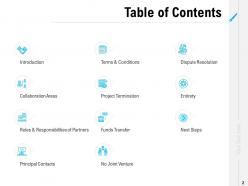
Slide 2: This slide displays Table of Contents of the presentation.
Slide 3: This slide showcases Introduction for New Partnership Agreement
Slide 4: This slide talks about Collaboration Areas in New Partnership Agreement
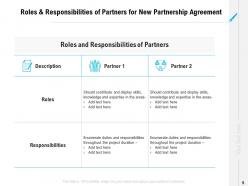
Slide 5: This slide highlights the Roles & Responsibilities of Partners for New Partnership Agreement
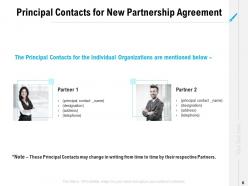
Slide 6: This slide depicts Principal Contacts for New Partnership Agreement
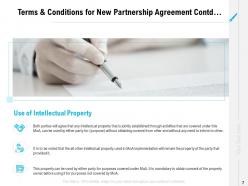
Slide 7: This slide is continued with Terms & Conditions for New Partnership Agreement.
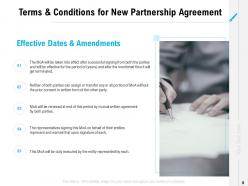
Slide 8: This slide displays Terms & Conditions for New Partnership Agreement.
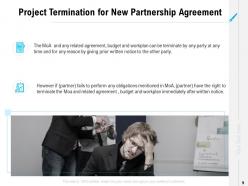
Slide 9: This slide shows Project Termination for New Partnership Agreement.
Slide 10: This slide depicts Funds Transfer for New Partnership Agreement.
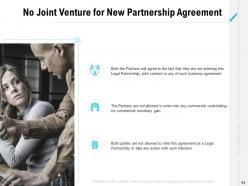
Slide 11: This slide showcases No Joint Venture for New Partnership Agreement
Slide 12: This slide presents Dispute Resolution for New Partnership Agreement
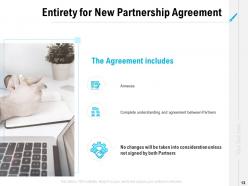
Slide 13: This slide shows Entirety for New Partnership Agreement.
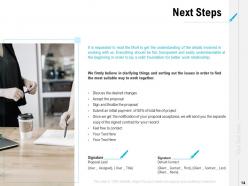
Slide 14: This slide presents Next Steps.
Slide 15: This is Contact Us slide with Address, Contact number and Email address.
Slide 16: This slide is titled as Additional Slides for moving forward.
Slide 17: This is About Us slide with Target audience, Value clients.
Slide 18: This is Our Mission slide with Vision, Mission and Goals.
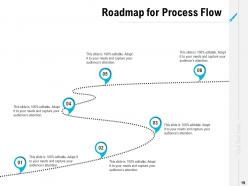
Slide 19: This slide showcases Roadmap for Process Flow.
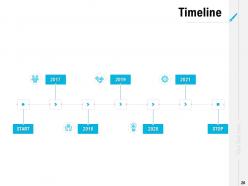
Slide 20: This slide depicts Timeline process.
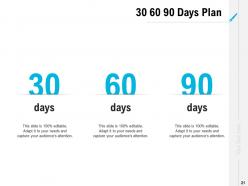
Slide 21: This is 30 60 90 Days Plans slide.
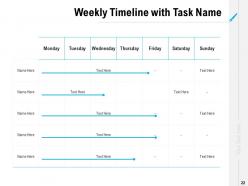
Slide 22: This slide presents Weekly Timeline with Task Name.
New partnership agreement proposal powerpoint presentation slides with all 22 slides:
Use our New Partnership Agreement Proposal Powerpoint Presentation Slides to effectively help you save your valuable time. They are readymade to fit into any presentation structure.








FAQs for New partnership agreement proposal
Okay so first tackle the obvious stuff - who owns what percentage, what everyone's putting in (cash, time, skills), and profit splits. Decision-making is huge though, like who gets final say on what? Trust me, that's where partnerships blow up later. Make sure you cover each person's actual role and responsibilities. The exit strategy part is kinda morbid but super important - what if someone dies or just wants out? Most people totally skip this. Oh and add how you'll handle disputes because you will argue eventually. Get a lawyer to look it over before signing, it's worth the money.
You really need a solid vision and mission in there - trust me on this one. It's like having a GPS for your partnership so nobody gets lost wondering what you're actually doing together. Honestly, I've seen too many deals fall apart because people skipped this step. Draft these together before you touch any other contract stuff. Makes decision-making way easier since you can always come back to your shared goals. Oh, and it'll save you from those super awkward moments when someone new joins and has no clue what's happening. Prevents a lot of headaches down the road.
Okay so first thing - get super clear on ownership percentages and how you'll split profits and losses. Figure out who's doing what job-wise too. The decision-making stuff is honestly where most partnerships blow up, so decide upfront who has final say on different types of choices. You need exit strategies covered (I know it sounds pessimistic but seriously), plus what happens if someone dies or can't work anymore. Liability protection and how you'll handle disputes are crucial too. Oh and definitely get a lawyer to look it over - costs way less than dealing with a mess later when you're fighting over money.
So basically it depends on your ownership stake - got 40%? You get 40% of profits. Though some partnerships mix it up based on who brings in clients or does more work. Honestly, the biggest mistake people make is not nailing this down in writing from day one. Trust me on that one. You'll also need to decide when money gets distributed - monthly, quarterly, whatever works. Oh and don't forget about profits you're keeping in the business for expansion stuff. Just get it all documented upfront before things get messy later.
Definitely set up a tiered dispute process in your agreement. First try direct negotiation between you guys. If that bombs, bring in a neutral mediator. Arbitration comes last before actual court - way faster and cheaper, though still sucks. Oh, and don't forget to nail down which state's laws apply and where you'd handle this stuff. Honestly, the whole point is mapping this out now so nobody's confused later when things get messy. I'd throw in some deadlines for each step too, otherwise disputes just drag on forever.
Write up detailed job descriptions for each partner - like, really detailed. Cover who does what daily tasks, who makes which decisions, and who owns what areas. Time commitments, money stuff, everything. Honestly, this is where most partnerships blow up later because nobody was clear upfront. Have each person write their own version first, then hash out the overlaps together. Don't leave any gray areas about who has final say on different things. Yeah, it feels weird being this formal with your partner, but trust me - it'll save your relationship and your business.
Dude, start with 2-3 years tops for your first partnership - I've watched too many people get burned on longer deals. Think about your timeline and how complex this thing actually is. Market's crazy volatile right now too, so shorter terms with renewal options are probably safer. Plus you don't really know these people yet, right? Check if there are any regulatory minimums you need to hit (boring but necessary). Build in some performance milestones so you're not stuck if things go sideways. Trust me on the shorter timeframe - you can always extend later when you know it's working.
Oh absolutely put exit stuff in your partnership agreement right from the start. Way less awkward when you're not at each other's throats yet! Hit the big ones - voluntary exits, death/disability, if someone breaks the rules, deadlock situations. Figure out business valuation ahead of time (appraisals, some formula, whatever works). Lock down who gets first dibs on shares when someone leaves. Don't forget notice periods and non-competes. Honestly the whole point is making it automatic so nobody's fighting through tears later. Your lawyer can write the specific language now while everyone's still rational.
So with partnerships, the business itself doesn't pay taxes - everything just passes through to you personally based on your ownership percentage. Each year you'll get this K-1 form showing your share of profits/losses to report on your 1040. Here's the annoying bit though: you might owe taxes even if the partnership keeps all the cash instead of paying you out. Super fun, right? Since there's no automatic withholding, you'll probably need to do quarterly estimated payments. Oh, and definitely get a tax person involved early - they'll help with the bookkeeping setup and any weird state rules.
Look, confidentiality clauses are basically insurance for both of you. They keep the sensitive stuff locked down - financials, customer lists, trade secrets, whatever. If things go south, your proprietary info won't walk out the door. Same protection goes both ways for your partner too. Honestly, it just builds trust from day one since you're both agreeing to keep your mouths shut. I'd throw in specific penalties for breaches though. Makes it way more enforceable when someone inevitably screws up and spills something they shouldn't have.
Pick 3-5 metrics that actually matter to both of you - revenue targets, customer numbers, project deadlines, whatever makes sense for your partnership. Both sides need to track stuff the same way though, because trust me, disagreeing over whether you hit goals will tank things fast. Set up who's collecting data and how often you'll report (monthly works well). Oh, and build in time to review and tweak these metrics later. Partnerships change, so your measurements should too. Don't overthink it - just make sure everything's measurable and you're both on the same page about what success looks like.
Look, partnership agreements actually make your stakeholder relationships way stronger. They create clear expectations so everyone knows what's up. Stakeholders see less risk when things are formalized - builds trust, you know? It shows you're thinking long-term instead of just figuring it out as you go (which honestly, nobody wants to see). You'll get solid frameworks for communication and handling disagreements too. Share the important partnership details with stakeholders early on. That way they can see how it benefits them directly. Trust me, the transparency thing really works.
Dude, don't be vague about profit splits and who makes the big calls - that's where partnerships blow up. Write down exact percentages and decision-making rules now while you still like each other. Also cover the messy scenarios: what if someone wants out, dies, or becomes dead weight? I know it feels awkward discussing that stuff early on, but handshake deals turn into total disasters when real money's on the table. Oh, and nail down who owns what IP and any non-compete stuff upfront. Verbal agreements? They're basically worthless later.
Yeah, most partnership agreements can be changed if everyone signs off on a written modification. Unless your original agreement says otherwise, you'll probably need all partners to agree - though some allow majority vote for certain stuff. Pro tip: figure this out beforehand rather than when you're already fighting about changes. Your original agreement should spell out the amendment process clearly. Like what needs a full vote versus just paperwork updates. Oh, and keep all amendments with your original docs. Trust me on this one - you don't want partners "forgetting" what got changed later.
Check your state bar association first - they've got the basics covered. Westlaw and LexisNexis are amazing but crazy expensive. Try sweet-talking your way into a university law library though, some let you browse their stuff. SBA.gov has decent primers too, surprisingly. International Bar Association works for global partnerships. But honestly? Just book a free consult with a business lawyer nearby. They'll know exactly what local rules you need to worry about and can save you from making expensive mistakes later.
-
Colors used are bright and distinctive.