

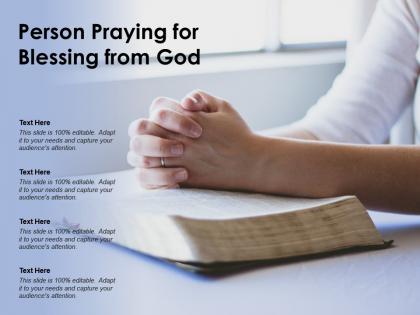
Person praying for blessing from god




Try Before you Buy Download Free Sample Product
 Impress Your
 Audience
 100%
100% Editable
 Save Hours
 of Time


Our Person Praying For Blessing From God are created with care and affection. Feel comfortable with them at hand.
People who downloaded this PowerPoint presentation also viewed the following :
Person praying for blessing from god with all 6 slides:
Attrition comes down with the help of our Person Praying For Blessing From God. Give your employees cause to be faithful.





FAQs for Person praying for
Prayer serves as a universal bridge connecting individuals to the divine across cultures, offering spiritual guidance, community bonding, healing, and moral framework development. These practices enhance personal well-being and social cohesion by providing structured reflection, communal gathering opportunities, and shared value systems, with many communities finding that regular prayer strengthens cultural identity while fostering interfaith understanding.
Prayer impacts mental health by reducing stress, providing emotional comfort, fostering mindfulness, and creating sense of purpose and connection. Through regular practice, individuals experience decreased anxiety, improved coping mechanisms, and enhanced emotional regulation, while many healthcare professionals and wellness organizations increasingly recognize prayer's therapeutic benefits in complementing traditional mental health approaches.
Common misconceptions about prayer include viewing it as wishful thinking, expecting instant results, believing it requires perfect conditions, assuming it's only for emergencies, and thinking it demands formal language. These misunderstandings often stem from cultural representations and limited exposure, with many spiritual communities finding that authentic prayer encompasses contemplation, gratitude, and personal growth, ultimately delivering deeper self-awareness and meaningful connection.
Prayer can be effectively incorporated into daily routines through morning meditation sessions, designated break times, evening reflections, scheduled reminders, and consistent timing patterns. Many individuals and organizations find that establishing specific prayer intervals throughout the day enhances focus, reduces stress, and provides spiritual grounding, ultimately delivering improved mental clarity and emotional resilience in increasingly demanding environments.
Community serves as the foundation for collective prayer practices, providing shared spiritual energy, mutual support, accountability, and deeper connection through unified intention. These gatherings enable participants to experience amplified faith, strengthen interpersonal bonds, and create meaningful traditions, while fostering belonging and spiritual growth that extends beyond individual practice, ultimately delivering enhanced spiritual fulfillment and lasting communal relationships.
Prayer serves as a transformative tool through meditation, self-reflection, gratitude practice, intention setting, and mindfulness cultivation. These approaches enable individuals to develop greater emotional resilience, clarity of purpose, and inner peace, while fostering personal growth and behavioral change, with many finding that consistent prayer practices ultimately deliver enhanced well-being and life direction.
Technology enhances prayer experiences through meditation apps, virtual reality spiritual environments, online prayer communities, digital scripture platforms, and guided prayer tools. These solutions streamline spiritual practice by offering personalized meditation sessions, connecting global faith communities, and providing accessible scripture study, with many religious organizations finding that digital platforms ultimately deliver deeper engagement and broader spiritual community participation.
Meditative practices typically involve mindful awareness, breath focus, and present-moment attention to calm the mind, while traditional prayer emphasizes communication with a divine presence through spoken words, requests, and spiritual connection. These approaches differ in structure and intention, with meditation enhancing mental clarity and stress reduction, while prayer strengthens faith and provides spiritual guidance, ultimately delivering complementary pathways for personal reflection and inner peace.
Prayer's perceived effectiveness often correlates with the sincerity, focus, and emotional investment of the individual, as intentional, heartfelt prayers tend to create deeper psychological engagement and spiritual connection. When people approach prayer with clear purpose, genuine belief, and concentrated attention, they frequently report more meaningful experiences, enhanced sense of peace, and greater alignment with their spiritual goals, ultimately strengthening their overall faith journey.
Prayer examples span diverse traditions, including Christianity's Lord's Prayer, Islam's Salah recitations, Judaism's Shema, Hinduism's mantras like Om Namah Shivaya, and Buddhism's compassionate loving-kindness meditations. These spiritual practices enhance community connection, personal reflection, and mindfulness across cultures, with many organizations increasingly recognizing prayer's role in promoting workplace wellness and employee well-being.
Individuals can navigate spiritual doubts by maintaining consistent prayer routines, exploring different prayer styles like contemplative or written prayers, and seeking guidance from spiritual mentors or faith communities. While doubt presents challenges, it also offers opportunities for deeper spiritual growth, with many finding that honest, questioning prayers ultimately strengthen their faith and deliver greater spiritual resilience and authenticity.
Prayer and mindfulness share deep connections through focused attention, present-moment awareness, and intentional reflection, with both practices cultivating inner peace and spiritual grounding. Many find that combining contemplative prayer with mindfulness techniques enhances emotional regulation, reduces stress, and deepens spiritual connection, while meditation-based approaches increasingly bridge traditional prayer practices with modern wellness strategies.
Prayer facilitates connection with others by creating shared spiritual experiences, fostering empathy through contemplating others' wellbeing, and establishing common ground across diverse communities. Through collective prayer practices, individuals experience unified purpose and mutual support, while personal prayer for others deepens relationships and builds bridges, ultimately delivering stronger social bonds and enhanced community cohesion.
Reflective prayer offers deep contemplation, structured meditation, and intentional spiritual growth, while spontaneous prayer provides authentic expression, immediate connection, and emotional release during challenging moments. These approaches complement each other beautifully, with many spiritual practitioners finding that combining both methods enhances their prayer life, ultimately delivering greater spiritual awareness and more meaningful connection.
Prayer rituals vary significantly across faiths through distinct postures, timing, locations, and sacred texts, with Muslims performing five daily prayers facing Mecca, Christians gathering for communal worship and personal prayer, and Hindus using mantras and meditation practices. These diverse approaches enable spiritual communities to maintain cultural traditions, strengthen group identity, and provide structured pathways for personal reflection, ultimately delivering meaningful spiritual experiences that enhance individual well-being and community cohesion.
No Reviews