


Personal Development Plan Effective Strategies




Try Before you Buy Download Free Sample Product
 Impress Your
 Audience
 100%
100% Editable
 Save Hours
 of Time


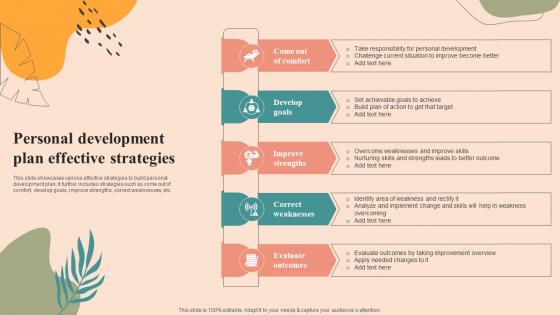
This slide showcases various effective strategies to build personal development plan. It further includes strategies such as come out of comfort, develop goals, improve strengths, correct weaknesses, etc.
People who downloaded this PowerPoint presentation also viewed the following :
Personal Development Plan Effective Strategies with all 9 slides:
Use our Personal Development Plan Effective Strategies to effectively help you save your valuable time. They are readymade to fit into any presentation structure.








FAQs for Personal Development
Key components of an effective personal development plan include clear goal setting, skills assessment, learning objectives, timeline establishment, and progress tracking mechanisms. These elements work together by identifying growth areas, creating structured pathways for improvement, and ensuring accountability, with many professionals finding that regular review and adjustment ultimately delivers enhanced career advancement and personal fulfillment.
Assessing current skills involves conducting honest self-evaluations, seeking feedback from colleagues and supervisors, analyzing performance reviews, and comparing abilities against industry standards or role requirements. Many professionals find that using structured frameworks like SWOT analysis, 360-degree feedback, and skills gap assessments enables targeted development planning, ultimately delivering enhanced performance and career advancement opportunities.
SMART goals provide structure and measurability to personal development planning by ensuring objectives are Specific, Measurable, Achievable, Relevant, and Time-bound. This framework enables professionals to track progress systematically, maintain accountability, and achieve tangible outcomes, with many organizations finding that employees using SMART goal methodology demonstrate significantly higher achievement rates and career advancement success.
A personal development plan aligns with career aspirations by identifying skill gaps, setting strategic learning objectives, and creating actionable timelines for professional growth. Through targeted competency development, networking strategies, and performance milestones, professionals can systematically bridge their current capabilities with future role requirements, ultimately accelerating career progression and enhancing their competitive advantage in evolving markets.
Effective motivation strategies include setting incremental milestones, celebrating small wins, finding accountability partners, regularly reviewing progress, and connecting goals to personal values. These approaches sustain momentum by providing consistent feedback loops and emotional reinforcement, with many professionals finding that visual progress tracking and peer support systems significantly enhance their commitment to long-term development objectives.
Incorporating feedback involves systematically collecting input through regular check-ins, 360-degree reviews, and structured mentorship sessions, then translating insights into specific development goals and action steps. Many professionals find that creating quarterly feedback cycles with supervisors and peer networks enables targeted skill enhancement, accelerated career progression, and measurable improvement in leadership capabilities, ultimately delivering stronger performance outcomes.
Personal growth tools include self-assessment platforms, goal-tracking apps, online learning courses, mentorship programs, and feedback systems. These resources enhance development by providing structured learning paths, measurable progress tracking, and personalized insights, with many professionals finding that strategic combinations of digital tools and human guidance ultimately deliver accelerated skill development and career advancement.
Progress in personal development can be measured through goal-specific metrics, regular self-assessments, feedback from mentors and colleagues, skill acquisition tracking, and behavioral change documentation. Organizations increasingly encourage employees to maintain development portfolios that demonstrate competency growth, leadership capabilities, and performance improvements, ultimately delivering enhanced career prospects and measurable contributions to business outcomes.
You can adapt your personal development plan by regularly reassessing goals, adjusting timelines, incorporating new skills based on market demands, seeking feedback from mentors, and embracing flexible learning methods. These strategies enable professionals to stay relevant in changing environments, with many organizations finding that adaptable employees deliver enhanced performance, navigate transitions more effectively, and ultimately maintain competitive advantage through continuous growth.
Self-awareness is fundamental to effective personal development planning, as it enables accurate assessment of current strengths, weaknesses, values, and goals while identifying specific areas requiring improvement. Through honest self-reflection and feedback mechanisms, individuals can create targeted development strategies that align with their authentic aspirations and capabilities, ultimately delivering more focused growth and sustainable behavioral changes.
Networking significantly enhances personal development by expanding professional opportunities, building valuable relationships, fostering knowledge exchange, and increasing industry visibility. Through strategic connections, professionals gain access to mentorship, career advancement opportunities, and diverse perspectives that accelerate skill development, while ultimately delivering enhanced confidence, broader expertise, and competitive advantage in an increasingly interconnected business landscape.
Balancing personal development with professional responsibilities requires strategic time management, setting clear boundaries, and integrating learning opportunities into your work routine. Many professionals find success by dedicating specific hours to skill-building, aligning personal goals with career objectives, and leveraging workplace training programs, ultimately enhancing both performance and growth simultaneously.
Common pitfalls include setting unrealistic goals, lacking specific timelines, failing to track progress regularly, and not aligning plans with career objectives. These challenges can derail development efforts, with many professionals finding that overly ambitious targets, insufficient accountability measures, and disconnect from organizational needs ultimately limit growth, while strategic, measurable approaches deliver sustained advancement and competitive advantage.
Journaling integrates into personal development through daily reflection, goal tracking, progress monitoring, emotional processing, and pattern identification. This practice enables professionals to clarify objectives, recognize growth opportunities, and maintain accountability, with many finding that consistent journaling accelerates self-awareness and strategic decision-making in their career advancement.
Lifelong learning serves as the foundation for sustained personal growth by continuously expanding knowledge, developing new skills, adapting to changing environments, and fostering intellectual curiosity. This ongoing educational approach enables professionals to remain competitive in evolving markets, enhance their problem-solving capabilities, and ultimately deliver greater value to their organizations while building lasting career resilience.
-
Impressive templates. Designing a presentation is fun now!
-
Great product with highly impressive and engaging designs.