


Personal development plan showing reflection habits goals and values




Try Before you Buy Download Free Sample Product
 Impress Your
 Audience
 100%
100% Editable
 Save Hours
 of Time


Drive home the implications of each clause with our Personal Development Plan Showing Reflection Habits Goals And Values. Ensure folks comprehend the intent of the judgement.
People who downloaded this PowerPoint presentation also viewed the following :
Content of this Powerpoint Presentation
Description:
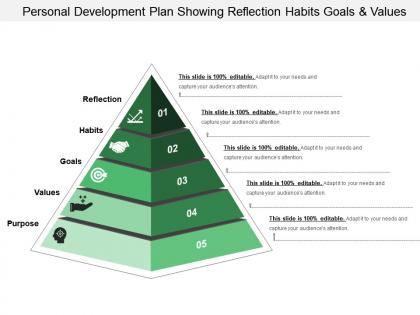
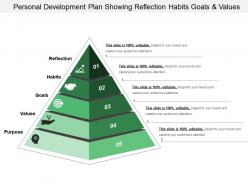
The image shows a PowerPoint slide titled "Personal Development Plan Showing Reflection Habits Goals & Values." It features a layered pyramid with five sections, each labeled with a key component of personal development:
1. Reflection:
At the top of the pyramid, suggested that self-reflection is a fundamental starting point in personal development.
2. Habits:
Below reflection, indicating that the establishment of positive habits is a crucial step following self-reflection.
3. Goals:
In the middle, emphasizing the importance of setting clear goals based on one's habits and reflections.
4. Values:
Next, signifying that personal values underpin the goals one sets for themselves.
5. Purpose:
At the base, represents the foundation upon which values, goals, habits, and reflection are built.
Each section of the pyramid has an icon representing its concept: a lightbulb for reflection, a handshake for habits, a target for goals, a flag for values, and a light bulb within a gear for purpose. Each layer has a corresponding note: "This slide is 100% editable. Adapt it to your needs and capture your audience's attention," highlighting the template's adaptability for individual requirements.
Use Cases:
This type of slide can be used in multiple industries for various purposes:
1. Corporate Training:
Use: Guiding employees through personal growth and professional development.
Presenter: HR Development Manager
Audience: Employees, team leaders
2. Education:
Use: Teaching students about setting personal goals and values.
Presenter: Career Counselor
Audience: Students, graduates
3. Healthcare:
Use: Assisting patients in setting health goals and developing healthy habits.
Presenter: Health Coach
Audience: Patients, healthcare staff
4. Consulting:
Use: Coaching clients on leadership development and organizational culture.
Presenter: Management Consultant
Audience: Corporate clients, business leaders
5. Non-Profit:
Use: Training volunteers and staff for personal effectiveness in their roles.
Presenter: Volunteer Coordinator
Audience: Volunteers, non-profit staff
6. Wellness and Coaching:
Use: Structuring personal development plans for clients.
Presenter: Life Coach
Audience: Coaching clients, workshop attendees
7. Financial Services:
Use: Supporting financial advisors in professional development planning.
Presenter: Training Director
Audience: Financial advisors, brokerage staff
Personal development plan showing reflection habits goals and values with all 5 slides:
Compete effectively with our Personal Development Plan Showing Reflection Habits Goals And Values. Your actions will be better coordinated.
FAQs for Personal development plan showing reflection habits
A personal development plan should include clear career goals, skill gap assessments, specific learning objectives, timeline milestones, and measurable success metrics. These components work together by identifying growth opportunities, establishing actionable steps, and tracking progress systematically, with many professionals finding that structured plans enhance career advancement and deliver greater workplace satisfaction.
Assess current skills through self-evaluation questionnaires, 360-degree feedback from colleagues and supervisors, performance reviews, and skills gap analysis against industry benchmarks. Many professionals find that combining formal assessments with peer feedback reveals blind spots, while comparing current abilities to role requirements or career aspirations ultimately delivers targeted development priorities and competitive advancement opportunities.
Effective goal-setting techniques include SMART criteria (specific, measurable, achievable, relevant, time-bound), backward planning from desired outcomes, breaking large objectives into milestone phases, and regular progress tracking systems. These approaches streamline personal growth by creating clear accountability measures, maintaining consistent momentum, and enabling strategic adjustments, with many professionals finding that structured frameworks ultimately deliver measurable advancement and sustained development success.
Balance short-term and long-term goals by aligning immediate actions with broader aspirations, creating quarterly milestones that support annual objectives, and regularly reviewing progress to adjust priorities. This strategic approach enables professionals across industries to maintain momentum through quick wins while building foundational skills, ultimately delivering sustained growth and competitive advantage in an increasingly dynamic career landscape.
Self-reflection serves as the foundational assessment phase in personal development planning, enabling individuals to identify strengths, weaknesses, values, and career aspirations through honest introspection. This critical process helps professionals in organizations across industries evaluate their current skills against future goals, ultimately creating targeted development strategies that enhance performance, accelerate career progression, and deliver measurable professional growth.
**INPUT**: How can I measure progress and success within my personal development plan? **OUTPUT**: Measuring progress involves tracking specific metrics like skill assessments, goal completion rates, feedback scores, performance reviews, and behavioral changes through regular self-evaluation and peer input. Organizations increasingly find that combining quantitative measures with qualitative insights, such as 360-degree feedback and milestone achievements, ultimately delivers clearer visibility into professional growth and competitive advancement.
Effective motivation strategies include setting incremental milestones, tracking tangible progress, creating accountability partnerships, celebrating small wins, and regularly revisiting your core objectives. These approaches streamline commitment by maintaining momentum through structured check-ins, peer support, and visible achievement markers, with many professionals finding that consistent progress visualization and strategic reward systems ultimately deliver sustained engagement and accelerated growth outcomes.
Utilize feedback by identifying recurring themes across multiple sources, incorporating specific skill development recommendations into measurable goals, and creating accountability checkpoints with mentors for progress tracking. Financial services professionals, healthcare managers, and retail leaders often find that structured feedback sessions reveal blind spots in leadership communication, technical competencies, and strategic thinking, ultimately accelerating career advancement and operational effectiveness.
Best practices for adjusting a personal development plan include regular quarterly reviews, tracking progress against measurable goals, seeking feedback from mentors or colleagues, reassessing priorities based on career changes, and incorporating new skills demanded by industry evolution. These strategic adjustments enable professionals to stay relevant in dynamic markets, with many finding that flexible planning approaches ultimately deliver enhanced career advancement and sustained professional growth.
Align your personal development plan by identifying skill gaps between your current abilities and career goals, setting measurable objectives with timelines, and focusing on competencies valued in your target roles. This strategic approach enables targeted learning through courses, mentorship, and practical experiences, while regularly reviewing progress ensures your development efforts directly support career advancement and long-term professional success.
Resources for creating effective personal development plans include self-assessment tools, goal-setting frameworks, learning management systems, mentorship platforms, and progress tracking applications. These tools streamline the planning process by identifying strengths and gaps, structuring actionable objectives, and monitoring growth over time, with many professionals finding that combining digital platforms with structured templates ultimately delivers clearer career direction and measurable skill advancement.
Time management is crucial for executing personal development plans, as it ensures consistent progress through structured scheduling, priority setting, and resource allocation. Without effective time management, professionals struggle to balance learning activities with daily responsibilities, with many organizations finding that employees who systematically schedule development time achieve significantly faster skill acquisition and career advancement.
Common pitfalls include setting unrealistic goals, lacking specific timelines, ignoring skill gaps assessment, and failing to track progress regularly. These oversights often derail development efforts by creating overwhelming expectations, unclear direction, and missed opportunities for course correction, with many professionals finding that structured, measurable approaches ultimately deliver sustained growth and career advancement.
Incorporate lifelong learning by setting specific skill acquisition goals, scheduling regular learning time, diversifying learning methods through online courses, mentoring, and industry conferences, and tracking progress quarterly. This strategic approach enables professionals to stay competitive in evolving markets, with many finding that continuous upskilling enhances career advancement opportunities and delivers sustained professional growth.
Emotional intelligence serves as a foundation for personal development planning by enhancing self-awareness, improving interpersonal relationships, and enabling better decision-making under pressure. Through developing EQ skills like empathy and self-regulation, professionals in leadership roles, customer service, and team management find they can navigate workplace challenges more effectively, ultimately delivering stronger performance outcomes and accelerated career growth.
-
Good research work and creative work done on every template.
-
Colors used are bright and distinctive.