


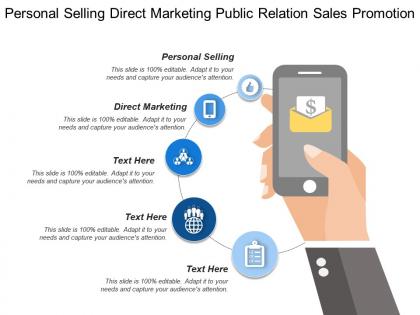
Personal selling direct marketing public relation sales promotion




Try Before you Buy Download Free Sample Product
 Impress Your
 Audience
 100%
100% Editable
 Save Hours
 of Time


Cover the ground with our Personal Selling Direct Marketing Public Relation Sales Promotion. They contain all desired details.
People who downloaded this PowerPoint presentation also viewed the following :
Personal selling direct marketing public relation sales promotion with all 5 slides:
Extract the best bargains with our Personal Selling Direct Marketing Public Relation Sales Promotion. You won't have to haggle around.


FAQs for Personal selling direct marketing public
Storytelling enhances marketing effectiveness by creating emotional connections, simplifying complex messages, increasing brand memorability, and differentiating products from competitors. Through compelling narratives, companies like Nike and Coca-Cola transform product features into aspirational experiences, with many brands finding that authentic stories drive deeper customer engagement and loyalty than traditional promotional approaches.
Businesses leverage social proof through customer testimonials, user-generated content, influencer partnerships, case studies, and social media reviews to build credibility and trust. These strategies enhance marketing effectiveness by showcasing real experiences, reducing purchase hesitation, and creating authentic connections with prospects, with many retail and service companies finding that social validation significantly increases conversion rates and brand loyalty.
Best practices for creating engaging visual content include using high-contrast colors, maintaining consistent branding, incorporating data visualizations, selecting relevant imagery, and ensuring clear typography throughout presentations. These design elements enhance audience comprehension by simplifying complex information, reducing cognitive load, and improving message retention, with many organizations finding that strategic visual consistency ultimately delivers stronger stakeholder engagement and more persuasive business outcomes.
Psychological triggers influence consumer behavior by leveraging scarcity, social proof, authority, and emotional appeals to drive purchasing decisions. Through strategic messaging and timing, retailers, e-commerce platforms, and service providers create urgency and trust, while personalized recommendations and testimonials enhance customer engagement, ultimately delivering higher conversion rates and stronger brand loyalty.
Data analytics shapes marketing campaign strategies by identifying target audience behaviors, optimizing channel performance, personalizing content delivery, measuring ROI effectiveness, and predicting consumer trends. Through advanced analytics tools, marketers streamline campaign targeting, enhance customer segmentation, and deliver personalized experiences across digital platforms, ultimately achieving higher conversion rates and competitive advantage.
Marketers should monitor AI-powered personalization, conversational commerce, predictive analytics, automated content generation, and voice search optimization. These technologies revolutionize customer engagement by delivering hyper-targeted experiences, streamlining campaign management, and enabling real-time decision making, with many organizations finding that strategic AI integration significantly enhances customer acquisition and retention rates.
Personalization enhances customer experience by delivering targeted content, customized product recommendations, and tailored messaging based on individual preferences and behaviors. Through data analytics and AI-driven insights, retailers and e-commerce platforms create more relevant interactions, reduce cart abandonment, and increase purchase likelihood, with many businesses finding that personalized experiences boost conversion rates significantly.
B2B marketing focuses on rational decision-making, longer sales cycles, relationship building, and targeting specific industries or roles, while B2C marketing emphasizes emotional appeals, shorter purchase decisions, and broader consumer segments. These approaches differ significantly in content strategy, messaging complexity, and channel selection, with B2B marketers increasingly finding that personalized, educational content delivers stronger engagement and ultimately drives better conversion rates across industries.
Businesses can effectively utilize influencer marketing by identifying authentic influencers aligned with their target demographics, creating collaborative content that showcases genuine product experiences, and leveraging micro-influencers for higher engagement rates. Through strategic partnerships, brands in retail, beauty, and technology sectors achieve expanded reach, enhanced credibility, and measurable conversion rates, ultimately delivering cost-effective brand awareness and customer acquisition.
A strong brand identity differentiates businesses through consistent messaging, visual elements, customer recognition, and emotional connections that build loyalty and trust. In competitive markets, distinctive branding enables companies to command premium pricing, attract target audiences more effectively, and maintain customer retention, with many organizations finding that cohesive brand strategies ultimately deliver sustainable competitive advantage.
Companies balance authenticity and promotional content by integrating genuine storytelling with product messaging, sharing behind-the-scenes insights, and highlighting real customer experiences alongside promotional materials. This strategic combination builds trust through transparent communication while driving sales, with many brands finding that authentic content ultimately delivers higher engagement rates and stronger customer loyalty than purely promotional approaches.
**INPUT**: What strategies can enhance customer retention through effective marketing? **OUTPUT**: Customer retention strategies include personalized email campaigns, loyalty programs, targeted social media engagement, content marketing, and data-driven segmentation approaches. These methods enhance relationships by delivering relevant experiences, rewarding continued engagement, and anticipating customer needs, with many retail and service organizations finding that strategic personalization ultimately reduces churn while increasing lifetime value. [Word count: 54 words]
Cultural differences significantly impact global marketing strategies by influencing consumer behavior, communication preferences, purchasing decisions, and brand perceptions across different regions. Companies must adapt their messaging, product positioning, visual elements, and channel strategies to resonate with local values, traditions, and cultural norms, ultimately delivering more authentic customer experiences and competitive advantage in diverse markets.
Key marketing metrics include conversion rates, customer acquisition cost (CAC), return on ad spend (ROAS), lifetime value (CLV), and engagement rates across channels. These metrics enable organizations to optimize budget allocation, identify high-performing campaigns, and refine targeting strategies, with many companies finding that balancing acquisition costs with long-term customer value delivers sustainable growth and competitive advantage.
Customer feedback integration enhances marketing efforts through social listening tools, survey analytics, review monitoring, sentiment analysis, and direct customer interviews. These insights enable marketers to refine messaging strategies, optimize campaign targeting, and personalize customer experiences, with many organizations finding that feedback-driven approaches deliver higher engagement rates and stronger brand loyalty.
-
Presentation Design is very nice, good work with the content as well.
-
Unique design & color.