

Pitch deck slide agenda ppt images





Try Before you Buy Download Free Sample Product
 Impress Your
 Audience
 100%
100% Editable
 Save Hours
 of Time


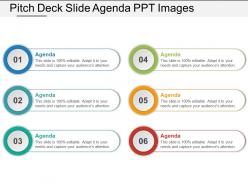
Looking for a creative way to highlight your business agenda? Here is our pitch deck slide agenda PPT images PowerPoint slide show to meet your professional requirements and help you to list out your business agenda and activities which are to be performed. Our PPT visual has a pre-designed graphic of six stages in which you can display your business information step by step. All the steps and its related information can be represented using our Presentation design. By incorporating our presentation graphic into your PPT presentation you can also showcase the features of your company’s products and services in an innovative way. The slide is fully editable, so you can add more steps and tailor it as per your requirements. When you are in management, meetings are important, and you can keep track of them by using our agenda slide diagram. So, take out sometime to browse our section of agenda slides which have useful agenda and schedule PPT templates and use it to make an impact on your audience. It is common to find presentations in all works of life but it?s difficult to find professional presentations. So make use of Pitch Deck Slide Agenda Ppt Images created by the pros when you want to appear like the professional that you are.
People who downloaded this PowerPoint presentation also viewed the following :
Pitch deck slide agenda ppt images with all 5 slides:
Felicitate consistent achievers with our Pitch Deck Slide Agenda Ppt Images. Ensure they get due accolades.
FAQs for Pitch deck slide
Essential pitch deck slides include problem identification, solution overview, market opportunity, business model, competitive analysis, financial projections, team introduction, and funding requirements. These slides work together by establishing market need, demonstrating strategic positioning, and showcasing execution capability, with many startups finding that this comprehensive approach ultimately delivers investor confidence and clearer communication of their competitive advantage.
Visual storytelling in pitch deck slides utilizes compelling narratives through data visualization, customer journey maps, problem-solution sequences, and strategic use of imagery and infographics. These approaches enhance engagement by transforming complex business concepts into memorable visual narratives, while improving retention through emotional connections and clear progression, with many investors finding that well-crafted visual stories significantly increase comprehension and investment appeal.
Common pitch deck mistakes include overcrowded slides, weak problem statements, unclear value propositions, unrealistic financial projections, and missing competitive analysis. These design flaws undermine investor confidence by creating confusion rather than clarity, with many startups finding that streamlined visuals, compelling storytelling, and data-driven projections ultimately deliver stronger presentations and higher funding success rates.
Tailoring pitch deck slides for different audiences is crucial for maximizing engagement and achieving specific objectives, as investors focus on financial returns and scalability, partners seek operational synergies and strategic alignment, while customers prioritize value propositions and practical benefits. This strategic customization enables presenters to emphasize relevant metrics, use audience-appropriate language, and highlight pertinent case studies, ultimately delivering more compelling presentations that resonate with each stakeholder group's priorities and decision-making criteria.
Data visualization transforms complex information into compelling, easily digestible visual narratives that capture investor attention and enhance comprehension. Through strategic charts, infographics, and interactive dashboards, startups demonstrate market opportunities, financial projections, and growth trajectories more persuasively, with many entrepreneurs finding that visual storytelling significantly accelerates investor understanding and decision-making processes.
An effective business model slide includes your value proposition, target customers, revenue streams, key partnerships, and cost structure, presented through clear visuals and concise bullet points. Many successful startups use frameworks like the Business Model Canvas or simple diagrams with icons, enabling investors to quickly grasp how you create, deliver, and capture value while demonstrating scalable profitability.
Effective pitch deck design principles include consistent visual hierarchy, strategic use of white space, cohesive color schemes, readable typography, and compelling data visualization. These elements work together by enhancing message clarity, maintaining investor attention, and projecting professional credibility, with many startups finding that clean, focused slide designs ultimately deliver stronger audience engagement and improved funding outcomes.
Pitch deck slides can be structured using problem-solution frameworks, customer journey mapping, before-and-after scenarios, and progressive reveal techniques that guide audiences through logical story arcs. These narrative approaches enhance investor engagement by demonstrating market validation, traction milestones, and scalable business models, with many startups finding that storytelling structures significantly improve funding outcomes and stakeholder buy-in.
Successful pitch delivery combines confident storytelling, audience engagement, and strategic timing alongside compelling visuals. Entrepreneurs should practice extensively, maintain eye contact while explaining key slides, address potential concerns proactively, and demonstrate genuine passion for their solution. Through clear communication and authentic enthusiasm, many founders find that connecting personally with investors, emphasizing market opportunity, and showcasing team expertise ultimately delivers memorable presentations and stronger investor interest.
Color schemes significantly influence audience perception by establishing credibility, evoking emotional responses, and enhancing message retention through strategic visual hierarchy. Well-chosen palettes create psychological associations that guide decision-making, with blue tones conveying trust and stability, while warmer colors generate energy and urgency, ultimately helping presenters control audience mood and improve pitch effectiveness.
Tech startup pitch decks should highlight user acquisition metrics, monthly recurring revenue (MRR), customer acquisition cost (CAC), lifetime value (LTV), churn rate, and product engagement statistics. These metrics demonstrate market traction, revenue scalability, and unit economics, with investors increasingly focusing on sustainable growth patterns, retention rates, and clear pathways to profitability in competitive tech markets.
Animation and transitions enhance pitch deck slides by highlighting key points, guiding audience attention, and creating smooth visual flow between concepts. Strategic use includes subtle fade-ins for bullet points, gentle slide transitions, and purposeful movement that emphasizes data or milestones, with many successful startups finding that minimal, consistent animations actually improve investor focus and message retention.
The ideal pitch deck length is typically 10-15 slides for presentations and up to 20 slides for detailed investor reviews, with each slide containing one core message supported by 3-5 key points or visual elements. Successful startups in sectors like fintech, healthcare, and SaaS find that balancing concise storytelling with comprehensive data enables clearer investor communication, faster decision-making, and ultimately stronger funding outcomes in today's competitive landscape.
Feedback from peers or mentors can be incorporated by systematically reviewing content clarity, narrative flow, visual design effectiveness, and audience alignment recommendations. Through structured feedback sessions, entrepreneurs can identify weak value propositions, confusing slides, and missing market validation elements, while mentors often highlight investor concerns and competitive positioning gaps, ultimately delivering more compelling presentations that resonate with target audiences.
Recommended tools include Canva, PowerPoint, Google Slides, Keynote, and SlideTeam for creating professional pitch decks quickly and efficiently. These platforms streamline design through pre-built templates, drag-and-drop functionality, and collaborative features, with many startups and entrepreneurs finding that template-based solutions significantly reduce creation time while delivering polished, investor-ready presentations.
-
Appreciate the research and its presentable format.
-
Wonderful templates design to use in business meetings.