


Pitch deck to raise funding from financial market powerpoint presentation slides





Try Before you Buy Download Free Sample Product
 Impress Your
 Audience
 100%
100% Editable
 Save Hours
 of Time


Our Pitch Deck To Raise Funding From Financial Market Powerpoint Presentation Slides are topically designed to provide an attractive backdrop to any subject. Use them to look like a presentation pro.
People who downloaded this PowerPoint presentation also viewed the following :
Content of this Powerpoint Presentation
Slide 1: This is the cover slide of Pitch Deck to Raise Funding from Financial Market PowerPoint Presentation.
Slide 2: This is the Agenda for Raise Funding from Financial Market slide.
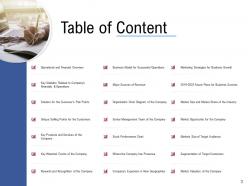
Slide 3: This is the Table of Contents slide that lists out all the essential elements covered in the deck.
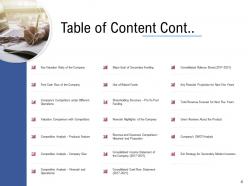
Slide 4: This is the Table of Contents slide that lists out all the essential elements covered in the deck.
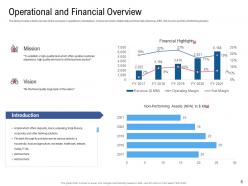
Slide 5: The slide provides a brief overview of the company’s operations (introduction, mission and vision statement) and financials (Revenue, EBIT, Net income and Non-Performing Assets)
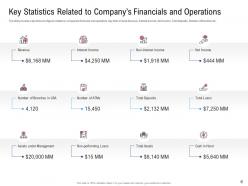
Slide 6: The slide provides a key facts and figures related to companies financials and operations. Key facts include Revenue, Interest Income, Net Income, Total Deposits, Number of Branches etc.
Slide 7: The slide explains the key problems faced by the customers and the solutions (for those problems) which the company offers through its products
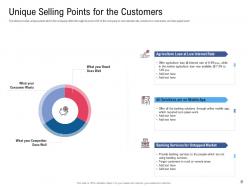
Slide 8: The slide provides unique points which the company offers through its point. USP of the company is: low interest rate, solutions in rural areas; and less paper work
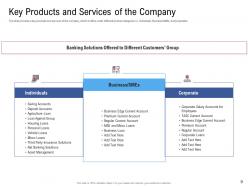
Slide 9: The slide provides a key products and services of the company, which it offers under different product categories i.e. Individuals; Business/SMEs; and Corporates
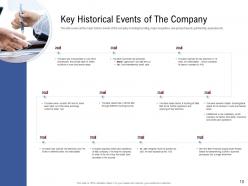
Slide 10: The slide covers all the major historic events of the company including founding, major acquisition, new product launch, partnership, expansion etc.
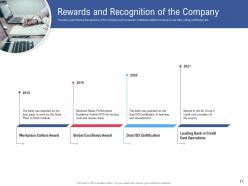
Slide 11: The slide covers the key Recognitions of the company such as awards, milestone related to revenue & user base, rating, certification etc.
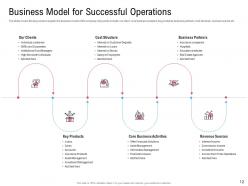
Slide 12: The slides covers the key points to explain the business model of the company. Key points include: our client. core business analytics; key products; business partners; cost structure, revenue sources etc.
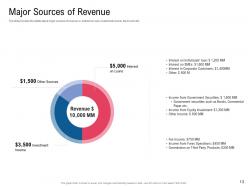
Slide 13: The slide provides the details about major sources of revenue i.e. interest on loan, investment income, fee income etc.
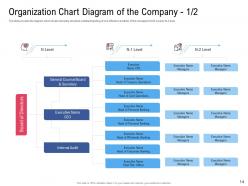
Slide 14: The slide provides the diagram which shows hierarchy structure (relation/reporting of one official to another) of the company from N Level to N-2 level
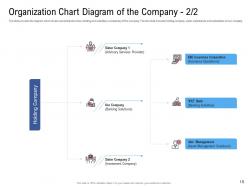
Slide 15: The slide provides the diagram which shows ownership structure (holding and subsidiary companies) of the company. The structure includes holding company, sister subsidiaries and subsidiaries of our company
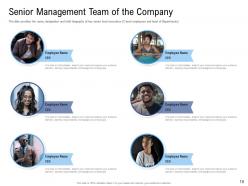
Slide 16: The slide provides the name, designation and brief biography of key senior level executives (C-level employees and head of Departments)
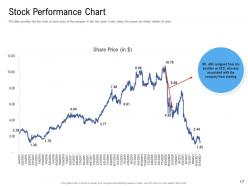
Slide 17: The slide provides the line chart of stock price of the company in last five years. It also states the reason for drastic decline of price
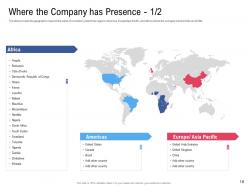
Slide 18: The slide provides the geographic map and the name of countries (under three regions: Americas, Europe/Asia Pacific, and Africa) where the company has branches and ATMs
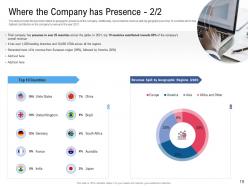
Slide 19: The slide provides the key facts related to geographic presence of the company. Additionally, it provides the revenue split (by geography) and top 10 countries which has highest contribution in the company’s revenue in the year 2021
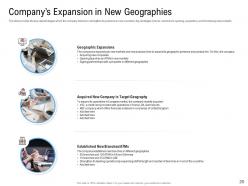
Slide 20: The slide provides the key step/strategies which the company follows to strengthen its presence in new countries. Key strategies include: new branch opening, acquisition, and introducing new products
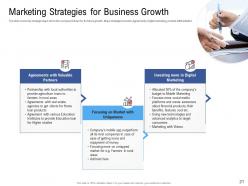
Slide 21: The slide covers key strategic steps which the company follows for its future growth. Major strategies includes, Agreements, Digital marketing, product differentiation
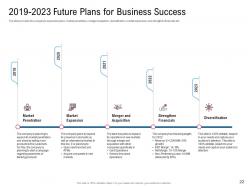
Slide 22: The slide provides the company’s expansion plans: market penetration, merger/acquisition, diversification, market expansion, and strengthen financials etc.
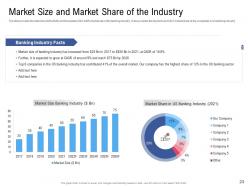
Slide 23: The slide provides the historical (2016-2020) and forecasted (2021-2025) market size of the banking industry. It also provides the key facts and 2021 market share of top companies in US banking industry
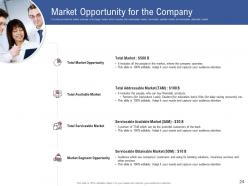
Slide 24: The slide provides the market overview of the target market which includes total addressable market, serviceable available market and serviceable obtainable market.
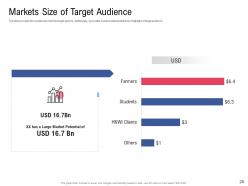
Slide 25: The slide provides the market size of all the target sectors. Additionally, it provides overall market potential and highlight of target audience
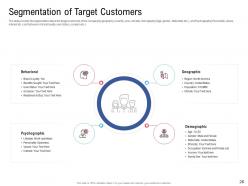
Slide 26: The slide provides the segmentation about the target customers of the company by geography (country, area, climate), Demography (Age, gender, Nationality etc.), and Psychography (Personality, values, interest etc.) and behaviour (brand loyalty, user status, occasion etc.)
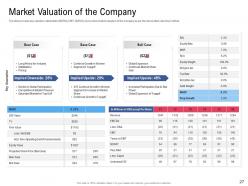
Slide 27: The slide provides key valuation ratios/stats (EBITDA, EBIT, NOPAT) and current market valuation of the company as per the discounted cash flow method
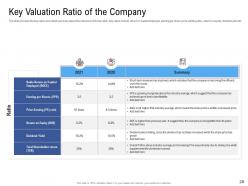
Slide 28: The slide provides the key ratios and a brief summary about the relevance of those ratios. Key ratios include: return on capital employed, earning per share, price-earning ratio, return on equity, dividend yield etc.
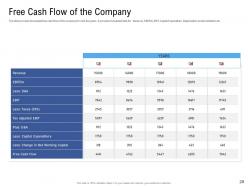
Slide 29: The slide provides forecasted free cash flow of the company for next five years. It provides forecasted data for : Revenue, EBITDA, EBIT, Capital Expenditure, Depreciation and Amortization etc.
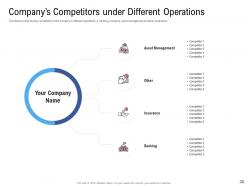
Slide 30: The slide provides the key competitors of the company in different operations i.e. banking, insurance, asset management and other businesses
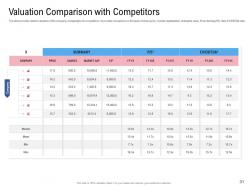
Slide 31: The slide provides relative valuation of the company comparing to its competitors. It provides comparison on the basis of share price, market capitalization, enterprise value, Price-Earning (PE) ratio; EV/EBITDA ratio.
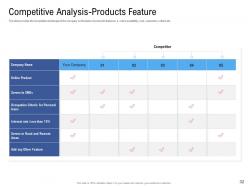
Slide 32: The slide provides the Competitive landscape of the company on the basis of products’ features i.e. online availability, cost, customers, criteria etc.
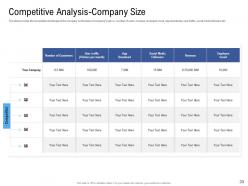
Slide 33: The slide provides the Competitive landscape of the company on the basis of company’s size i.e. number of users, revenue, employee count, app downloads, user traffic, social media followers etc.
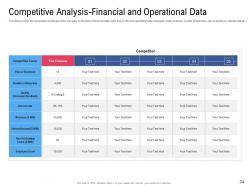
Slide 34: The slide provides the Competitive landscape of the company on the basis of financial data (sales and profit) and operational data (employee count, locations, number of branches, year of existence, interest rate etc.)
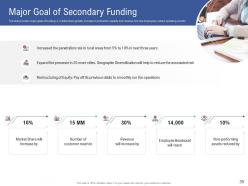
Slide 35: The slide provides major goals of funding i.e. market share growth, increase in production capacity and revenue, hire new employees, reduce operating cost etc.
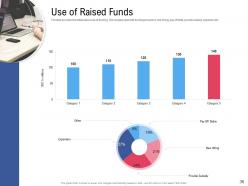
Slide 36: The slide provides the details about use of funding. The company spend its funding amount on new hiring, pay off debt, provide subsidy, expansion etc.
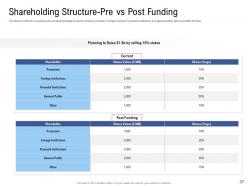
Slide 37: The slide provides the comparison of number/percentage of shares (hold by promotors, Foreign investors, Financials institutions, and general public) before and after funding
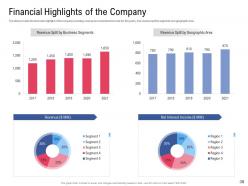
Slide 38: The slide provides the financials highlight of the company including: revenue and net interest income for five years; and revenue split by segments and geographic area
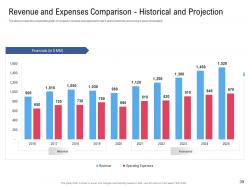
Slide 39: The slide provides the comparative graph of company’s revenue and expenses for last 5 years (historical) and coming 4 years (forecasted)
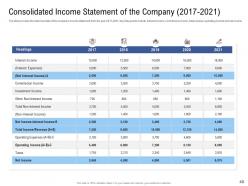
Slide 40: The slide provides the historical data of the company’s income statement from the year 2017-2021. Key Data points include: interest income, commission income, total revenue, operating income and net income
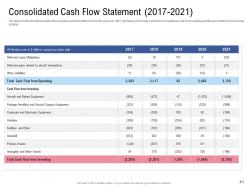
Slide 41: The slide provides the historical data of the company’s cash flow statement from the year 2017-2021. Key Data points include: cash flow from operations, cash from investing activities and cashflow from financing activities.
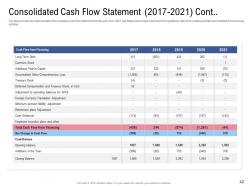
Slide 42: The slide provides the historical data of the company’s cash flow statement from the year 2017-2021. Key Data points include: cash flow from operations, cash from investing activities and cashflow from financing activities.
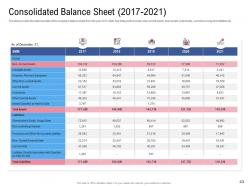
Slide 43: The slide provides the historical data of the company’s balance sheet from the year 2017-2020. Key Data points include: total current assets, fixed assets, total assets, current and long-term labilities etc.
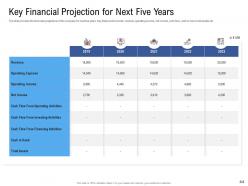
Slide 44: The slide provides the financials projections of the company for next five years. Key Data points include: revenue, operating income, net income, cash flow, cash in hand, total assets etc.
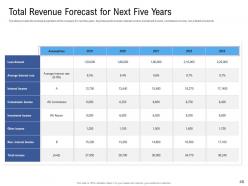
Slide 45: The slide provides the revenue projections of the company for next five years. Key Data points include: Interest income, investment income, commission income, non-interest income etc.
Slide 46: The slide provides the client’s person reviews about the products and services of the company.
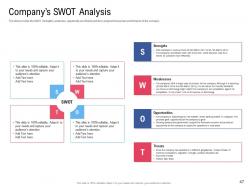
Slide 47: The slide provides the SWOT (strengths, weakness, opportunity and threat) points to analyse the business performance of the company
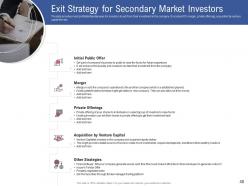
Slide 48: The slide provides most profitable/feasible ways for investors to exit from their investment in the company. It includes IPO, merger, private offerings, acquisition by venture capital firm etc.
Slide 49: This is an Icon slide. Use it as per your needs.
Slide 50: This is an Additional Slide.
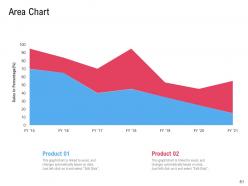
Slide 51: This is an Area Chart slide that can be used to compare two products.
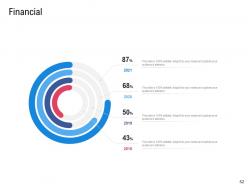
Slide 52: This is a Financial score slide that can be used to jot down your company's financial aspects.
Slide 53: This is a Post it Notes slide that can be used to keep important data at one place.
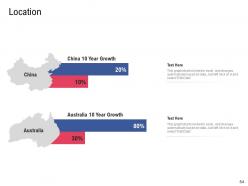
Slide 54: This is a Location slide that can be used to showcase your company's global presence.
Slide 55: This is a Thank you slide. You can share your contact details here.
Pitch deck to raise funding from financial market powerpoint presentation slides with all 55 slides:
Use our Pitch Deck To Raise Funding From Financial Market Powerpoint Presentation Slides to effectively help you save your valuable time. They are readymade to fit into any presentation structure.







FAQs for Pitch deck to raise funding from financial market
Essential pitch deck components include problem identification, solution presentation, market opportunity analysis, business model explanation, competitive landscape assessment, financial projections, and team credentials. These elements work together by demonstrating market need, showcasing strategic positioning, and building investor confidence, with many startups finding that clear revenue models and experienced leadership teams ultimately deliver the strongest competitive advantage in securing funding.
Tailoring pitch decks involves customizing content emphasis, financial projections, market positioning, risk assessments, and growth timelines based on investor priorities and investment stages. Angel investors typically focus on founder credibility and early traction, while VCs emphasize scalability and market size, and institutional investors prioritize comprehensive financial modeling, ultimately delivering more targeted presentations that resonate with specific investor expectations.
Visual elements for maximum engagement include clean, professional slide layouts, compelling infographics that simplify complex data, high-quality product screenshots or mockups, strategic use of brand colors and fonts, and clear charts that showcase market opportunity and financial projections. These elements work together by reducing cognitive load, enhancing information retention, and creating emotional connection with investors, with many successful startups finding that visual storytelling ultimately accelerates funding decisions and stakeholder buy-in.
Effectively conveying your business's value proposition requires a clear problem-solution framework, quantifiable market opportunity, competitive differentiation, and demonstrated traction through metrics or customer validation. Structure your pitch deck to flow logically from market pain point to your unique solution, incorporating specific examples from your target industry, compelling financial projections, and evidence of early adoption, ultimately delivering investor confidence through measurable outcomes and scalable growth potential.
Common pitfalls include overloading slides with excessive text, lacking clear financial projections, providing vague market analysis, underestimating competition, and failing to articulate your unique value proposition. These mistakes often result from rushing the preparation process, with many startups finding that investors respond better to concise, data-driven presentations that demonstrate clear market understanding and realistic growth trajectories.
A pitch deck should typically contain 10-15 slides for optimal impact, covering problem, solution, market size, business model, traction, competition, team, and financial projections. This range enables comprehensive storytelling while maintaining investor attention, with many successful startups finding that concise decks streamline presentations, enhance message clarity, and ultimately deliver stronger funding outcomes.
The ideal story arc follows a problem-solution-opportunity progression, beginning with market pain points, introducing your solution and unique value proposition, demonstrating traction and market validation, then concluding with funding requirements and growth projections. This narrative structure enables investors to understand the business journey while building confidence in scalability, with many venture capital firms finding that compelling storytelling combined with solid metrics ultimately delivers the emotional connection and logical framework needed for investment decisions.
Incorporate market research through compelling data visualizations, target audience demographics, competitive landscape analysis, market size validation, and growth trend projections. These elements demonstrate market understanding while building investor confidence, with successful startups finding that comprehensive research slides showcasing addressable market opportunities, customer pain points, and competitive positioning ultimately strengthen funding prospects and validate business viability.
Financial projections demonstrate your startup's revenue potential, growth trajectory, market opportunity, and path to profitability, providing investors with concrete data to evaluate ROI potential. These projections build credibility by showing realistic assumptions, scalable business models, and strategic milestones, with many investors finding that well-researched financials ultimately differentiate serious entrepreneurs from unprepared founders seeking funding.
Focus on 3-4 key team members with clearly defined roles, relevant experience, and specific achievements that directly relate to your business success. Highlight complementary skills through concise bullet points under each member's photo, emphasizing previous exits, industry expertise, or quantifiable results, while positioning your team as uniquely capable of executing your vision and delivering sustainable competitive advantage.
Your executive summary slide should focus on your compelling value proposition, target market size, unique competitive advantage, proven traction metrics, and clear funding requirements with expected returns. This slide serves as your hook for investors, distilling your entire business opportunity into digestible key points that demonstrate scalability, market validation, and strategic positioning, ultimately delivering the confidence investors need to engage further.
**INPUT**: How can I create a compelling call to action in my pitch deck? **OUTPUT**: A compelling call to action combines specific funding requirements, clear timelines, and concrete next steps that guide investors toward immediate engagement. Successful startups enhance their closing impact by presenting precise investment amounts, detailed fund allocation plans, and defined milestones, while offering immediate follow-up opportunities like product demonstrations or investor meetings, ultimately delivering clarity and urgency that accelerates funding decisions. *[Word count: 60 words]*
Infographics enhance pitch decks by transforming complex data, market trends, business models, and financial projections into visually compelling, easily digestible formats that capture investor attention immediately. These visual elements streamline information processing, reduce cognitive load during presentations, and enable faster decision-making, with many successful startups finding that strategic infographic placement significantly improves funding outcomes and investor engagement rates.
Customer testimonials and case studies enhance pitch decks by providing social proof, demonstrating real-world value, and building investor confidence through validated success stories. These elements showcase market traction, reduce perceived risk, and illustrate scalability potential, with many startups finding that authentic customer voices and quantified results significantly strengthen their funding narrative and competitive positioning.
PowerPoint, Keynote, Google Slides, Canva, and Prezi offer comprehensive design capabilities for creating compelling pitch decks, with advanced platforms like Figma and Adobe Creative Suite providing enhanced customization options. These tools streamline presentation development through professional templates, collaboration features, and visual enhancement capabilities, with many startups finding that combining intuitive platforms like Canva with PowerPoint's functionality ultimately delivers polished, investor-ready presentations.
-
Presentation Design is very nice, good work with the content as well.
-
Excellent work done on template design and graphics.