

Plastic Recycling And Waste Management Techniques




Try Before you Buy Download Free Sample Product
 Impress Your
 Audience
 100%
100% Editable
 Save Hours
 of Time


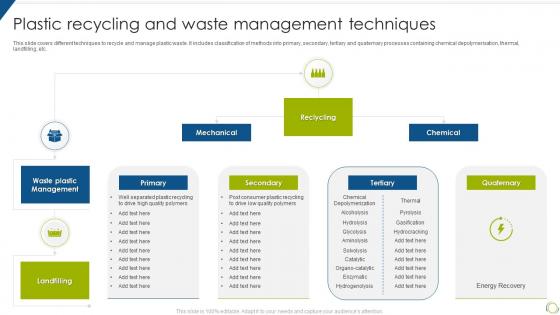
This slide covers different techniques to recycle and manage plastic waste. It includes classification of methods into primary, secondary, tertiary and quaternary processes containing chemical depolymerisation, thermal, landfilling, etc.
People who downloaded this PowerPoint presentation also viewed the following :
Plastic Recycling And Waste Management Techniques with all 6 slides:
Use our Plastic Recycling And Waste Management Techniques to effectively help you save your valuable time. They are readymade to fit into any presentation structure.





FAQs for Plastic Recycling And
Global plastic recycling rates remain relatively low, with only 9-10% of all plastic waste being recycled worldwide, while 22% is mismanaged and 36% goes to landfills. These statistics present both challenges and opportunities, with many countries increasingly investing in advanced recycling infrastructure, circular economy initiatives, and waste-to-energy technologies, ultimately delivering improved resource recovery and competitive advantages for forward-thinking organizations.
Plastic recycling processes vary significantly based on polymer type, with PET bottles undergoing wash-and-flake systems, HDPE containers requiring density separation, and flexible films needing specialized collection networks. These differentiated approaches enable manufacturers to recover high-quality resins for food packaging, automotive components, and construction materials, ultimately delivering cost-effective raw materials while reducing environmental impact across industries.
Recycling plastic significantly reduces greenhouse gas emissions, conserves fossil fuels, minimizes landfill waste, decreases ocean pollution, and preserves natural resources compared to virgin plastic production. Through advanced recycling technologies, manufacturing facilities achieve up to 70% lower energy consumption and substantially reduced carbon footprints, with many companies finding that recycled materials deliver both environmental compliance and cost advantages in increasingly sustainability-focused markets.
Consumers drive plastic recycling success through proper sorting, cleaning containers before disposal, choosing recyclable products, and supporting businesses with sustainable packaging practices. Their purchasing decisions and disposal habits directly influence recycling rates, with many municipalities finding that educated consumers significantly reduce contamination levels, ultimately enabling more efficient processing and creating stronger markets for recycled materials.
Recycling facilities face significant challenges including sorting contaminated materials, removing food residues and adhesives, managing mixed plastic types, dealing with non-recyclable additives, and maintaining equipment efficiency. These contamination issues increase processing costs, reduce output quality, and require advanced sorting technologies, with many facilities finding that contaminated plastics can compromise entire batches, ultimately affecting operational profitability and recycling effectiveness.
Consumer demand significantly influences recycled plastics markets by driving investment in recycling infrastructure, encouraging manufacturers to incorporate recycled content, and creating premium pricing for sustainable products. With many companies finding that eco-conscious consumers pay higher prices for recycled packaging, brands increasingly prioritize circular economy initiatives, ultimately delivering competitive advantage and enhanced brand loyalty while streamlining resource costs.
Emerging plastic recycling innovations include chemical recycling processes, AI-powered sorting systems, enzymatic breakdown technologies, advanced pyrolysis methods, and molecular recycling techniques. These technologies streamline waste processing by breaking down complex plastics into reusable materials, enhancing sorting accuracy, and enabling closed-loop systems, with manufacturing and packaging industries finding significantly improved resource recovery and cost efficiency.
Businesses can improve plastic waste management through comprehensive recycling programs, waste auditing, supplier partnerships with sustainable packaging providers, employee training initiatives, and technology investments for sorting and processing. Many manufacturing companies and retail chains find that implementing circular economy principles, partnering with certified recyclers, and setting reduction targets ultimately delivers cost savings, regulatory compliance, and enhanced brand reputation.
Increasing plastic recycling rates delivers significant cost reductions through decreased raw material expenses, waste management fees, and landfill costs, while creating new revenue streams from recycled materials and job opportunities in processing facilities. Manufacturing companies, packaging industries, and municipalities find that higher recycling rates enhance operational efficiency, reduce environmental compliance costs, and ultimately provide competitive advantages in increasingly sustainability-focused markets.
Effective policies include extended producer responsibility programs, plastic bag bans, bottle deposit systems, recycling mandates, and tax incentives for recycled content. These regulatory approaches streamline waste management by shifting responsibility to manufacturers, creating financial incentives, and establishing clear standards, with many municipalities finding that combined policy frameworks deliver higher recycling rates and reduced plastic waste.
Education and awareness campaigns significantly boost plastic recycling participation by teaching proper sorting techniques, highlighting environmental impacts, and demonstrating community benefits through clear messaging and accessible information. These initiatives work particularly well in schools, residential complexes, and corporate environments, with many municipalities finding that targeted campaigns increase recycling rates by 30-40%, ultimately delivering improved waste management and environmental outcomes.
Common misconceptions about plastic recycling include believing all plastics are recyclable, that recycled products are lower quality, and that recycling alone solves plastic waste problems. While these perceptions persist, many organizations are finding that advanced sorting technologies, chemical recycling processes, and strategic partnerships with manufacturers actually enable high-quality recycled materials, ultimately delivering both environmental benefits and cost-effective sustainable solutions.
The circular economy framework positions plastic recycling as a core strategy for keeping materials in continuous use, minimizing waste through reuse, remanufacturing, and regeneration processes. This approach enables manufacturers, packaging companies, and consumer goods industries to reduce raw material costs, meet sustainability targets, and create closed-loop systems, ultimately delivering competitive advantage while addressing environmental concerns.
Best practices for sorting plastic waste include identifying resin codes, separating by plastic type, removing labels and adhesives, and segregating colored from clear plastics. These methods enhance recycling efficiency by ensuring material purity, reducing contamination, and improving end-product quality, with many recycling facilities finding that proper pre-processing significantly increases operational throughput and material value.
Cross-industry collaboration enhances plastic recycling through shared infrastructure development, standardized collection systems, joint research initiatives, and coordinated supply chain optimization. By partnering across sectors like packaging, automotive, and consumer goods, companies streamline material flows, reduce processing costs, and create circular economies, with many organizations finding that collaborative approaches deliver scalable solutions and competitive advantages.
-
Use of icon with content is very relateable, informative and appealing.
-
SlideTeam never fails to surprise me with its amazing PPT designs. Thanks team for providing me with your constant support!