


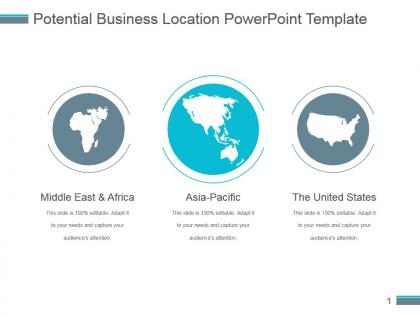
Potential business location powerpoint template




Try Before you Buy Download Free Sample Product
 Impress Your
 Audience
 100%
100% Editable
 Save Hours
 of Time


Deliver efficiently with our Potential Business Location Powerpoint Template. You will create happy customers.
People who downloaded this PowerPoint presentation also viewed the following :
Potential business location powerpoint template with all 5 slides:
Each of our Potential Business Location Powerpoint Template have an alluring effect. Keep their minds rivetted with to your thoughts.


FAQs for Potential business
Key factors for selecting a business location include target market proximity, operational costs, transportation accessibility, workforce availability, and regulatory environment. These considerations work together to determine long-term viability, with many retail businesses finding that foot traffic and visibility drive revenue growth, while manufacturing companies prioritize supply chain efficiency and cost reduction, ultimately delivering competitive advantage and sustainable profitability.
Demographic profiles significantly influence business location decisions by determining target customer density, purchasing power, workforce availability, and market demand patterns. Retail businesses often choose areas with specific age groups and income levels, while tech companies seek locations with educated populations, ultimately enabling businesses to optimize customer reach, operational costs, and revenue potential in increasingly competitive markets.
Accessibility significantly influences business viability by affecting customer reach, employee recruitment, operational costs, and regulatory compliance. Strategic locations with strong transportation links, ADA compliance, and proximity to target demographics enable enhanced foot traffic, reduced logistics expenses, and broader talent acquisition, while ensuring legal adherence and competitive positioning in increasingly accessibility-conscious markets.
Local competition significantly influences site selection by affecting market saturation, pricing strategies, customer acquisition costs, and differentiation opportunities within specific geographic areas. While intense competition can challenge market penetration, it also validates market demand, with many businesses finding that strategic positioning near competitors in retail, dining, or professional services can enhance foot traffic and customer convenience, ultimately delivering shared market benefits and increased visibility.
Key economic indicators include local GDP growth, unemployment rates, median household income, cost of living indices, and commercial real estate prices. These metrics help businesses evaluate market viability, labor availability, and operational costs, with many organizations finding that comprehensive economic analysis streamlines location decisions and delivers sustainable competitive advantage.
Geographic location significantly affects supply chain management through transportation costs, supplier proximity, infrastructure quality, labor availability, and regulatory environments. Businesses in manufacturing hubs like Detroit or tech corridors like Silicon Valley benefit from established supplier networks and specialized logistics infrastructure, while remote locations may face higher shipping costs but lower operational expenses, ultimately requiring strategic balance between accessibility and cost efficiency.
Urban locations offer greater market access, workforce availability, infrastructure quality, networking opportunities, and customer density, while rural areas provide lower operational costs, reduced competition, community integration, and regulatory flexibility. While urban settings enable faster growth and diverse talent acquisition, rural locations deliver significant cost advantages and stronger local relationships, with many businesses finding that location choice depends on industry type, target market, and growth strategy.
Skilled labor availability significantly influences business site selection by determining operational capabilities, reducing recruitment costs, and ensuring sustainable growth potential. Companies across manufacturing, technology, and healthcare sectors increasingly prioritize locations with established talent pools, as this strategic decision ultimately delivers faster scaling, enhanced productivity, and competitive advantages in today's knowledge-driven economy.
Local government policy significantly influences business location decisions through tax incentives, zoning regulations, permit processes, infrastructure investment, and regulatory compliance requirements. These policies can streamline operations by reducing administrative burdens, offering financial advantages, and providing supportive business environments, with many companies finding that favorable local policies ultimately deliver cost savings and competitive advantages in their chosen markets.
Market research enables businesses to identify optimal locations by analyzing demographic data, competitor positioning, foot traffic patterns, economic indicators, and consumer behavior trends. Through comprehensive market analysis, companies can assess factors like target audience proximity, accessibility, operational costs, and growth potential, ultimately delivering strategic positioning advantages and minimizing investment risks while maximizing revenue opportunities.
Environmental considerations in site selection include climate resilience, natural disaster risks, air and water quality, waste management infrastructure, and regulatory compliance requirements. These factors significantly impact operational costs, employee health, insurance premiums, and long-term sustainability goals, with many organizations finding that environmentally conscious location choices enhance brand reputation while reducing regulatory risks and operational expenses.
Supplier and customer locations significantly impact logistics costs, delivery times, and supply chain efficiency by determining transportation distances, shipping methods, and distribution strategies. Businesses in manufacturing and retail sectors often establish regional warehouses and distribution centers near key customer clusters, while sourcing suppliers within optimal geographic ranges to minimize costs and enhance service reliability.
Zoning regulations determine permitted business activities, building specifications, operational hours, signage restrictions, and environmental compliance requirements for specific geographic areas. These regulations significantly impact location feasibility, operational costs, and expansion potential, with retail businesses, manufacturing facilities, and service providers finding that understanding zoning laws early prevents costly relocations and enables strategic growth planning.
Technology and remote work trends fundamentally reshape business location strategies by reducing dependency on prime real estate, enabling hybrid workforce models, and expanding talent pools beyond geographic constraints. Companies increasingly prioritize cost-effective locations with strong digital infrastructure over traditional business districts, while maintaining smaller satellite offices for collaboration, ultimately delivering significant operational savings and enhanced employee flexibility.
Businesses can evaluate long-term location potential using demographic growth projections, economic stability indicators, infrastructure development plans, market competition density, and regulatory environment assessments. Through analyzing population trends, employment rates, and planned transportation improvements, organizations in retail, manufacturing, and services can identify areas offering sustained customer bases, operational efficiency, and strategic competitive advantages over time.
-
Great product with effective design. Helped a lot in our corporate presentations. Easy to edit and stunning visuals.
-
Appreciate the research and its presentable format.