


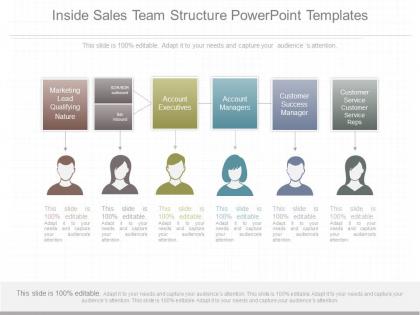
Ppt inside sales team structure powerpoint templates




Try Before you Buy Download Free Sample Product
 Impress Your
 Audience
 100%
100% Editable
 Save Hours
 of Time


Our Ppt Inside Sales Team Structure Powerpoint Templates help address growing demands. They build capability to cater.
People who downloaded this PowerPoint presentation also viewed the following :
Ppt inside sales team structure powerpoint templates with all 7 slides:
Our Ppt Inside Sales Team Structure Powerpoint Templates are a handy asset to have around. You will find them to be of admirable assistance.


FAQs for Ppt inside sales team
So there are basically three main roles you'll see. SDRs do the initial outreach and qualify leads - they're constantly prospecting. Once those leads are warmed up, Account Executives jump in to actually close deals. Sales Managers oversee everything and coach the team. Some companies throw in Customer Success reps too, but that's more for complex products where you need ongoing support. The biggest thing? Make sure everyone knows exactly when to hand leads off. I've seen so many potential deals just disappear because nobody knew whose job it was to follow up. Definitely nail down those handoff processes first.
Dude, having a proper inside sales structure is a game changer. Everyone knows exactly what they're supposed to be doing instead of stepping on each other's toes. Your SDRs focus purely on prospecting while closers handle demos and negotiations - makes everyone way better at their specific thing. No more "wait, who was calling this lead?" disasters. Leads get qualified faster, follow-ups actually happen, and honestly way less stuff gets completely forgotten about. The trick is nailing those handoff points between stages. I've seen too many good prospects just vanish because the process was messy.
Look, revenue per rep is what everyone obsesses over, but that won't help you catch problems early. Focus on conversion rates at each funnel stage instead - way more useful. Call-to-meeting rates, meeting-to-opportunity rates, that stuff. Also track your average deal size and how long your sales cycle takes. Oh, and don't forget activity metrics like daily calls and emails. Pipeline velocity matters too - basically how fast deals actually move through your stages. Honestly though? Pick maybe 2-3 of these to start. Tracking everything just makes you crazy and you won't act on any of it.
So team size basically dictates your whole structure. Small teams under 10? Keep it simple - one manager, everyone does the full cycle. But once you're at 15+ people, you've gotta specialize or things fall apart. I learned this the hard way watching companies try to wing it. SDRs handle prospecting, AEs close deals, maybe throw in customer success for upsells. The magic number is like 6-8 reps per manager - any more and you're spread too thin. Don't hesitate to add management layers when you grow. Better to have too much structure than chaos, trust me.
Ugh, where do I even start? Lead quality is probably the worst - your reps waste hours on garbage leads that'll never convert. Territory fights are brutal too. Someone's always stepping on someone else's accounts, which creates drama you don't need. Marketing and sales never seem to get along either, like they're from different planets or something. Oh, and quota pressure just makes everything worse. Your CRM probably doesn't work half the time, which slows everyone down. Honestly? Start with better lead routing and actually talk to your team regularly. Those two things alone will save you tons of headaches.
Break your sales team into small pods with their own territories. Each pod gets SDRs who pass leads to AEs, and here's the thing - they should report to the same manager. Trust me, this kills those stupid arguments about lead quality vs follow-up effort. Your CRM needs to track everything so nothing gets lost in handoffs. Daily standups work great for keeping everyone on the same page. The whole point is accountability without creating silos. Everyone knows who owns what at each stage. Set up Slack channels for each pod too - keeps the communication flowing naturally throughout the day instead of everything going through email.
Honestly, tech is completely changing how sales teams work. Your SDRs can focus just on prospecting with automation tools while closers jump on video calls for demos. CRM tracks everything automatically - way less micromanaging needed. Plus you're seeing these new roles pop up, like rev ops people who basically optimize your whole sales funnel using AI and analytics. The trick is figuring out what to automate and what still needs actual humans. It's pretty wild how specialized everyone's getting these days.
Your sales methodology basically dictates how you build your team. BANT means you'll want dedicated SDRs just doing qualification, then handing off to closers. But with consultative selling? Fewer handoffs work better since relationships matter more. Challenger is tricky - you need reps who can handle pushback and aren't afraid to challenge prospects. Not gonna lie, some people just aren't wired for that. MEDDIC people need to be detail freaks who love mapping out complex org structures. Don't just copy what other companies do. Match your hiring and team structure to whatever methodology you pick.
Dude, start with product knowledge first - that's your foundation. Once they've got that down, layer in whatever sales methodology works for your space (SPIN, Challenger, whatever). Don't sleep on CRM training though! Inside sales teams are totally screwed without solid data habits and pipeline management. Oh, and definitely do objection handling workshops. People are way meaner over email than in person, I swear. The phone can be rough too. Get your methodology training going after they're comfortable with product basics - trying to do both at once usually overwhelms people.
So it really depends on what you're selling and how long your sales take. SaaS companies usually split things up - you've got SDRs doing outreach, account execs handling demos, customer success managing retention. Makes sense since those deals are complicated and take forever. Consumer goods is way simpler though - one person just handles everything start to finish because it's more transactional. Honestly, SaaS can get ridiculous with all the handoffs between teams! The whole thing comes down to whether you need speed and volume or deep relationships. I'd just map out how your customers actually buy from you first.
Set up a solid 30-60-90 day plan covering product training, sales process, and CRM stuff. Have them shadow your best reps on calls first - that's honestly where they'll pick up the most useful tricks. Get them practicing pitches and handling objections before they talk to any real prospects. Pair them with a team buddy for casual questions (managers can be intimidating at first). Start them off with smaller, easier accounts to build some wins early. Oh, and schedule regular check-ins to see how they're doing. Once they're comfortable, gradually give them more complex territory. It's all about mixing formal training with actual hands-on experience.
Honestly, just get way more intentional about staying connected since you can't randomly walk over to someone's desk anymore. Set up dedicated Slack channels for each pod and make sure everyone's got eyes on the same pipeline dashboards. Daily standups are clutch for this stuff. Oh, and here's something most people don't think about - if your reps are all over the place geographically, try splitting territories by time zones instead. Makes coordination so much easier. Start by figuring out where your communication is breaking down right now, then build specific fixes for those gaps. The stuff that used to happen naturally? You've gotta force it now.
Honestly, start with a decent CRM - Salesforce or HubSpot work great for territory stuff and tracking your team. Slack keeps everyone talking without the endless email chains (thank god). Look, I've watched teams blow budgets on crazy tools when Excel honestly does the job fine if you're small. Once you grow though, grab Outreach for sequences and maybe Gong for coaching calls. Oh, and here's the thing - pick like 3 or 4 tools max that actually sync together. Otherwise you'll spend half your time moving data around instead of selling.
Dude, alignment can totally make or break your inside sales numbers. When marketing and sales aren't talking, you end up with garbage leads and confused prospects. Same thing happens with customer support - you'll promise stuff you can't actually deliver and the handoff becomes a disaster. I've watched teams spin their wheels for months on this exact problem. The teams that crush it? They do weekly sync meetings with both departments, share revenue goals instead of just lead counts, and have solid processes for qualifying leads and handing off customers. Honestly, just start with 30-minute weekly calls with each team and you'll see a difference pretty quick.
Honestly, specialists are game-changers once you hit a certain size. Your SDRs get crazy good at prospecting when that's all they do. AEs close more deals. Makes sense, right? Coaching becomes so much easier too - way better than trying to help someone juggle five different things poorly (trust me on this one). Generalists work great for smaller teams since you need that flexibility. But here's the thing - look at where you're bleeding the most leads or deals. That bottleneck? Perfect spot for your first specialist hire. The performance jump is usually pretty obvious once you make the switch.
-
Thanks for all your great templates they have saved me lots of time and accelerate my presentations. Great product, keep them up!
-
Awesomely designed templates, Easy to understand.