


Predictive Analytics Powerpoint Presentation Slides





Try Before you Buy Download Free Sample Product
 Impress Your
 Audience
 100%
100% Editable
 Save Hours
 of Time


Adapt the growing field of IT for your company with this predictive analytics PowerPoint Presentation slides. Make an effective use of this PowerPoint design to describe the importance of an emerging business intelligence tool which helps your business in collecting as well as analyzing the business data. You can utilize this PPT design to explain the importance of this cloud based technology for success and growth of the organizations. This Predicative analytics Presentation will be used to improve the business decisions, enhancing the rate of interest of the association on the amount spent on sales or marketing. The predictive analytics is a concept which helps the business in strengthening its overall business procedures and functions. Thus, start creating a predicative analytics PowerPoint Presentation for the prospective audience to know about this emerging business tools which not only helps in managing the business information but also results in attaining the business objectives for its continuous success in the business industry. Say cheerio to doubts with our Predictive Analytics Powerpoint Presentation Slides. Treat your audience to your decisive thoughts.
People who downloaded this PowerPoint presentation also viewed the following :
Content of this Powerpoint Presentation
Slide 1: This slide introduces Predictive Analytics as titular heading. Write your Company name and get started.
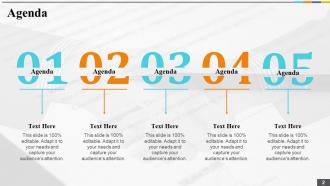
Slide 2: This is an Agenda slide. State your agenda here.
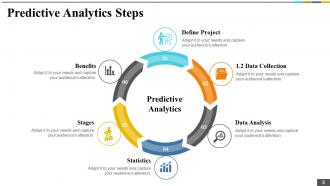
Slide 3: This slide shows 6 steps of Predictive Analytics. The steps included are- Define Project, Data Collection, Data Analysis, Statistics Stages, and Benefits
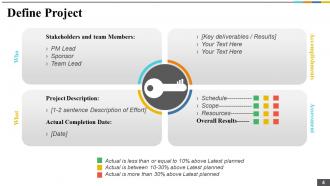
Slide 4: This slide displays Define Project with What, Who, Accomplishments, Assessments as the parameters to fulfil. Write Project Description, Actual completion date, Key Deliverables, and Stakeholders (PM Lead, Sponsor, Team Lead) and Results (Scope, Schedule, Resources) with three colored indicators.
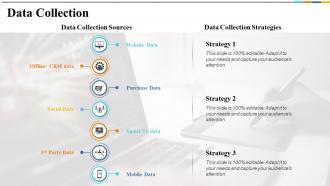
Slide 5: This slide covers Data Collection Sources (3rd Party Data, Website Data, Purchase Data, Social Data, Smart Tv data, Mobile Data, Offline/ CRM data) with Data collection strategies.
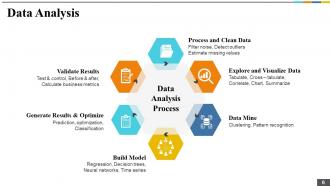
Slide 6: This slide covers Data Analysis Process with the following headings- Process and Clean Data (Filter noise, Detect outliers, Estimate missing values), Explore and Visualize Data (Tabulate, Cross – tabulate, Correlate, Chart, Summarize), Data Mine (Clustering, Pattern recognition), Generate Results and Optimize (Prediction, optimization, Classification), Validate Results (Test & control, Before & after, Calculate business metrics), Build Model (Regression, Decision trees, Neural networks, Time series).
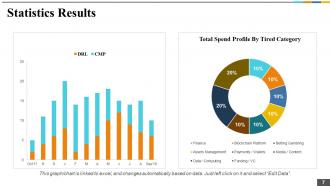
Slide 7: This slide displays Statistics of Total Spend Profile by tired category.
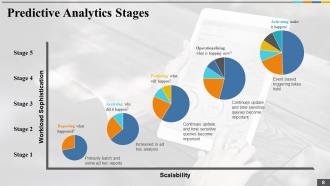
Slide 8: This slide displays Predictive Analytical stages in terms of Scalability and Workload sophistication. The stages shown are- Reporting what happened?-Primarily batch and some ad hoc reports. Analyzing why did it happen? Increased in ad hoc analysis. Predicting what will happen? Continues update and time sensitive queries become important. Operationalizing what is happing now? Continues update and time sensitive queries become important. Activating make it happen! - Event based triggering takes hold.
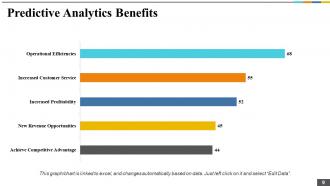
Slide 9: This slide showcases a bar graph for the benefits of Predictive Analytics.
Slide 10: This slide shows a Coffee break image.
Slide 11: This slide is titled additional slides which are to be used if required.
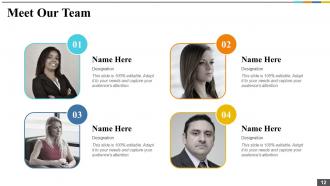
Slide 12: This slide showcases Meet Our Team with designation, text boxes and image to fit.
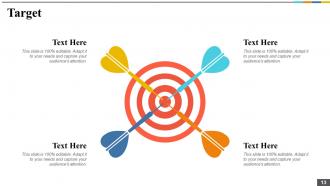
Slide 13: This slides displays Target image with text boxes.
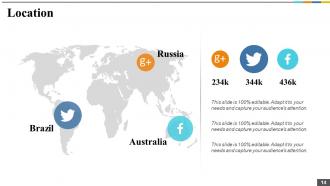
Slide 14: This slide displays a World map with some cities (Russia, Brazil, and Australia) with different followers’ count.
Slide 15: This slide displays magnifying glasses image with text boxes.
Slide 16: This slide is titled Charts and Graphs.
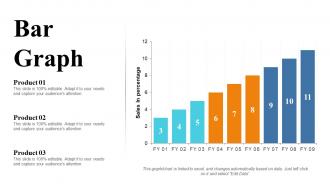
Slide 17: This slide showcases a Bar graph with Product comparison for respective fiscal years.
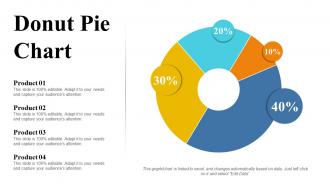
Slide 18: This slide displays a Donut Pie chart to show percentages of entities.
Slide 19: This is a Thank You slide with Address, Email Address, and Contact Number.
Predictive Analytics Powerpoint Presentation Slides with all 19 slides:
Use our Predictive Analytics Powerpoint Presentation Slides to effectively help you save your valuable time. They are readymade to fit into any presentation structure.




FAQs for Predictive Analytics
So predictive analytics is basically using old data to guess what's coming next - pretty useful before making big calls. Companies are doing this everywhere now. Retailers figure out what you'll buy, banks spot risky loans, hospitals predict patient stuff. Manufacturing uses it to catch equipment problems early (which honestly saves them tons). Marketing teams love it for campaign planning. Some of these models are getting crazy accurate too. Instead of just going with your gut, you're making moves based on actual patterns. Fewer expensive screw-ups, plus you catch opportunities others miss. I'd say start with just one thing in your department first.
Honestly, predictive analytics is a game changer for this stuff. Look at your customer behavior - things like dropping usage, tons of support tickets, late payments. Those are your red flags right there. Build a model around whatever patterns you're seeing most. Once you can spot who's about to bail, you can actually do something about it before they're gone. Same thing works for figuring out what they'll want to buy next or when they'll need help. I'd start simple though - even basic predictions can seriously help your retention numbers. Way better than just waiting around for customers to leave.
Honestly, the messiest part is always your data - way worse than you'd expect. Missing chunks, weird formats, systems that just refuse to work together. Leadership wants results yesterday but doesn't get why it takes time. Plus good ML people cost a fortune, and even when you build something decent, try explaining to your boss why the model flagged certain customers. It's like being a fortune teller who has to show their work. My advice? Pick one small project where you can show quick wins first, then expand once people see it actually works.
Dude, data quality is seriously everything for predictive models. Your algorithms will pick up on all the wrong stuff if you've got missing values, duplicates, or messy inconsistencies floating around. Clean data helps models spot actual trends instead of random noise. I've literally watched models jump 40-50% in performance just from decent data cleaning - it's wild how much difference it makes. The annoying thing? Data prep eats up like 80% of your time on these projects. My advice: audit your data sources early and build some validation rules so you don't get burned later.
Honestly, predictive analytics is a game-changer for supply chains. You can forecast demand so you're not drowning in inventory or scrambling when you run out. Equipment maintenance becomes way easier too - predict failures before your conveyor belt dies during Black Friday (been there, not fun). Routes and delivery schedules get optimized using traffic and weather data. Oh, and you'll spot supplier issues before they blow up in your face. I'd say start with demand forecasting for your bestsellers first. Don't try to boil the ocean right away - build from there once you see results.
Honestly? Just start with Python and scikit-learn if your team knows coding - it handles most predictive stuff you'll need. R's solid too, especially for stats-heavy work. If coding isn't your thing, Tableau's analytics features are pretty decent, and Excel's forecasting tools are way better than they used to be (who knew, right?). I see so many teams jumping straight into fancy neural networks when basic regression would totally work. My advice: pick whatever your team already uses, start simple, then get fancier later if you actually need it.
So predictive analytics is pretty much looking at your data to catch problems before they blow up. Models dig through historical stuff and flag risky situations early - like which customers might default or when fraud's about to spike. Way better than scrambling after everything falls apart, honestly. You can actually adjust your approach ahead of time, maybe tighten up lending or put money aside for the hit. Market volatility predictions help too. My advice? Figure out what keeps you up at night risk-wise and build models for those areas first.
Bias is the big scary one - your model can totally discriminate if it learned from crappy historical data. Privacy's another nightmare since you're basically predicting people's lives with their personal info. Most companies suck at transparency, but people should know when algorithms are making decisions about them. Also, did anyone actually consent to this? Like, really consent, not just click "agree" on some 50-page terms thing. Test everything across different groups and document your ethics process early. Oh, and prepare for awkward conversations with leadership about fairness vs. profit.
So ML basically finds patterns in your data that you'd never catch on your own. It handles huge datasets and gets smarter over time without you having to reprogram anything. What's really neat is these algorithms don't just follow preset rules - they figure out what actually matters for making predictions. Traditional stats methods? You have to tell them exactly what relationships to look for upfront. ML discovers those connections by itself. Oh, and definitely start with simple stuff like linear regression - I made the mistake of jumping straight into deep learning and got totally overwhelmed.
Yeah, totally doable! Companies do this all the time now. Netflix recommendations? That's predictive analytics running while you browse. Same with credit card fraud alerts - they're analyzing your transaction in real-time. The trick is training your models beforehand, then deploying them through APIs that can handle tons of requests super fast. You'd use something like Kafka for streaming data (honestly took me forever to wrap my head around that one). Cloud services work great too. Pick one specific problem where instant predictions actually matter for your business first.
Healthcare's all about patient privacy and getting things right - people's lives depend on it. But retail? Totally different game - you're chasing seasonal patterns and figuring out why customers buy random stuff. Financial companies obsess over fraud detection and staying compliant with regulations (so boring but necessary). Manufacturing cares most about predicting when machines will break down. The data types vary wildly between industries too. You really need to chat with people who know your specific field before diving into any modeling. Each industry has its own weird constraints and success metrics that'll completely change your approach.
Look, Netflix is wild - their algorithm basically controls 80% of what people binge. Amazon's whole inventory thing saves them crazy money by predicting what we'll buy. Walmart somehow knows exactly which stuff to stock before hurricanes even hit certain areas (kinda creepy but smart). UPS cuts their fuel costs by constantly figuring out better routes. Healthcare places like Kaiser actually spot patients who might end up back in the hospital and help them before it happens. Honestly, just start small with whatever data you already have. Pick one problem where you can actually see if it worked or not.
Okay so first thing - get your baseline numbers locked down before you start anything. Pick like 2-3 metrics that actually matter to your business goals and track those religiously. Look for stuff like "cut inventory costs by 15%" or "boosted retention 8%" - real numbers, not fluffy metrics. Here's the annoying part though: figuring out what improvements actually came from your analytics vs everything else happening at once. That attribution stuff gets super messy, not gonna lie. Focus on the obvious wins - revenue bumps from better forecasting, money saved from efficiency gains, or catching churn before it happens. Just don't overthink it at first.
Honestly, you're gonna need both the tech stuff and business sense. Start with Python or R - pick one and stick with it. SQL's a must too since you'll constantly be grabbing data from databases. Statistics and ML are your bread and butter - regression, classification, that whole thing. But here's what they don't tell you enough: explaining your work to people who aren't technical is huge. Like, maybe more important than the actual coding sometimes? Time series forecasting is super useful too. My advice? Get decent with one language first, learn a few core algorithms, then practice breaking down your analysis for your non-tech friends. Trust me on that last part.
AI tools are getting way easier to use - like drag-and-drop stuff that doesn't need a data science degree. Real-time analytics is becoming standard now instead of just batch processing. Edge computing's pretty big too, so predictions happen right where data gets collected rather than bouncing everything to the cloud first. The coolest part? Marketing teams can build their own churn models without waiting forever for IT to get around to it. That democratization thing is honestly game-changing. I'd mess around with AutoML tools now before your CEO inevitably drops the "we need AI-powered insights" bomb next quarter and you're scrambling.
-
I discovered this website through a google search, the services matched my needs perfectly and the pricing was very reasonable. I was thrilled with the product and the customer service. I will definitely use their slides again for my presentations and recommend them to other colleagues.
-
Informative presentations that are easily editable.
-
Amazing product with appealing content and design.