


Private Equity Strategies Investors Growth Business Framework Success Investment Structure





Try Before you Buy Download Free Sample Product
 Impress Your
 Audience
 100%
100% Editable
 Save Hours
 of Time


Our Private Equity Strategies Investors Growth Business Framework Success Investment Structure are topically designed to provide an attractive backdrop to any subject. Use them to look like a presentation pro.
People who downloaded this PowerPoint presentation also viewed the following :
Private Equity Strategies Investors Growth Business Framework Success Investment Structure with all 12 slides:
Use our Private Equity Strategies Investors Growth Business Framework Success Investment Structure to effectively help you save your valuable time. They are readymade to fit into any presentation structure.




FAQs for Private Equity Strategies Investors Growth Business Framework
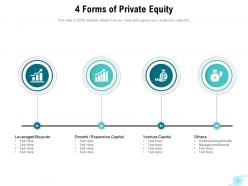
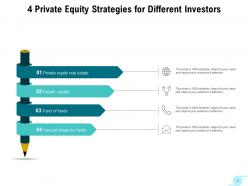
Private equity strategies include leveraged buyouts, growth capital, distressed investing, venture capital, and mezzanine financing, each targeting different company stages and market conditions. These approaches differ significantly in risk profiles, with venture capital presenting higher volatility but potentially greater returns, while growth capital offers more moderate risk-return ratios, ultimately enabling investors to diversify portfolios across various market cycles and investment horizons.
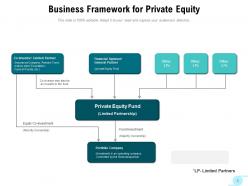
Buyout funds structure deals through leveraged acquisitions using debt financing, equity investments, management partnerships, and staged capital deployment to maximize returns while minimizing initial investment. Key valuation considerations include EBITDA multiples, cash flow projections, market comparables, and debt capacity, with funds focusing on operational improvement potential, scalability factors, and exit opportunities, ultimately delivering enhanced enterprise value through strategic operational enhancements.
Venture capital investments prove more advantageous than traditional buyouts when targeting high-growth technology companies, early-stage disruptive businesses, and emerging market opportunities that require significant scaling capital rather than operational restructuring. These investments excel in scenarios involving innovative startups, software platforms, and biotech ventures, where traditional buyouts lack the growth potential, ultimately delivering higher returns through exponential expansion rather than efficiency optimization.
Leverage amplifies private equity returns by using debt to finance acquisitions, reducing required equity capital while magnifying gains on successful investments. However, highly leveraged deals present significant risks including increased financial vulnerability during economic downturns, potential covenant breaches, and reduced operational flexibility, with many firms finding that excessive leverage can transform manageable challenges into distressed situations requiring complex restructuring.
Private equity firms identify operational risks through comprehensive due diligence, financial audits, management assessments, and industry benchmarking analysis. They mitigate these risks by implementing robust governance structures, installing experienced management teams, and establishing regular monitoring systems, with many firms finding that proactive risk management across manufacturing, healthcare, and technology sectors ultimately delivers enhanced operational efficiency and significantly higher returns.
Primary private equity exit strategies include strategic sales to corporations, initial public offerings, secondary buyouts to other PE firms, management buyouts, and dividend recapitalizations. Market conditions significantly influence these choices, with strong equity markets favoring IPOs for maximum valuations, while uncertain conditions often drive strategic sales or secondary buyouts, ultimately enabling firms to optimize returns based on sector performance and buyer appetite.
ESG criteria have fundamentally reshaped private equity strategies by integrating sustainability metrics into due diligence, portfolio management, and exit planning processes. These frameworks enable firms to identify long-term value creation opportunities, mitigate regulatory risks, and attract institutional investors, with many funds finding that ESG-focused investments deliver enhanced returns and competitive positioning.
Macroeconomic factors significantly influence private equity performance through interest rates, inflation, GDP growth, and market volatility, affecting valuations, exit timing, and leverage costs across sectors. While technology and healthcare often demonstrate resilience during downturns, cyclical industries like manufacturing and retail face greater sensitivity, with many funds finding that diversified portfolios and flexible exit strategies help navigate economic uncertainties while maintaining competitive returns.
Private equity firms approach due diligence through comprehensive financial audits, market analysis, operational assessments, legal reviews, and management evaluations to validate investment opportunities. These systematic processes enable firms to identify value creation potential, assess risk factors, and avoid common pitfalls like inadequate market research, overlooking operational inefficiencies, and insufficient management assessment, ultimately delivering stronger portfolio performance.
Fundraising challenges in competitive private equity markets include investor fatigue from oversupply, heightened due diligence requirements, pressure for lower fees, differentiation difficulties among similar strategies, and longer fundraising cycles. Many funds find that demonstrating unique value propositions, maintaining strong existing investor relationships, and showcasing consistent performance history ultimately delivers fundraising success despite increased competition.
Technological advancements have revolutionized private equity through AI-powered deal sourcing platforms, automated due diligence tools, predictive analytics for investment screening, and digital portfolio management systems. These technologies streamline deal identification by analyzing vast market datasets, accelerate due diligence timelines, and enhance portfolio company oversight, ultimately enabling faster decision-making and improved investment returns across increasingly competitive markets.
Secondary private equity markets enable investors to sell existing fund commitments or portfolio company stakes before traditional exit timelines, providing crucial liquidity in an otherwise illiquid asset class. These markets deliver significant value by allowing pension funds, endowments, and institutional investors to rebalance portfolios, access capital for new opportunities, and manage cash flow timing, while specialized secondary buyers acquire quality assets at attractive valuations.
Emerging markets offer private equity firms higher growth potential, undervalued assets, and market expansion opportunities, while presenting challenges including regulatory complexity, currency volatility, and limited exit options. These markets enable firms to capitalize on rapid economic development and consumer growth, particularly in sectors like technology and healthcare, with many finding that strategic local partnerships and patient capital deployment ultimately deliver superior returns despite increased operational complexity.
Key trends reshaping private equity include ESG integration, technology-driven due diligence, increased competition for deals, regulatory changes, and growing LP demands for transparency and impact. Successful firms are adapting by developing specialized sector expertise, leveraging data analytics for deal sourcing, implementing comprehensive ESG frameworks, and creating value through operational improvements rather than financial engineering alone, ultimately delivering stronger returns while meeting evolving stakeholder expectations.
Co-investment opportunities benefit private equity firms by providing additional capital without management fees, enabling larger deal sizes and reduced fund pressure, while offering institutional investors direct access to deals, lower fee structures, and enhanced portfolio diversification. These partnerships ultimately deliver improved returns through aligned interests, with many pension funds and endowments finding that co-investments significantly outperform traditional fund commitments.
-
Innovative and attractive designs.
-
Very unique and reliable designs.
-
Visually stunning presentation, love the content.
-
Illustrative design with editable content. Exceptional value for money. Highly pleased with the product.
-
Great product with effective design. Helped a lot in our corporate presentations. Easy to edit and stunning visuals.