


Product Adoption Strategy Curve Model




Try Before you Buy Download Free Sample Product
 Impress Your
 Audience
 100%
100% Editable
 Save Hours
 of Time


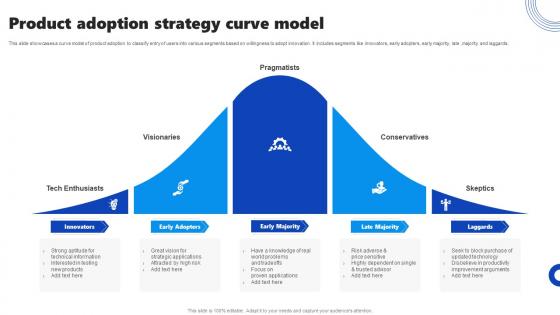
This slide showcases a curve model of product adoption to classify entry of users into various segments based on willingness to adopt innovation. It includes segments like innovators, early adopters, early majority, late ,majority and laggards.
People who downloaded this PowerPoint presentation also viewed the following :
Product Adoption Strategy Curve Model with all 6 slides:
Use our Product Adoption Strategy Curve Model to effectively help you save your valuable time. They are readymade to fit into any presentation structure.





FAQs for Product Adoption
So there's this Product Adoption Curve thing with five stages. Innovators (2.5%) will literally try anything new - total risk-takers. Then you've got Early Adopters (13.5%) who are super influential and take smart risks. These guys are amazing for testimonials. The Early and Late Majority each make up 34% of your market, but they need way more convincing through social proof. Laggards (16%) only adopt when they're basically forced to. Here's the thing though - you can't market the same way to innovators as you do to the majority. What gets early adopters excited will totally fall flat with mainstream customers.
So basically, the adoption curve shows you who to target and how. Early adopters want cool new features, but mainstream folks need proof it actually works. I'd start by figuring out where your customers sit on that curve - honestly saved me tons of trial and error when I did this. Beta access works great for the tech nerds, while regular people need testimonials and guarantees. Different groups, different messages. Oh and pricing strategies change too depending on the segment. Makes way more sense than blasting everyone with the same campaign.
So early adopters are basically your first real fans - they'll take a chance on your product when it's still rough around the edges. These people give you the feedback you actually need to improve things. Here's the thing though: they're not just users, they're your biggest advocates who'll tell their friends about what you're building. Without them, you're stuck trying to convince mainstream users who honestly don't care about unproven stuff. They're like your bridge between the super techy early crowd and regular people. Focus on finding these folks first.
Tech companies move crazy fast - we're talking months for adoption. But healthcare? Agriculture? You're looking at literal decades sometimes. B2B software innovators jump on things quickly, while manufacturing needs years of testing and approvals (which honestly makes sense given the stakes). Consumer stuff falls in the middle, though social media has sped everything up recently. Risk tolerance makes all the difference here. Plus switching costs. Look at how long previous innovations took in your space - that's probably your best guess for timing your launch and what growth to actually expect.
Honestly, start with tech forums and beta user lists - that's where the real early adopters hang out. Hit up industry conferences too, especially sessions on cutting-edge stuff. Social media's actually pretty useful here... look for people griping about current tools or getting excited about new trends. Companies that always jump on new tech first? They're perfect since they've got innovation budgets and teams dedicated to trying stuff. But here's the thing - don't just chase novelty seekers. You want people with actual decision-making power who are dealing with real problems your product fixes. Start building those relationships now, way before launch.
Honestly, mainstream users are totally different from early adopters. They don't want shiny new stuff - they want proof it actually works for people like them. Start collecting real testimonials and case studies, but not from your tech-savvy customers. Get stories from regular folks who've had success. The other big thing? Make onboarding stupid simple. Most people will bail if they have to figure things out or jump through hoops. They're looking for something proven that just works right away. Oh, and remove any signup friction that gives them a reason to hesitate.
Honestly, it boils down to three main things: does your product fit into what people already do, how much risk they're cool with, and who they talk to. Younger people jump on stuff faster - they're not as scared of change and gossip spreads like wildfire in their circles. Money matters too though. When you've got cash to burn, you're way more likely to try random new things. Oh, and some cultures are just naturally skeptical while others eat up anything shiny and new. I'd figure out what's actually bugging your target audience and who influences them, then build your launch around that.
Oh man, cultural stuff totally changes how products catch on. Japan's interesting - people wait to see what others do first, but then everyone jumps in at once. Americans? Completely opposite. We've got those early adopter types who grab anything new immediately. Some cultures are just more risk-averse too, which makes sense I guess. Word-of-mouth works differently everywhere, and honestly that's huge for adoption. You can't just copy-paste the same launch strategy across regions. Timeline's gotta shift based on where you're selling.
So it really depends on where your users fall on that adoption curve. Innovators and early adopters? Just track activation rates and time-to-first-value - they'll figure stuff out. The early majority needs more babying though, so watch onboarding completion and how deep they actually go with features. Late majority and laggards are different beasts entirely. Focus on retention rates and support tickets since they're naturally more skeptical. Churn matters everywhere but becomes make-or-break with mainstream users. My advice? Map out where your current users sit, then pick maybe 2-3 solid metrics per stage. Don't overcomplicate it.
Think of feedback loops as your reality check while rolling out a product. Users will tell you straight up what's broken before it tanks your whole launch. Early adopters are goldmines for this - they're super opinionated (sometimes painfully honest) but that's exactly what you need. Set up proper ways to collect their input though - surveys, interviews, maybe some analytics tracking. You don't want just random rants cluttering your inbox. The goal is turning their complaints into actual fixes that'll make mainstream adoption way smoother. It's like having free QA testers who actually care.
Honestly, most companies just sprint toward the mainstream market without figuring out what those customers actually want. Your early tech nerds were all about the cool new features, but regular buyers? They want something that works reliably and doesn't mess up their existing setup. I've seen teams keep building flashy stuff for the innovators when they should be making things simpler for everyone else. It's like they think one approach fits all - spoiler alert, it doesn't. Before you switch up your messaging, actually talk to each group. Find out what's bugging them first.
So here's the thing - competition usually speeds up adoption because it gets more people talking about the problem you're solving. Look at Uber and Lyft, right? They both pushed ridesharing mainstream together. Your market share will probably take a hit later on though, especially when customers have tons of proven options. But early on, that competitive buzz actually helps everyone. The trick is using that initial boost to really stand out and build loyalty before things get crazy saturated. Honestly, it's better than trying to educate an entire market solo.
iPhone's the classic case study here - they nailed it by starting with tech nerds camping outside stores, then slowly added cheaper models for regular people. Tesla pulled the same move with that fancy Roadster first, then worked down to the Model 3. Netflix too, though they got lucky with timing honestly. Started with DVD mail service for early users, then streaming hit mainstream. Each phase needs totally different marketing though - what hooks an early adopter won't work on your average consumer. You've gotta switch up your whole approach as you move down the curve.
Skip the tech enthusiast stuff - laggards don't care what early adopters think. Show them regular people using your product for boring, everyday problems. Customer reviews are gold here. Case studies work too, but make them relatable. These folks are scared of looking dumb, so tackle their worries directly with FAQ videos or whatever. Honestly? They've probably been lurking and watching your product anyway. Focus on content that screams "everyone's doing this now" and makes it feel super safe to jump in. Remove every barrier you can think of.
Customer education is honestly one of the biggest things you can do to speed up adoption. It cuts down on all that perceived risk and complexity that keeps people hesitant. When you teach users about your product's value and how to actually use it, you're basically shortening their learning curve and building confidence. I've literally seen products tank because nobody understood what they even did! You want to match your educational approach to where people are though - start simple and benefit-focused for early adopters, then get more detailed as you move toward mainstream users. Makes a huge difference.
-
The best and engaging collection of PPTs I’ve seen so far. Great work!
-
Been using SlideTeam for some time now…can’t imagine why I wasted all that time in front of the screen trying to make the perfect presentation.