


Product And Services Complaint Analysis Log




Try Before you Buy Download Free Sample Product
 Impress Your
 Audience
 100%
100% Editable
 Save Hours
 of Time


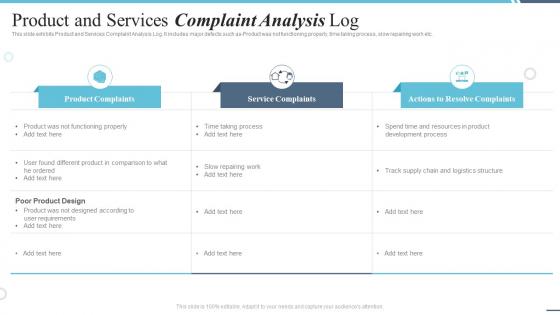
This slide exhibits Product and Services Complaint Analysis Log. It includes major defects such as-Product was not functioning properly, time taking process, slow repairing work etc.
People who downloaded this PowerPoint presentation also viewed the following :
Product And Services Complaint Analysis Log with all 6 slides:
Use our Product And Services Complaint Analysis Log to effectively help you save your valuable time. They are readymade to fit into any presentation structure.





FAQs for Product And Services
**INPUT**: What are the key components of an effective complaint analysis log? **OUTPUT**: Effective complaint analysis logs include complaint categorization, severity assessment, root cause identification, resolution timelines, and customer satisfaction tracking. These components streamline operations by enabling pattern recognition, resource allocation optimization, and proactive issue prevention, with many organizations finding that systematic logging ultimately delivers faster resolution times and enhanced customer experiences.
A complaint analysis log improves customer satisfaction by identifying recurring issues, tracking resolution times, and revealing service gaps across different departments or touchpoints. Through systematic analysis, companies can address root causes proactively, streamline their complaint handling processes, and implement targeted improvements, ultimately delivering faster resolutions and enhanced customer experiences.
Complaint analysis tools include customer relationship management (CRM) systems like Salesforce, specialized complaint management software such as Zendesk, data analytics platforms like Tableau, and enterprise solutions including ServiceNow and Microsoft Dynamics. These technologies streamline complaint tracking, categorization, and trend analysis, while enabling organizations to identify recurring issues, measure resolution times, and ultimately enhance customer satisfaction and operational efficiency across departments.
Organizations should review complaint analysis logs monthly for trend identification and quarterly for comprehensive strategic analysis, with immediate reviews triggered by complaint spikes or emerging patterns. This regular cadence enables proactive issue resolution, customer experience improvements, and operational adjustments, with many companies finding that consistent monitoring reduces complaint volumes by 30-40% while enhancing service quality.
Common pitfalls include inconsistent data entry, inadequate categorization systems, delayed logging, lack of follow-up tracking, and insufficient detail recording. Many organizations find that poor staff training, irregular review schedules, and failure to integrate findings into actionable improvements ultimately diminish the log's strategic value, reducing customer satisfaction and operational efficiency gains.
Qualitative complaint data can be quantified through categorization systems, sentiment scoring, frequency tracking, severity ratings, and thematic coding that transforms narrative feedback into measurable metrics. This approach enables organizations to identify patterns, prioritize resolution efforts, and track improvement trends over time, with many customer service teams finding that structured quantification delivers clearer insights and more strategic resource allocation.
Key metrics include complaint volume trends, resolution time averages, customer satisfaction scores, root cause categories, repeat complaint rates, and cost per resolution. These measurements enable organizations to streamline response processes, enhance service quality, and reduce operational costs, with many customer service departments finding that systematic tracking ultimately delivers improved customer retention and competitive advantage.
Complaints are categorized by type, severity level, department involved, resolution time, and customer impact to enable systematic analysis and pattern identification. This strategic categorization allows organizations to streamline response processes, allocate resources more effectively, and identify recurring issues across different service areas, ultimately delivering faster resolutions and enhanced customer experiences while minimizing operational inefficiencies.
Complaint analysis logs reveal actionable insights through pattern identification, root cause analysis, feature gap assessment, and customer pain point mapping. By systematically tracking recurring issues across product lines, companies like software providers and consumer goods manufacturers can prioritize development resources, enhance user experiences, and ultimately reduce future complaint volumes while strengthening competitive positioning.
**INPUT**: How can different departments collaborate using information from a complaint analysis log? **OUTPUT**: Different departments can collaborate using complaint analysis logs by sharing insights across customer service, product development, quality assurance, marketing, and operations teams to identify systemic issues and improvement opportunities. Through centralized data access, teams streamline communication, enhance product quality, and accelerate resolution processes, with many organizations finding that cross-departmental collaboration ultimately delivers improved customer experiences and operational efficiency. **Word count: 58 words**
Best practices for accurate complaint analysis logs include standardized categorization systems, regular data validation checks, consistent entry protocols, automated quality controls, and periodic audits. These approaches streamline data collection by minimizing human error, establishing clear documentation standards, and implementing verification processes, with many organizations finding that systematic validation ultimately delivers more reliable insights and faster resolution times.
A complaint analysis log ensures regulatory compliance by systematically documenting issues, tracking resolution timelines, identifying recurring patterns, and maintaining audit trails required by regulatory bodies. In heavily regulated sectors like healthcare, financial services, and pharmaceuticals, these logs demonstrate proactive risk management and continuous improvement efforts, ultimately helping organizations avoid penalties while enhancing operational transparency and customer trust.
Employee training ensures staff understand proper complaint categorization, data entry protocols, trend identification techniques, and follow-up procedures when using complaint analysis logs. Well-trained employees can accurately capture complaint details, recognize patterns across customer feedback, and implement corrective actions more effectively, ultimately delivering improved customer satisfaction and operational efficiency while enabling organizations to transform complaints into strategic improvement opportunities.
Complaint analysis logs assist in identifying customer behavior trends by tracking recurring issues, seasonal patterns, demographic preferences, service touchpoints, and satisfaction drivers across multiple interactions. Through systematic data analysis, organizations can predict customer needs, personalize experiences, and proactively address concerns, ultimately enhancing retention strategies and competitive positioning in increasingly customer-centric markets.
Organizations can implement targeted staff training programs, process improvements, policy revisions, enhanced communication protocols, and proactive customer service measures based on complaint analysis findings. These strategies enable companies to address root causes systematically, reduce recurring issues, and enhance customer satisfaction, with many businesses finding that data-driven improvements ultimately deliver competitive advantage and operational efficiency.
-
Superb! The innovative and inspiring template designs provide an edge to the presentation.
-
Impressive templates. Designing a presentation is fun now!