


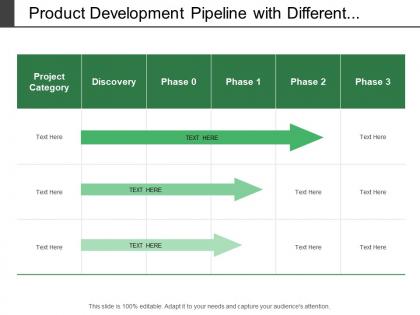
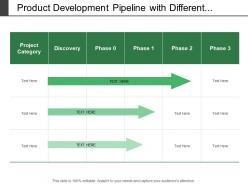
Product development pipeline with different number of development phases




Try Before you Buy Download Free Sample Product
 Impress Your
 Audience
 100%
100% Editable
 Save Hours
 of Time


Package your ideas in our Product Development Pipeline With Different Number Of Development Phases. They will get that attractive look.
People who downloaded this PowerPoint presentation also viewed the following :
Product development pipeline with different number of development phases with all 5 slides:
Our Product Development Pipeline With Different Number Of Development Phases help calm apprehensions. They will always find cause for cheer.
FAQs for Product development pipeline with different number
Key stages in a typical product development pipeline include ideation and market research, concept development and validation, design and prototyping, testing and refinement, and launch preparation. These stages streamline innovation by enabling systematic evaluation, reducing development risks, and accelerating time-to-market, with many organizations finding that structured pipelines deliver more successful products and stronger competitive positioning.
Market research influences product development by providing customer insights during ideation, validating concepts in early design phases, and guiding feature prioritization throughout development cycles. Through targeted surveys, focus groups, and competitive analysis, companies across industries streamline decision-making, reduce development costs, and enhance product-market fit, with many organizations finding that continuous research integration ultimately delivers faster time-to-market and stronger customer adoption rates.
Customer feedback serves as a critical validation and refinement mechanism throughout product development, enabling teams to identify usability issues, validate feature priorities, adjust functionality based on real-world needs, and ensure market alignment before launch. This iterative approach helps organizations minimize development costs, reduce time-to-market risks, and ultimately deliver products that resonate with target audiences, with many companies finding that early feedback integration significantly enhances product-market fit and customer satisfaction.
Cross-functional teams collaborate effectively through structured communication protocols, shared project management platforms, regular sprint reviews, and clearly defined roles across departments. These frameworks streamline coordination between engineering, design, marketing, and operations teams, enabling faster iteration cycles, reduced development bottlenecks, and improved product-market alignment, with many organizations finding that integrated workflows ultimately accelerate time-to-market significantly.
Key metrics include time-to-market, development costs, quality scores, customer satisfaction rates, conversion rates between stages, resource utilization, and defect rates. These measurements enable organizations to identify bottlenecks, optimize resource allocation, and enhance overall efficiency, with many companies finding that systematic tracking across development phases ultimately delivers faster product launches and improved competitive positioning.
Agile methodologies enhance product development pipeline efficiency by enabling iterative development cycles, continuous feedback integration, and rapid prototype testing. Through sprint-based planning and cross-functional collaboration, organizations streamline time-to-market, reduce development costs, and improve product quality, with many tech companies and startups finding that agile approaches ultimately deliver greater customer satisfaction and competitive advantage.
Essential tools include project management platforms, version control systems, collaboration software, analytics dashboards, and automation technologies. These solutions streamline workflows by centralizing communication, tracking progress across development stages, and enabling real-time visibility, with many organizations finding that integrated pipeline management delivers faster time-to-market, reduced bottlenecks, and enhanced cross-team coordination.
Risk assessment influences product development decisions by evaluating market viability, technical feasibility, resource requirements, and competitive positioning at each pipeline stage. Through systematic risk analysis, organizations identify potential roadblocks early, allocate resources strategically, and make informed go/no-go decisions, ultimately reducing costly late-stage failures and enhancing overall product success rates.
Common product development pipeline challenges include scope creep, resource allocation issues, market timing misalignment, cross-functional communication gaps, and quality control bottlenecks. These obstacles can be mitigated through agile methodologies, regular stakeholder reviews, dedicated project management tools, and strategic milestone checkpoints, with many organizations finding that structured frameworks ultimately streamline delivery timelines and enhance product-market fit.
Companies ensure alignment by establishing strategic frameworks that integrate market analysis, customer feedback, competitive intelligence, and revenue goals directly into development processes. Through regular cross-functional reviews between product, marketing, and executive teams, organizations streamline decision-making, prioritize high-impact features, and accelerate time-to-market, ultimately delivering products that enhance competitive advantage and drive sustainable growth.
Best practices for prototyping include rapid iteration, user feedback integration, cross-functional collaboration, risk validation, and cost-effective testing methods. These approaches streamline development by identifying design flaws early, reducing time-to-market, and minimizing costly revisions, with many technology companies and consumer goods manufacturers finding that strategic prototyping ultimately delivers faster innovation cycles and higher market success rates.
Organizations foster innovation culture by encouraging experimentation, establishing cross-functional collaboration, implementing rapid prototyping processes, creating psychological safety for risk-taking, and rewarding creative problem-solving. These approaches streamline product development by reducing time-to-market, enhancing team creativity, and accelerating iteration cycles, with many technology and manufacturing companies finding that innovation-focused cultures ultimately deliver competitive advantage and faster product launches.
Digital transformation revolutionizes traditional product development by accelerating time-to-market, enabling real-time collaboration, enhancing data-driven decision making, and streamlining cross-functional workflows through cloud-based platforms and automated testing. Organizations increasingly find that digital tools reduce development cycles by 30-40%, while improving product quality and customer feedback integration, ultimately delivering competitive advantage in rapidly evolving markets.
Sustainability integrates into product development through eco-friendly material selection, energy-efficient design processes, lifecycle assessment during prototyping, sustainable manufacturing methods, and circular economy principles in packaging. Companies across automotive, electronics, and consumer goods sectors streamline these practices by incorporating environmental impact metrics, renewable resources, and waste reduction strategies, ultimately delivering competitive advantage while meeting increasingly demanding consumer expectations for responsible innovation.
Regulatory requirements significantly extend product development timelines through mandatory compliance reviews, documentation processes, testing protocols, and approval phases that can add months or years to launch schedules. However, early regulatory integration streamlines later stages, with industries like pharmaceuticals, medical devices, and financial services finding that proactive compliance strategies ultimately reduce costly delays and enhance market credibility.
-
Unique and attractive product design.
-
Excellent template with unique design.