


Product Launch Marketing Campaign Plan Strategies To Ramp Strategy SS V




Try Before you Buy Download Free Sample Product
 Impress Your
 Audience
 100%
100% Editable
 Save Hours
 of Time


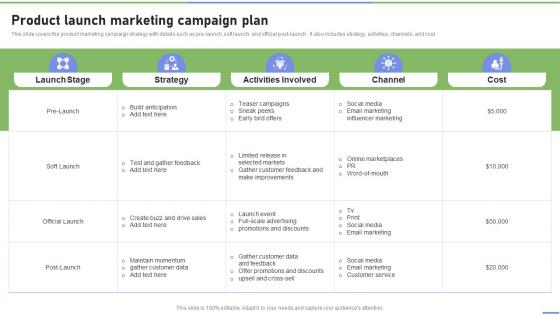
This slide covers the product marketing campaign strategy with details such as pre launch, soft launch, and official post launch. It also includes strategy, activities, channels, and cost.
People who downloaded this PowerPoint presentation also viewed the following :
Product Launch Marketing Campaign Plan Strategies To Ramp Strategy SS V with all 9 slides:
Use our Product Launch Marketing Campaign Plan Strategies To Ramp Strategy SS V to effectively help you save your valuable time. They are readymade to fit into any presentation structure.









FAQs for Product Launch Marketing Campaign Plan Strategies To Ramp
Key elements include market research and segmentation, compelling messaging and positioning, multi-channel marketing campaigns, strategic partnerships, and comprehensive launch timeline planning. These components work together by identifying target audiences, creating resonant brand narratives, and coordinating promotional efforts across digital and traditional platforms, with many organizations finding that integrated approaches ultimately deliver stronger market penetration and sustainable competitive advantage.
Market research informs product launch campaigns by identifying target demographics, analyzing competitor strategies, understanding customer pain points, and revealing optimal pricing strategies. Through comprehensive market analysis, companies can tailor messaging that resonates with specific audiences, select effective channels like social media or traditional advertising, and position their products strategically, ultimately delivering higher conversion rates and competitive market advantage.
Social media platforms serve as essential channels for product launch promotion through targeted advertising, influencer partnerships, content amplification, real-time customer engagement, and community building. These platforms enable brands to reach specific demographics, generate pre-launch buzz, and gather immediate feedback, with many companies finding that strategic social media campaigns significantly enhance brand visibility, accelerate market penetration, and drive measurable conversion rates.
Businesses can effectively leverage influencers during product launches by selecting partners whose audiences align with target demographics, creating authentic collaborative content, and implementing strategic timing across multiple touchpoints. Through early access programs and exclusive previews, companies enable influencers to generate genuine excitement while building credibility, ultimately delivering broader reach, enhanced brand trust, and accelerated market penetration.
Pre-launch engagement techniques include exclusive preview events, interactive teaser campaigns, influencer partnerships, early access programs, and community-driven content creation. These approaches enhance anticipation by building personal connections, gathering valuable feedback, and creating authentic buzz, with many companies finding that strategic pre-launch engagement significantly increases initial sales and long-term customer loyalty.
Key product launch metrics include conversion rates, customer acquisition costs, market penetration, revenue growth, and customer lifetime value. These measurements enable organizations to assess campaign effectiveness, optimize resource allocation, and refine targeting strategies, with many companies finding that tracking both leading indicators and revenue outcomes ultimately delivers comprehensive insights for future launch optimization.
Storytelling enhances product launch presentations by creating emotional connections, simplifying complex features through relatable narratives, and making key benefits memorable for audiences. Through compelling customer journey stories and problem-solution frameworks, companies like Apple and Tesla transform technical specifications into powerful brand experiences, ultimately driving stronger audience engagement and purchase intent.
Email marketing builds anticipation through teaser campaigns, exclusive previews, countdown sequences, behind-the-scenes content, and early access offers for subscribers. These strategies create buzz by delivering personalized sneak peeks and limited-time opportunities, with many companies finding that segmented email campaigns generate significantly higher engagement rates and ultimately drive stronger launch-day sales conversions.
Common pitfalls include insufficient market research, unclear messaging, poor timing, inadequate budget allocation, and neglecting post-launch support. These missteps can derail launches by creating confusion among target audiences, missing competitive windows, and failing to sustain momentum, with many organizations finding that comprehensive planning and stakeholder alignment ultimately deliver stronger market penetration and customer adoption.
Timing is critical for product launch success because it determines market receptivity, competitive positioning, and resource alignment with business cycles. Strategic timing considers seasonal demand patterns, competitor activities, and industry events, with companies in retail, technology, and consumer goods finding that well-timed launches significantly enhance market penetration, customer adoption rates, and ultimately deliver stronger revenue performance and competitive advantage.
Digital tools for product launches include project management platforms like Asana, marketing automation software such as HubSpot, social media schedulers, email marketing systems, and analytics dashboards. These technologies streamline coordination by centralizing timelines, automating campaign sequences, and tracking performance metrics, with many organizations finding that integrated tool stacks reduce launch complexity while delivering faster market entry and measurable engagement results.
Visual content enhances product launch marketing by simplifying complex product information, increasing engagement rates, and creating memorable brand experiences that resonate across multiple channels. Through strategic infographics and videos, companies streamline customer education, accelerate purchase decisions, and boost social media reach, with many brands finding that visual storytelling ultimately delivers higher conversion rates and stronger market penetration than traditional text-based approaches.
Post-launch customer feedback strategies include surveys, focus groups, social media monitoring, customer interviews, and analytics tracking. These approaches streamline insights by capturing sentiment across multiple touchpoints, identifying improvement opportunities, and measuring satisfaction levels, with many organizations finding that combining digital feedback tools with direct customer engagement ultimately delivers deeper product understanding and competitive advantage.
Brands create exclusivity through limited-time pre-orders, VIP early access programs, invitation-only launch events, exclusive partnerships with select retailers, and premium packaging options. These strategies enhance perceived value and urgency, with luxury brands, tech companies, and fashion retailers finding that scarcity-driven launches generate stronger demand, higher engagement, and ultimately deliver premium positioning while building lasting customer loyalty.
Competitive analysis enables product launch teams to identify market gaps, differentiate positioning, benchmark pricing strategies, and anticipate competitor responses during launch phases. Through comprehensive competitor research, companies can refine their value propositions, optimize messaging for underserved segments, and develop strategic advantages, with many organizations finding that thorough competitive insights significantly enhance launch success rates and market penetration.
-
The ease of modifying templates is just superb! Also, the vast collection offers plenty of options to choose from.
-
Innovative and creative templates with high-quality designs. Helped me with my presentation as the slides were easy to edit.