


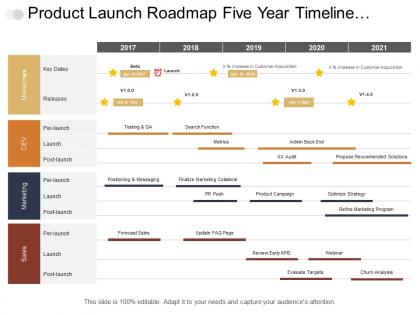
Product launch roadmap five year timeline covering milestone marketing and sales




Try Before you Buy Download Free Sample Product
 Impress Your
 Audience
 100%
100% Editable
 Save Hours
 of Time


Every discipline is fully covered by our Product Launch Roadmap Five Year Timeline Covering Milestone Marketing And Sales. Get a great choice available at hand.
People who downloaded this PowerPoint presentation also viewed the following :
Product launch roadmap five year timeline covering milestone marketing and sales with all 5 slides:
Achieve the glory you aspire to with our Product Launch Roadmap Five Year Timeline Covering Milestone Marketing And Sales. They enable you to chase desired goals.
FAQs for Product launch roadmap five year timeline covering milestone
Key milestones include market research completion, product development phases, beta testing, marketing campaign launch, sales team training, and go-to-market execution. These strategic checkpoints streamline coordination across teams, ensure quality standards, and minimize launch risks, with many organizations finding that structured milestone tracking accelerates time-to-market and enhances competitive positioning.
Determining ideal product launch timelines involves analyzing market readiness, competitive landscape, development milestones, resource availability, and seasonal factors that impact customer behavior. Strategic planning considers manufacturing lead times, marketing campaign duration, and stakeholder coordination requirements, with many organizations finding that working backward from target launch dates while building in buffer time ultimately delivers more successful, less rushed market entries.
Market research fundamentally shapes product launch roadmaps by identifying target audiences, competitive landscapes, pricing strategies, market timing, and customer pain points. Through comprehensive analysis, companies can strategically position their products, anticipate market responses, and optimize launch sequences, with many organizations finding that research-driven roadmaps deliver higher success rates and reduced market entry risks.
Aligning your product launch roadmap with business goals requires integrating strategic objectives, market positioning, revenue targets, and resource allocation into your timeline planning. Through careful milestone mapping, cross-functional collaboration, and performance metrics tracking, organizations ensure their launches support broader growth initiatives, competitive positioning, and customer acquisition strategies, ultimately delivering measurable business impact and sustainable market advantage.
Critical go-to-market strategy components include market research, target audience identification, competitive positioning, pricing strategy, distribution channels, and marketing campaigns. These elements work together by defining clear value propositions, establishing optimal pricing models, and creating multi-channel approaches that reach customers effectively, ultimately delivering faster market penetration and sustainable competitive advantage.
Product launch roadmap prioritization involves evaluating tasks by customer impact, revenue potential, resource requirements, and timeline dependencies, while aligning with strategic business objectives. Through frameworks like MoSCoW or weighted scoring matrices, organizations streamline resource allocation across marketing, development, and operations teams, ultimately delivering coordinated launches that maximize market penetration and competitive advantage.
Key product launch metrics include user acquisition rates, conversion percentages, customer acquisition costs, feature adoption levels, and customer satisfaction scores. These indicators enable teams to monitor market penetration, optimize marketing spend, and identify performance gaps, with many organizations finding that tracking these metrics simultaneously delivers faster iteration cycles and more strategic resource allocation decisions.
Cross-functional teams collaborate effectively through shared roadmap visibility, regular milestone check-ins, and defined accountability frameworks that align marketing, engineering, and sales efforts. With integrated project management platforms and weekly cross-team standups, organizations streamline communication, minimize bottlenecks, and accelerate time-to-market, ultimately delivering cohesive launches that maximize competitive advantage.
Risk management strategies for product launches include comprehensive market research, phased rollout approaches, contingency planning, stakeholder alignment, and robust testing protocols. Through strategic pilot programs and feedback loops, organizations can identify potential issues early, minimize operational disruptions, and adapt quickly to market responses, ultimately delivering more successful launches while reducing costly setbacks.
Adapting your product launch roadmap involves incorporating customer insights through iterative testing, feature prioritization adjustments, timeline modifications, and messaging refinements based on user response patterns. Through continuous feedback loops, companies can pivot marketing strategies, adjust pricing models, and enhance product features, with many organizations finding that customer-driven adaptations ultimately deliver higher adoption rates and stronger market positioning.
Effective product launch roadmap tools include Asana, Monday.com, Roadmunk, ProductPlan, and Gantt chart software like Microsoft Project. These platforms streamline project management by enabling timeline visualization, cross-functional collaboration, and milestone tracking, with many organizations finding that integrated tools deliver better coordination, faster execution, and ultimately more successful launches.
Competitor analysis enhances product launch strategy by identifying market gaps, analyzing pricing strategies, evaluating messaging approaches, and understanding competitive positioning. Through comprehensive research, companies can differentiate their offerings, optimize launch timing, and develop targeted marketing campaigns, with many organizations finding that strategic competitor insights ultimately deliver stronger market entry and sustainable competitive advantage.
Defining your target audience requires comprehensive market research, demographic analysis, customer persona development, competitive landscape assessment, and behavioral pattern identification. This strategic combination enables organizations to streamline messaging, enhance product positioning, and optimize resource allocation, with many companies finding that detailed audience segmentation ultimately delivers faster market penetration and stronger customer engagement across diverse sectors.
Social media amplifies product launches through strategic content scheduling, influencer partnerships, teaser campaigns, user-generated content initiatives, and real-time engagement monitoring throughout your timeline. These platforms enable brands to build anticipation weeks before launch, capture immediate feedback during release, and sustain momentum post-launch, with many companies finding that coordinated social campaigns increase launch visibility by 300% while reducing traditional marketing costs.
Common pitfalls include unrealistic timelines, insufficient market research, inadequate stakeholder alignment, poor resource allocation, and lack of contingency planning. These challenges often derail launches in technology, retail, and healthcare sectors, with many organizations finding that thorough cross-functional coordination and realistic milestone setting ultimately delivers smoother launches and stronger market entry success.
-
Very unique, user-friendly presentation interface.
-
Innovative and attractive designs.