


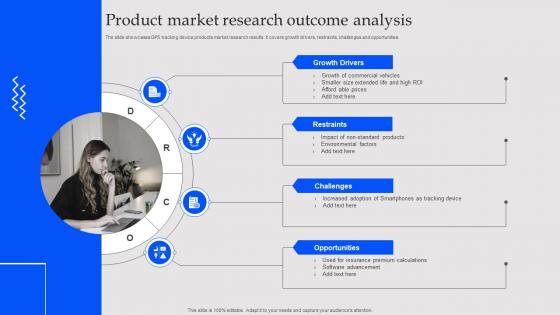
Product Market Research Outcome Analysis




Try Before you Buy Download Free Sample Product
 Impress Your
 Audience
 100%
100% Editable
 Save Hours
 of Time


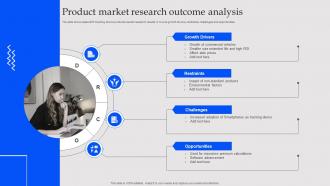
The slide showcases GPS tracking device products market research results. It covers growth drivers,restraints,challenges and opportunities.
People who downloaded this PowerPoint presentation also viewed the following :
Product Market Research Outcome Analysis with all 6 slides:
Use our Product Market Research Outcome Analysis to effectively help you save your valuable time. They are readymade to fit into any presentation structure.





FAQs for Product Market
Key components of a successful product market research strategy include target audience analysis, competitive landscape assessment, market sizing and segmentation, consumer behavior studies, and pricing analysis. These elements work together by identifying market opportunities, validating product concepts, and informing strategic decisions, with many organizations finding that comprehensive research ultimately delivers reduced launch risks and enhanced competitive positioning.
Qualitative research complements quantitative data by providing deeper context and emotional insights that explain the "why" behind consumer patterns, preferences, and decision-making processes. Through focus groups, interviews, and observational studies, businesses uncover underlying motivations, cultural influences, and unmet needs that numbers alone cannot reveal, ultimately enabling more strategic product positioning and targeted marketing approaches.
Effective target market segmentation methods include demographic analysis, psychographic profiling, behavioral segmentation, geographic targeting, and needs-based clustering. These approaches work by analyzing customer data, purchasing patterns, and lifestyle preferences, enabling businesses to create precise marketing strategies that resonate with specific audiences, ultimately delivering higher conversion rates and improved resource allocation across diverse market segments.
Competitor analysis is crucial in product market research, providing insights into market positioning, pricing strategies, feature gaps, and customer preferences that inform strategic decisions. Tools like SEMrush, Ahrefs, SimilarWeb, and Brandwatch facilitate this process by tracking competitor digital presence, social sentiment, and market share, ultimately enabling businesses to identify opportunities and enhance competitive advantage.
Customer feedback serves as a critical compass during market research, guiding product features, pricing strategies, user experience design, and competitive positioning decisions. Through surveys, focus groups, and beta testing programs, companies can identify unmet needs, validate assumptions, and refine offerings before launch, with many organizations finding that early customer input reduces development costs and accelerates market acceptance significantly.
AI and big data enhance product market research by analyzing vast consumer datasets, predicting market trends, and personalizing customer insights in real-time. These technologies streamline research processes through automated sentiment analysis, behavioral tracking, and predictive modeling, enabling companies across retail, automotive, and consumer goods sectors to accelerate product development cycles and deliver more targeted offerings.
Common pitfalls include relying on insufficient sample sizes, asking leading questions, ignoring competitor analysis, overlooking target demographic nuances, and focusing solely on positive feedback. These research missteps can derail product launches by creating false confidence, with many companies finding that comprehensive, unbiased research methodologies ultimately deliver more accurate market insights and competitive positioning.
Businesses can effectively analyze market trends and consumer preferences through longitudinal data collection, social media monitoring, customer surveys, competitor analysis, and predictive analytics tools. These methodologies enable organizations to track purchasing patterns, seasonal fluctuations, and emerging demands across sectors like retail and hospitality, ultimately delivering strategic insights that enhance product development and competitive positioning.
Ethical product market research considerations include obtaining informed consent, ensuring data privacy and security, maintaining participant anonymity, avoiding deceptive practices, and providing transparent data usage policies. These principles enhance research credibility by building consumer trust, reducing legal risks, and improving data quality, with many organizations finding that ethical practices ultimately deliver more reliable insights and stronger brand reputation.
Seasonal trends significantly influence product market research by creating cyclical demand patterns, shifting consumer preferences, and altering purchasing behaviors throughout the year. These fluctuations require researchers to analyze historical seasonal data, adjust forecasting models accordingly, and segment research by time periods, with many retail and consumer goods companies finding that seasonal adjustments improve forecast accuracy by 15-30%.
Businesses should track metrics including response rates, sample representativeness, data accuracy, time-to-insight, and cost-per-data-point to evaluate research effectiveness. These measurements enable organizations to assess research quality, optimize methodologies, and maximize ROI, with many companies finding that tracking conversion rates from insights to actionable strategies ultimately delivers competitive advantage and improved decision-making outcomes.
Businesses can utilize surveys and questionnaires by crafting targeted questions that explore customer preferences, pain points, purchasing behaviors, and satisfaction levels across different demographics. Through strategic survey design, companies in retail, healthcare, and financial services gather data on market trends, product feedback, and competitive positioning, ultimately enabling data-driven decisions that enhance customer experiences and drive revenue growth.
Cultural context significantly influences product market research through varying communication styles, consumer behaviors, purchasing patterns, social hierarchies, and interpretation of survey methodologies across different regions. These cultural factors reshape how respondents engage with research questions, what they prioritize in products, and how they express preferences, with many global companies finding that standardized research approaches often miss critical cultural nuances that ultimately determine market success.
Businesses leverage social media analytics by monitoring customer sentiment, tracking competitor performance, analyzing hashtag trends, identifying emerging topics, and measuring engagement patterns across platforms. Through advanced analytics tools, companies streamline market research, enhance product development strategies, and accelerate response times to consumer preferences, ultimately delivering competitive advantage and more targeted marketing approaches.
Innovative approaches include social listening analytics, micro-influencer partnerships, virtual focus groups, ethnographic digital studies, and AI-powered sentiment analysis. These methods enable businesses to reach specialized audiences through targeted online communities, real-time behavioral tracking, and predictive modeling, with many niche companies finding that combining traditional surveys with emerging technologies delivers deeper customer insights and competitive advantages.
-
Great product, helpful indeed!
-
Topic best represented with attractive design.