


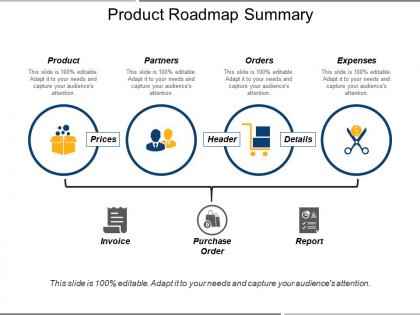
Product roadmap summary





Try Before you Buy Download Free Sample Product
 Impress Your
 Audience
 100%
100% Editable
 Save Hours
 of Time


Ensure each individual becomes aware with our Product Roadmap Summary. Convey your ideas clearly across the board.
People who downloaded this PowerPoint presentation also viewed the following :
Product roadmap summary with all 5 slides:
Our Product Roadmap Summary get you blistering along. Your ideas will go at full gallop.
FAQs for
A product roadmap presentation should include strategic objectives, target market analysis, feature prioritization frameworks, timeline milestones, and success metrics. These elements work together by aligning stakeholder expectations, demonstrating market responsiveness, and showcasing competitive positioning, with many organizations finding that clear visual timelines and measurable outcomes enhance investor confidence and cross-team collaboration.
Product roadmaps can be tailored by emphasizing technical specifications and sprint timelines for developers, highlighting feature benefits and launch dates for marketing teams, and focusing on strategic objectives and revenue impact for executives. This stakeholder-specific approach streamlines communication across organizations, with many companies finding that customized roadmaps enhance alignment, accelerate decision-making, and ultimately deliver better product outcomes and stronger cross-functional collaboration.
The best way to visualize product roadmap timelines involves using horizontal timeline bars, color-coded phases, milestone markers with clear icons, and progressive disclosure of detail levels. Strategic combinations of Gantt-style layouts, swimlane organization by feature categories, and interactive elements enable stakeholders to quickly grasp priorities, dependencies, and delivery schedules, ultimately delivering enhanced alignment and faster decision-making across development teams.
Balancing short-term objectives with long-term goals requires strategic prioritization through milestone mapping, stakeholder alignment, and iterative planning cycles that connect immediate deliverables to broader vision. Many organizations streamline this process by establishing quarterly checkpoints, maintaining flexible resource allocation, and ensuring each short-term sprint contributes to long-term competitive advantage while delivering measurable business value.
Common pitfalls include overcommitting to specific timelines, lacking stakeholder alignment, prioritizing features over outcomes, ignoring market feedback, and creating overly detailed long-term plans. These challenges often derail product development through unrealistic expectations, resource misallocation, and strategic drift, with many organizations finding that flexible, outcome-focused roadmaps deliver better market responsiveness and stakeholder satisfaction.
Product roadmaps should be revisited quarterly for major reviews, with minor updates occurring monthly or even bi-weekly as new customer feedback and market data emerge. This flexible approach enables organizations to maintain strategic direction while adapting to evolving user needs, competitive pressures, and technological shifts, with many successful companies finding that regular iteration ultimately delivers more relevant products and stronger market positioning.
**INPUT**: What tools and software are most effective for creating and maintaining a product roadmap? **OUTPUT**: Effective product roadmap tools include Aha!, ProductPlan, Roadmunk, Jira Product Discovery, and Monday.com, each offering visualization capabilities, stakeholder collaboration features, and integration options. These platforms streamline roadmap management by enabling real-time updates, cross-functional alignment, and strategic prioritization, with many organizations finding that centralized roadmap tools enhance communication clarity and accelerate product development cycles.
Ensuring product roadmap alignment requires establishing clear connections between product initiatives and strategic business objectives, regularly reviewing priorities with leadership stakeholders, and incorporating market feedback into development cycles. Through strategic planning sessions and cross-functional collaboration, organizations streamline resource allocation, enhance competitive positioning, and accelerate goal achievement, with many companies finding that quarterly alignment reviews ultimately deliver measurable business outcomes.
Customer feedback can be integrated through user surveys, focus groups, support ticket analysis, feature request tracking, and direct customer interviews during roadmap planning cycles. These insights help prioritize features based on actual user needs, validate assumptions, and identify pain points, with many product teams finding that regular feedback integration reduces development costs while accelerating market fit.
Prioritizing product roadmap features requires evaluating customer value, business impact, development effort, and strategic alignment through frameworks like RICE scoring, value vs complexity matrices, and stakeholder feedback analysis. Organizations typically balance quick wins with long-term initiatives, with many product teams finding that regular reassessment based on market feedback and revenue potential ultimately delivers higher ROI and sustainable competitive advantage.
Competitive analysis shapes product roadmaps by identifying market gaps, revealing feature opportunities, and informing strategic positioning decisions. Through systematic competitor evaluation, product teams can prioritize differentiating capabilities, anticipate industry trends, and allocate resources more effectively, with many organizations finding that regular competitive insights ultimately deliver stronger market positioning and accelerated innovation cycles.
Effective roadmap communication involves regular stakeholder meetings, visual roadmap updates, clear rationale documentation, and proactive change notifications through multiple channels. Financial services and healthcare organizations streamline this process by establishing structured communication cadences, maintaining transparent priority frameworks, and providing context-rich updates that help teams understand strategic shifts, ultimately ensuring alignment and minimizing disruption across departments.
Product roadmap success metrics include user adoption rates, feature utilization scores, customer satisfaction indices, revenue impact measurements, and time-to-market benchmarks. These KPIs enable organizations to assess strategic alignment, operational efficiency, and market responsiveness, with many companies finding that comprehensive tracking ultimately delivers enhanced product-market fit and sustainable competitive advantage.
Different industries significantly influence product roadmaps through varying regulatory requirements, customer expectations, development cycles, and market dynamics. In healthcare, roadmaps emphasize compliance milestones and lengthy approval processes, while fintech prioritizes security features and regulatory updates, and retail focuses on seasonal launches and customer experience enhancements, with each sector ultimately shaping timeline structures and feature prioritization.
Agile methodologies revolutionize product roadmap development by enabling iterative planning, continuous customer feedback integration, and adaptive prioritization based on market changes. Through shorter sprint cycles and regular stakeholder reviews, organizations streamline feature delivery, minimize development risks, and enhance product-market fit, with many tech companies and startups finding significantly faster time-to-market and improved customer satisfaction.
-
Understandable and informative presentation.
-
The content is very helpful from business point of view.