

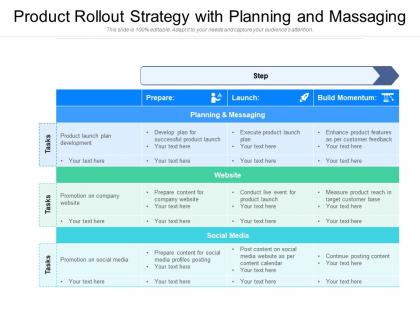
Product rollout strategy with planning and massaging




Try Before you Buy Download Free Sample Product
 Impress Your
 Audience
 100%
100% Editable
 Save Hours
 of Time


Our Product Rollout Strategy With Planning And Massaging are topically designed to provide an attractive backdrop to any subject. Use them to look like a presentation pro.
People who downloaded this PowerPoint presentation also viewed the following :
Product rollout strategy with planning and massaging with all 2 slides:
Use our Product Rollout Strategy With Planning And Massaging to effectively help you save your valuable time. They are readymade to fit into any presentation structure.
FAQs for Product rollout strategy with
Okay so there are four main phases you'll want to hit: pre-launch planning, soft launch, full launch, and post-launch tweaks. Pre-launch is where you build your strategy and create some hype - honestly this part always drags on forever. Your soft launch lets you test with real users before going big. Full launch is the major push with all your marketing stuff. Then post-launch you're analyzing what worked and fixing what didn't. Oh and definitely map out timelines early because these phases mess with each other way more than you'd think. Like if your soft launch uncovers issues, it'll push everything back.
Look, market research basically saves you from launching something nobody wants. I learned this the hard way watching a startup ignore user feedback about their confusing interface - total disaster. You'll get real insights on timing and pricing instead of just guessing. When people say "this is too complicated," listen to them! Build those feedback loops into development early so you're not panicking last-minute trying to fix everything. Honestly, treat it like your reality check rather than hunting for validation. Way too many founders just want to hear "great idea" when they should be asking "what sucks about this?"
Honestly, competitive analysis is like your cheat sheet for launch day. You've gotta know what your competitors are crushing and where they're totally missing the mark. I can't tell you how many teams I've watched crash because they thought they "knew" their competition without actually researching it properly. Look, it helps you nail your pricing and find those messaging gaps you can jump into. Also keeps you aware of any curveballs that might mess with your timeline. Track 3-5 direct competitors minimum and update that info monthly before launch. Trust me on this one.
Oh man, timing really can make or break everything - doesn't matter how brilliant your product is. I've watched incredible stuff completely bomb just because they launched during a recession or when everyone was distracted by some other shiny thing. Launch too early? You'll burn through cash trying to educate people who aren't ready. Wait too long and suddenly there's five competitors doing the exact same thing. The trick is catching that moment when people are starting to want what you've got but the market isn't crowded yet. Start tracking competitor moves and industry events like 6 months out, then pick your spot carefully.
Honestly, social media teasers are your best friend here - drop hints and show behind-the-scenes stuff. Makes people feel special, you know? Get an email list going with some early perks. I'd also hit up influencers in your niche and maybe do beta testing with a few customers who'll hype you up later. PR is huge if you've got a good story angle. Oh, and those countdown posts? They actually work on Instagram and LinkedIn. The whole point is hitting people from different directions so they keep seeing your stuff. Start this whole thing like 4-6 weeks out from launch.
Honestly, digital marketing is just so much better for control and feedback. You can target exactly who you want and see results within hours - not weeks like with traditional stuff. Traditional feels like throwing money at a wall sometimes. TV ads and print campaigns go out there and you're basically crossing your fingers that the right people see them. With digital though, you'll know immediately what's working. Test different versions at the same time too. Way cheaper overall, and if something's not hitting, just change it on the spot. My advice? Always start small with digital tests before dropping serious cash on traditional campaigns.
Track adoption stuff first - sign-ups, downloads, how engaged people are those first few weeks. Revenue's obvious but break it down by different customer types, see how you're hitting projections. Customer feedback and support tickets will humble you real quick if your product sucks. Market penetration matters too, like are you actually stealing customers from competitors? Oh and set this tracking up BEFORE you launch - learned that one the hard way. You need both the quick wins and the longer-term stuff to actually know what's working.
Dude, people remember stories way better than boring feature lists. Like, nobody wants to hear "our app has 15 new capabilities" - that's just specs. Start with some customer who's totally frustrated, walk through their whole mess, then boom - your product swoops in and fixes everything. Way more engaging than bullet points, honestly. Think movie vs instruction manual, you know? When you tell it like a story, people actually picture themselves using your stuff. Oh and try that three-act thing next time instead of the usual presentation format. Trust me, it works.
Honestly, the worst mistake is not testing if people actually want your thing before you go all-in. Teams get way too hyped about cool features and forget basic stuff - like, does your messaging even make sense to regular humans? Don't rush your timeline either. Oh, and "launch and pray" is such a trap - you need actual metrics, not just hope. Support is huge too, way more work than you'd think. Buffer time is your friend because something WILL break. Have your support people ready with answers day one or you're screwed.
Ugh, launch week chaos is the worst but totally normal! Quick assessment first - is this a "stop everything" problem or can you patch it while moving forward? Don't try to hide issues from your team or stakeholders, just tell them what's up. Honestly, I've never seen a launch go 100% smooth anyway, so you're in good company. Having backup plans saves your sanity here. Daily check-ins are clutch - catch the small stuff before it explodes into something massive. Stay flexible and you'll figure it out!
Your launch will tank without cross-departmental teamwork - I've watched it happen. Marketing, sales, product, engineering, customer success need to be on the same page about timing and messaging. Otherwise sales promises features that aren't built yet, or your marketing doesn't match what actually shipped (nightmare territory). Different teams spot issues others totally miss. Set up cross-functional standups 8 weeks out minimum. Oh, and make sure everyone can see each other's timelines and what they're waiting on. Trust me on this one.
Honestly, social media is perfect for this - people are already scrolling anyway, so meet them there. I'd start posting like 4-6 weeks before launch to build real momentum. Tease your features, throw in some behind-the-scenes stuff, maybe do countdown posts. The engagement can get pretty addictive when it's working lol. You'll get instant feedback too, which is clutch for tweaking your message. User content and influencer collabs will push you way past your own follower count. Oh and the whole before/during/after thing keeps the buzz alive longer than just a one-day announcement.
Start training your sales team 2-3 weeks before launch - give them hands-on demos so they actually know the product inside out. Honestly, there's nothing more painful than listening to a rep fumble through features they've never touched. Get them ready for the objections they'll hear and practice different customer scenarios through role-play. Cover your competitive positioning too since prospects will definitely ask how you stack up. Oh, and create a simple one-pager with key talking points - trust me, they'll reference it constantly during calls even if they think they won't need it.
Start teasing on SMS before you even launch - gets people hyped. Push notifications work amazing for the actual reveal. Location-based ads are seriously underrated, most people skip them but they shouldn't. Social campaigns during launch week need to be mobile-first since everyone's scrolling on their phones anyway. If it's an app launch, don't sleep on store optimization. Here's the thing though - everything has to feel natural on mobile, not like you just squeezed desktop stuff onto a tiny screen. Map this out alongside your main strategy so you're not scrambling later.
Honestly, three things you can't slack on after launch. First - talk to your early users constantly. Like, religiously check in with them because they'll spot problems you missed. Content is huge too (most teams totally abandon this once the launch hype dies down, which is dumb). Keep sharing real stories and use cases from actual customers. Partnership stuff is the third piece - always be hunting for new ways to get in front of people. The whole thing loses steam super fast if you're not feeding it. Oh, and map out your next 3 months of campaigns now while you're thinking about it.
-
Excellent template with unique design.
-
Easily Understandable slides.
-
Very well designed and informative templates.
-
Topic best represented with attractive design.
-
Unique and attractive product design.