

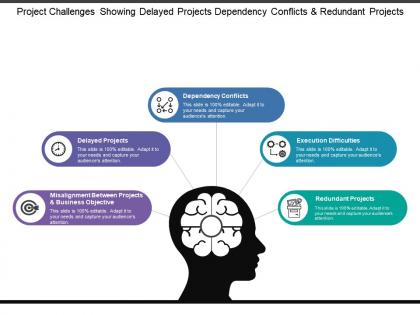
Project challenges showing delayed projects dependency conflicts and redundant projects




Try Before you Buy Download Free Sample Product
 Impress Your
 Audience
 100%
100% Editable
 Save Hours
 of Time


Our Project Challenges Showing Delayed Projects Dependency Conflicts And Redundant Projects employ expressions folks are familiar with. Be able to avoid jargon.
People who downloaded this PowerPoint presentation also viewed the following :
Project challenges showing delayed projects dependency conflicts and redundant projects with all 5 slides:
Our Project Challenges Showing Delayed Projects Dependency Conflicts And Redundant Projects enable customer focused functioning. They allow you to act according to their demands.




FAQs for Project challenges showing delayed projects dependency conflicts
Common obstacles include resource constraints, shifting priorities, stakeholder misalignment, budget overruns, and unrealistic deadlines in increasingly complex project environments. These challenges are amplified by remote team coordination and rapid market changes, with many organizations finding that streamlined communication tools and agile methodologies help deliver better outcomes while maintaining competitive advantage.
Effective communication strategies mitigate project management challenges by establishing clear expectations, creating regular feedback loops, and ensuring transparent progress reporting across all stakeholders. Through structured communication protocols, project teams streamline decision-making, minimize misunderstandings, and accelerate issue resolution, with many organizations finding that consistent communication ultimately delivers improved project outcomes and enhanced team collaboration.
Stakeholder engagement serves as a critical foundation for overcoming project management difficulties by ensuring clear communication, aligning expectations, securing necessary resources, and maintaining project support throughout execution. Through regular stakeholder involvement, project managers streamline decision-making processes, minimize scope creep, and enhance collaboration across departments, ultimately delivering successful outcomes while reducing delays and budget overruns.
Resource constraints impact project delivery by limiting available talent, budget, and time, often causing delays, scope reductions, and quality compromises. Effective management involves strategic resource allocation, cross-training team members, implementing agile methodologies, and leveraging project management tools, with many organizations finding that proactive planning and stakeholder communication ultimately deliver improved efficiency and successful outcomes.
Project managers can prevent scope creep by establishing clear project boundaries, implementing formal change control processes, maintaining detailed documentation, conducting regular stakeholder reviews, and securing written approval for any modifications. Through structured communication protocols and baseline documentation, organizations streamline decision-making, enhance project transparency, and minimize costly delays, with many finding that proactive scope management ultimately delivers projects on time and within budget while maintaining stakeholder satisfaction.
Project management tools include Asana, Trello, Microsoft Project, Slack, and Zoom, which streamline task tracking, communication, and resource allocation. These platforms enhance collaboration by centralizing project data, automating workflow notifications, and enabling real-time updates, with many organizations finding that integrated solutions ultimately deliver faster project completion and improved team coordination.
Team dynamics significantly influence project success by affecting communication flow, decision-making speed, conflict resolution, and overall collaboration effectiveness. Strong team cohesion enhances productivity through clear role definition, regular feedback sessions, and structured communication protocols, while poor dynamics create bottlenecks and delays, with many organizations finding that investing in team-building initiatives and collaborative tools ultimately delivers faster project completion and higher quality outcomes.
Proactive risk management best practices include early risk identification through stakeholder workshops, regular risk assessments using probability-impact matrices, comprehensive mitigation planning, continuous monitoring with key indicators, and maintaining updated risk registers. These approaches enable organizations to anticipate potential issues, streamline response strategies, and minimize project disruptions, with many teams finding that structured risk frameworks ultimately deliver better project outcomes and enhanced stakeholder confidence.
Cultural differences create challenges in international project management through varying communication styles, decision-making processes, work schedules, and hierarchical expectations. These variations can lead to misunderstandings, delayed approvals, and conflicting approaches to deadlines and authority, with many global organizations finding that proactive cultural training and flexible management frameworks ultimately enhance team cohesion and project success rates.
Remote work presents both challenges and opportunities for project team performance, with communication barriers, coordination difficulties, and reduced spontaneous collaboration often impacting project timelines and deliverables. However, many organizations find that strategic use of digital project management tools, structured virtual meetings, and clear accountability frameworks actually enhances productivity and outcomes, ultimately delivering greater flexibility and access to global talent pools.
Project managers balance quality and deadlines by implementing phased quality checkpoints throughout project timelines, prioritizing critical deliverables, and establishing clear scope boundaries from the outset. Through strategic resource allocation and regular stakeholder communication, teams can identify potential bottlenecks early, adjust workflows accordingly, and maintain standards while delivering on schedule, ultimately ensuring both client satisfaction and project success.
Effective conflict management strategies include establishing clear communication protocols, implementing structured mediation processes, defining roles and responsibilities upfront, fostering collaborative problem-solving sessions, and creating transparent escalation procedures. These approaches streamline team dynamics by addressing issues early, maintaining project momentum, and preserving working relationships, with many organizations finding that proactive conflict resolution ultimately delivers improved team performance and project success rates.
Leadership style significantly affects project management through communication approaches, decision-making speed, team motivation methods, and conflict resolution strategies. Transformational leaders often enhance project outcomes by inspiring innovation and adaptability, while directive styles streamline execution in time-sensitive projects, with many organizations finding that matching leadership approach to project complexity and team dynamics ultimately delivers improved stakeholder satisfaction and operational efficiency.
Continuous learning enables project managers to stay current with emerging methodologies, technologies, and best practices, while developing critical skills like stakeholder management, risk assessment, and adaptive leadership. Through professional certifications, industry workshops, and peer networks, project managers can anticipate challenges more effectively, implement proven solutions faster, and ultimately deliver projects with greater success rates and stakeholder satisfaction.
Methods to enhance accountability include establishing clear role definitions, implementing regular progress check-ins, creating transparent reporting systems, setting measurable milestones, and utilizing collaborative project management tools. These approaches streamline communication and tracking by defining ownership, facilitating real-time visibility, and enabling proactive issue resolution, with many organizations finding that structured accountability frameworks ultimately deliver improved project outcomes and stronger team performance.
-
Content of slide is easy to understand and edit.
-
Best Representation of topics, really appreciable.