


Project dependencies determine task duration and identify path




Try Before you Buy Download Free Sample Product
 Impress Your
 Audience
 100%
100% Editable
 Save Hours
 of Time


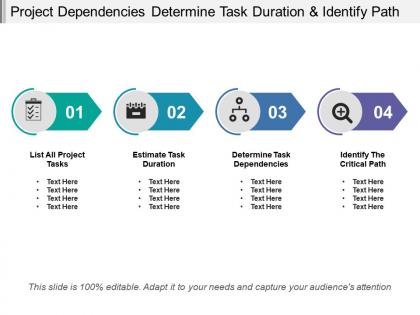
Establish dependencies between the task by employing this Project Dependencies Determine Task Duration And Identify Path slideshow. Discuss the ways by which you can identify tasks in a project. Showcase how project duration and critical path are determined. Take advantage of this project schedule planning PowerPoint theme to estimate the time to complete the task. Steps that you should take to manage task dependencies effectively can be depicted with the help of this PPT layout. Also, give your audience some examples of project task dependencies to make your presentation attention-grabbing. Track the path for your project and determine which tasks can affect your project's finish date by using the project dependencies PowerPoint template. You can also explain the stages of project management with this content-ready PPT theme. Hence build the accountability of your team by downloading this ready to use project PowerPoint presentation.
People who downloaded this PowerPoint presentation also viewed the following :
Project dependencies determine task duration and identify path with all 5 slides:
No challenge is too complex for our Project Dependencies Determine Task Duration And Identify Path. They will help you figure a way out.
-
Project dependencies determine task duration and identify path
-

Project dependencies determine task duration and identify path
-

Project dependencies determine task duration and identify path
-

Project dependencies determine task duration and identify path
-

Project dependencies determine task duration and identify path
FAQs for Project dependencies determine task duration
Key factors include stakeholder mapping, task sequencing analysis, resource allocation assessment, timeline evaluation, and risk dependency identification. These approaches streamline project planning by clarifying interdependencies, minimizing bottlenecks, and establishing realistic milestones, with many project managers finding that comprehensive dependency mapping ultimately delivers improved coordination and reduced delays across complex initiatives.
Improper dependency management creates cascading delays where blocked tasks accumulate waiting time, resource conflicts emerge from poor scheduling coordination, and critical path disruptions exponentially extend project timelines. These management failures frequently result in budget overruns, missed deliverables, and stakeholder dissatisfaction, with many organizations finding that dependency bottlenecks ultimately compromise competitive positioning and market opportunities.
Tools for visualizing project dependencies include Gantt charts, network diagrams, dependency matrices, critical path method (CPM), and PERT charts. These methodologies enhance project planning by mapping task relationships, identifying bottlenecks, and streamlining resource allocation, with many project managers finding that clear dependency visualization ultimately delivers faster project completion and improved team coordination.
Mandatory dependencies stem from technical requirements, legal constraints, or logical work sequences that cannot be altered, while discretionary dependencies reflect preferred approaches, resource optimization, or strategic choices that teams can modify. For example, software testing must follow development completion (mandatory), whereas conducting market research before design phase might be discretionary, ultimately enabling project managers to optimize scheduling and resource allocation.
Managing dependencies in remote project teams involves establishing clear communication protocols, implementing robust project management tools, creating detailed dependency mapping, and scheduling regular cross-team synchronization meetings. These strategies streamline coordination by enhancing visibility, automating status updates, and facilitating real-time collaboration, with many distributed organizations finding that proactive dependency tracking and transparent workflows ultimately deliver faster project delivery and improved team alignment.
Assessing dependency risks involves analyzing probability and impact through dependency mapping, critical path analysis, stakeholder assessment, and contingency planning. Organizations typically evaluate external vendor reliability, resource availability, and timeline constraints, while implementing risk matrices and regular monitoring protocols, ultimately enabling proactive mitigation strategies and improved project success rates.
Stakeholder involvement significantly influences dependency management through enhanced communication, resource coordination, and strategic prioritization across project teams and external partners. When stakeholders actively participate in dependency planning, organizations streamline risk identification, accelerate decision-making, and improve resource allocation, with many project teams finding that collaborative stakeholder engagement ultimately delivers faster project completion and reduced dependency-related delays.
Communication serves as the primary mechanism for identifying, tracking, and resolving dependency-related issues through regular stakeholder updates, cross-team coordination, and proactive risk escalation. Effective communication protocols enable project managers to streamline dependency management, minimize delays from resource conflicts, and enhance overall project delivery timelines, with many organizations finding that structured communication frameworks ultimately deliver greater operational efficiency and reduced project risks.
Dependencies evolve from high-level strategic relationships during planning to detailed technical and resource interdependencies during execution, then shifting to integration and handoff dependencies during closure. Throughout this lifecycle, many project managers find that dependencies become increasingly complex and require continuous monitoring, ultimately delivering better risk management and stakeholder coordination as teams adapt to changing requirements and emerging constraints.
Common pitfalls include underestimating dependency complexity, failing to identify all interdependencies upfront, poor communication between dependent teams, inadequate buffer time allocation, and lack of regular dependency monitoring. These oversights frequently lead to cascading delays, resource conflicts, and budget overruns, with many organizations finding that proactive dependency mapping and cross-functional collaboration significantly reduce project risks.
Agile methodologies accommodate changing dependencies through iterative sprint planning, continuous stakeholder communication, and flexible resource allocation that allows teams to adjust priorities dynamically. Through daily standups and sprint retrospectives, organizations identify dependency shifts early, enabling cross-functional collaboration and risk mitigation, with many project teams finding that this adaptive approach ultimately delivers faster time-to-market and enhanced project success rates.
Techniques for prioritizing interdependent tasks include critical path analysis, dependency mapping, resource leveling, risk-based prioritization, and value stream analysis. These methods enable project managers to identify bottlenecks, sequence activities strategically, and allocate resources efficiently, with many organizations finding that systematic dependency management reduces delays and enhances overall project delivery timelines.
Handling dependencies across multiple project teams requires establishing clear communication protocols, implementing dependency mapping frameworks, and creating cross-team coordination mechanisms. Through integrated project management platforms, organizations streamline resource allocation, synchronize timelines, and maintain visibility across interdependent workflows, while regular stakeholder alignment sessions ensure seamless collaboration, ultimately delivering faster project completion and enhanced operational efficiency.
External dependencies significantly impact project success through scheduling constraints, quality variations, cost fluctuations, and communication complexities that can create bottlenecks or delays. While they present challenges, organizations increasingly find that strategic vendor partnerships, clear SLAs, and proactive dependency management enable enhanced capabilities, specialized expertise, and competitive advantages that internal resources alone cannot deliver.
Historical data on previous projects informs current dependency management by revealing recurring bottlenecks, identifying resource constraints, and highlighting successful sequencing patterns from past implementations. Through analytics-driven insights, organizations can anticipate potential delays, optimize resource allocation, and establish more realistic timelines, with many project managers finding that data-backed dependency planning reduces project overruns by significantly improving predictive accuracy.
-
Excellent design and quick turnaround.
-
Unique design & color.