


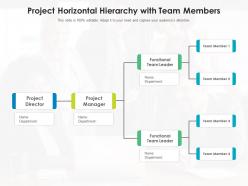
Project horizontal hierarchy with team members





Try Before you Buy Download Free Sample Product
 Impress Your
 Audience
 100%
100% Editable
 Save Hours
 of Time


Our Project Horizontal Hierarchy With Team Members are topically designed to provide an attractive backdrop to any subject. Use them to look like a presentation pro.
People who downloaded this PowerPoint presentation also viewed the following :
Project horizontal hierarchy with team members with all 2 slides:
Use our Project Horizontal Hierarchy With Team Members to effectively help you save your valuable time. They are readymade to fit into any presentation structure.
FAQs for Project horizontal hierarchy
Key roles in a well-functioning team structure include team leader, subject matter experts, project coordinator, quality assurance specialist, and communication facilitator. These roles streamline collaboration by establishing clear accountability, leveraging specialized expertise, and maintaining consistent workflows, with many organizations finding that defined role structures enhance productivity, reduce conflicts, and ultimately deliver faster project completion and improved team performance.
Team structure significantly impacts communication flow, decision-making speed, and collaborative effectiveness by determining reporting relationships, information pathways, and role clarity among members. Hierarchical structures often streamline decision-making but may slow innovation, while flat structures enhance cross-functional collaboration and faster problem-solving, with many organizations finding that hybrid approaches ultimately deliver both operational efficiency and creative agility.
Flat team structures minimize management layers and promote direct communication, while hierarchical structures feature clear authority chains and defined reporting relationships. Hierarchical models excel in large organizations requiring oversight and accountability, whereas flat structures enhance agility and innovation in smaller teams, with many companies finding that hybrid approaches ultimately deliver optimal balance between control and flexibility.
Organizations determine optimal team structure by analyzing project complexity, required skill sets, communication needs, decision-making speed requirements, and available resources. Through careful assessment of goals, timeline constraints, and team member strengths, companies can design structures that enhance collaboration, streamline workflows, and accelerate project delivery, with many finding that flexible, cross-functional approaches deliver superior results.
Cross-functional team structures deliver enhanced collaboration, faster decision-making, improved innovation, reduced silos, and comprehensive problem-solving by combining diverse expertise. While these teams can face communication challenges and role confusion initially, organizations across industries like technology and healthcare find that cross-functional approaches ultimately accelerate project delivery and strengthen competitive advantage through integrated solutions.
Remote work transforms team structure by emphasizing digital communication channels, outcome-based performance metrics, and flexible collaboration frameworks rather than traditional hierarchical oversight. Organizations increasingly adopt flatter structures with enhanced project management systems, asynchronous workflows, and cross-functional virtual teams, ultimately delivering greater operational flexibility and access to global talent while requiring stronger digital leadership capabilities.
Effective integration practices include structured onboarding programs, clear role definitions, mentorship assignments, gradual responsibility increases, and regular check-ins with team leaders. These approaches streamline adaptation by establishing expectations early, fostering relationships through paired guidance, and ensuring cultural alignment, with many organizations finding that systematic integration ultimately delivers higher retention rates and faster productivity gains.
Team structure can be adapted through flattened hierarchies, cross-functional collaboration, dedicated innovation time, psychological safety initiatives, and flexible reporting relationships. Organizations increasingly implement matrix structures and innovation labs, with companies like Google and 3M finding that autonomous teams and "20% time" policies enhance creative problem-solving, accelerate product development, and ultimately deliver sustainable competitive advantage.
Team effectiveness metrics include productivity rates, project completion times, employee engagement scores, communication frequency, and goal achievement percentages. These measurements enable organizations to evaluate collaboration efficiency, resource allocation, and performance outcomes across different departments, with many companies finding that regular assessment drives strategic improvements and competitive advantage.
Team size significantly impacts performance through communication complexity, coordination challenges, and resource allocation, with smaller teams often delivering faster decision-making and accountability while larger teams provide diverse expertise and capabilities. Organizations typically find that teams of 5-7 members optimize productivity by balancing collaborative efficiency with skill diversity, ultimately enabling streamlined workflows and enhanced project outcomes.
Leadership serves as the architect of team structure by defining roles, establishing communication channels, setting performance standards, and ensuring resource allocation aligns with organizational goals. Effective leaders continuously adapt structure based on project demands and team dynamics, with many organizations finding that strong leadership presence enhances collaboration, minimizes role confusion, and ultimately delivers improved productivity and employee engagement across departments.
A clear team structure contributes to conflict resolution by establishing defined roles, reporting hierarchies, decision-making authority, and communication protocols that prevent misunderstandings. Through transparent organizational frameworks, teams can address disputes more efficiently using established escalation paths and accountability measures, while designated leaders facilitate mediation, ultimately reducing workplace tensions and enhancing collaborative productivity.
Challenges include communication barriers across cultural differences, varying work styles and expectations, potential for misunderstandings, differing approaches to hierarchy and decision-making, and coordinating across time zones. While these complexities require strategic management, organizations increasingly find that diverse teams deliver enhanced innovation, broader market insights, and competitive advantages through comprehensive inclusion strategies.
Team structures evolve through flexible role definitions, cross-functional integration, and adaptive reporting relationships that respond to changing project scopes and organizational priorities. Many organizations increasingly adopt matrix structures, agile pods, and hybrid models that enable rapid resource reallocation, enhanced collaboration across departments, and scalable team configurations, ultimately delivering greater operational efficiency and competitive responsiveness.
**INPUT**: What tools and technologies can support effective team structure and management? **OUTPUT**: Team structure and management technologies include project management platforms, communication tools, performance analytics software, workflow automation systems, and organizational charting applications. These solutions streamline coordination, enhance transparency, and optimize resource allocation across departments, with many organizations finding that integrated platforms deliver improved collaboration, faster decision-making, and ultimately stronger operational efficiency in increasingly complex business environments. **Word count: 56 words**
-
Understandable and informative presentation.