


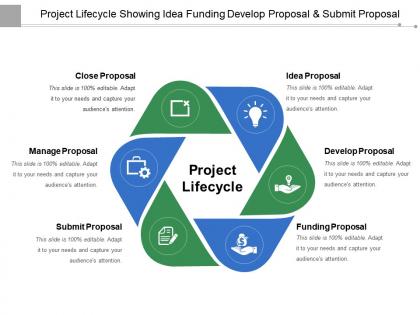
Project lifecycle showing idea funding develop proposal and submit proposal




Try Before you Buy Download Free Sample Product
 Impress Your
 Audience
 100%
100% Editable
 Save Hours
 of Time


Even under pressure your presentation needs to perform at peak performance. Get your project looking its best in moments in seconds with our Project Lifecycle Showing Idea Funding Develop Proposal And Submit Proposal.
People who downloaded this PowerPoint presentation also viewed the following :
Project lifecycle showing idea funding develop proposal and submit proposal with all 5 slides:
The going is always fresh and bubbly with our Project Lifecycle Showing Idea Funding Develop Proposal And Submit Proposal. They help you get away from ennui.



FAQs for Project lifecycle showing idea funding develop proposal
A typical project lifecycle includes initiation, planning, execution, monitoring and controlling, and closure phases. These phases streamline project delivery by establishing clear objectives, defining scope and resources, implementing planned activities, tracking progress against milestones, and capturing lessons learned, with many organizations finding that structured lifecycle management ultimately delivers improved outcomes and competitive advantage.
Project initiation focuses on defining the project's purpose, objectives, stakeholders, and feasibility, establishing whether the project should proceed and securing initial authorization. Project planning then develops detailed roadmaps, timelines, resource allocation, and risk management strategies, with many organizations finding that thorough initiation streamlines planning phases and ultimately delivers better project outcomes.
Stakeholder analysis identifies key individuals, groups, and organizations impacted by or influencing project outcomes, assessing their interests, power levels, communication preferences, and potential resistance points. This strategic process enables project managers to develop targeted engagement strategies, mitigate risks through proactive relationship management, and secure necessary support throughout project phases, ultimately delivering smoother implementations and higher success rates.
Risk management strategies integrate throughout the project lifecycle through continuous identification, assessment, and mitigation planning at each phase, from initiation to closure. Organizations implement risk registers, regular monitoring protocols, and adaptive response strategies, with many project teams finding that proactive integration reduces costs by 15-20% while enhancing delivery success rates.
Project execution phase tools include project management software like Microsoft Project or Asana, collaboration platforms such as Slack or Teams, resource management systems, quality assurance tools, and performance dashboards. These technologies streamline workflow coordination, enhance team communication, and enable real-time progress tracking, with many organizations finding that integrated toolsets significantly improve delivery timelines and operational efficiency.
Monitoring and controlling processes contribute to project success by tracking performance against baselines, identifying deviations early, and implementing corrective actions to keep projects on track. These processes enable project managers to maintain budget adherence, meet deadlines, and ensure quality standards, while providing stakeholders with transparency and confidence, ultimately delivering successful outcomes within scope and timeline constraints.
The project lifecycle adapts to agile methodologies through iterative sprints, continuous stakeholder feedback, flexible scope management, regular retrospectives, and incremental delivery cycles. These approaches streamline traditional linear phases into dynamic workflows, with many software development teams, financial institutions, and healthcare organizations finding that agile adaptation delivers faster time-to-market, enhanced customer satisfaction, and improved project outcomes.
Effective project closure practices include conducting comprehensive post-project reviews, documenting lessons learned, transferring deliverables to operational teams, releasing resources systematically, and obtaining formal stakeholder sign-offs. These structured approaches streamline future project initiation, enhance organizational knowledge retention, and minimize resource conflicts, with many organizations finding that systematic closure processes reduce subsequent project startup time by 20-30%.
Communication evolves from broad stakeholder alignment and requirement gathering in initiation, to detailed technical coordination during planning and execution phases. During project closure, communication shifts toward documentation, lessons learned, and stakeholder reporting, with many organizations finding that structured communication protocols throughout these stages significantly enhance project success rates and stakeholder satisfaction.
Key project metrics include schedule adherence, budget variance, scope completion, quality indicators, and stakeholder satisfaction scores across all phases. These metrics enable project managers to track progress, identify bottlenecks, and make data-driven adjustments, with many organizations finding that consistent measurement throughout each phase ultimately delivers better outcomes and competitive advantage.
Project managers ensure alignment with organizational goals by establishing clear success metrics, conducting regular stakeholder reviews, implementing milestone checkpoints, and maintaining transparent communication channels throughout each phase. Through strategic planning sessions and quarterly assessments, organizations streamline decision-making processes, minimize resource misallocation, and accelerate project delivery, with many finding that consistent goal alignment ultimately delivers enhanced operational efficiency and competitive advantage.
Teams typically face communication gaps, resource reallocation issues, deliverable handoff complexities, stakeholder alignment challenges, and timeline coordination problems during phase transitions. These bottlenecks often create delays and confusion, with many organizations finding that implementing structured transition protocols, clear documentation standards, and cross-functional checkpoints streamlines handoffs while maintaining project momentum and quality.
Stakeholder engagement is crucial throughout the project lifecycle, directly impacting project success rates, resource allocation, and strategic alignment through consistent communication, feedback loops, and collaborative decision-making. Effective techniques include regular stakeholder mapping, structured communication plans, interactive workshops, and digital collaboration platforms, with many organizations finding that proactive engagement reduces project risks by 40% while enhancing buy-in and delivering superior outcomes.
Project scope changes significantly impact timelines, budgets, resource allocation, and deliverable quality throughout the project lifecycle. These modifications often trigger cascading effects across planning, execution, and closure phases, with many organizations finding that uncontrolled scope creep can increase costs by 20-50% while potentially compromising project success and stakeholder satisfaction.
Project lifecycles vary significantly between industries, with construction following sequential phases like planning, design, procurement, and execution, while software development uses iterative approaches with continuous testing and deployment cycles. Construction projects emphasize strict regulatory compliance and resource coordination, whereas software projects prioritize flexibility and rapid adaptation, with many organizations finding that hybrid methodologies ultimately deliver better outcomes across both sectors.
-
Topic best represented with attractive design.
-
Innovative and Colorful designs.