

Project Management Process Flow Phases




Try Before you Buy Download Free Sample Product
 Impress Your
 Audience
 100%
100% Editable
 Save Hours
 of Time


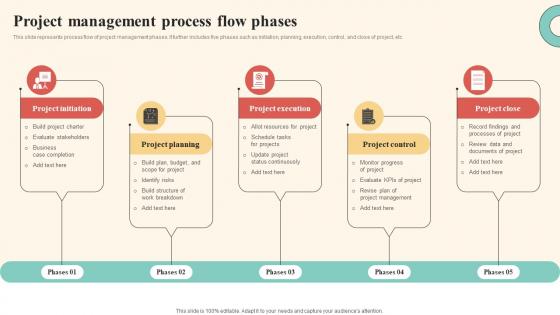
This slide represents process flow of project management phases. It further includes five phases such as initiation, planning, execution, control, and close of project, etc
People who downloaded this PowerPoint presentation also viewed the following :
Project Management Process Flow Phases with all 9 slides:
Use our Project Management Process Flow Phases to effectively help you save your valuable time. They are readymade to fit into any presentation structure.








FAQs for Project Management
The five primary phases include initiation, planning, execution, monitoring and controlling, and closure, each building upon the previous phase while maintaining continuous oversight. These phases interconnect through iterative feedback loops, with monitoring and controlling occurring throughout all stages, enabling project managers to adjust scope, timelines, and resources while ensuring deliverables meet stakeholder expectations and strategic objectives.
Project managers can effectively initiate projects by conducting comprehensive stakeholder analysis, establishing clear project charters with defined objectives and success criteria, and facilitating alignment workshops to ensure shared understanding. Through early engagement strategies and transparent communication frameworks, organizations streamline decision-making processes, minimize scope creep, and build stakeholder buy-in, ultimately delivering projects with stronger foundation support and reduced execution risks.
Essential project planning tools include Gantt charts, work breakdown structures, resource allocation matrices, risk assessment frameworks, and stakeholder analysis templates. These methodologies streamline project execution by establishing clear timelines, defining deliverables, and identifying potential bottlenecks, with many organizations finding that comprehensive upfront planning reduces costs and accelerates delivery timelines significantly.
Risk management practices can be integrated into project execution through continuous risk monitoring, real-time issue tracking, proactive mitigation strategies, stakeholder communication protocols, and regular assessment updates. These approaches enable project teams to identify emerging threats quickly, adjust resource allocation dynamically, and maintain project momentum, with many organizations finding that embedded risk practices ultimately deliver improved timelines and reduced costs.
Project management methodologies significantly reshape how phases are structured and executed, with Waterfall following sequential, linear phases while Agile breaks projects into iterative sprints with overlapping activities. These approaches influence timeline flexibility, stakeholder involvement, and deliverable frequency, with many organizations finding that Agile methodologies enable faster adaptation to changing requirements, enhanced collaboration, and ultimately deliver improved project outcomes in dynamic business environments.
Communication serves as the central nervous system during monitoring and controlling, enabling real-time status updates, stakeholder alignment, issue escalation, and decision-making coordination. Through structured reporting mechanisms and collaborative platforms, project managers ensure transparency across teams, facilitate rapid problem resolution, and maintain stakeholder confidence, while many organizations finding that consistent communication protocols significantly reduce project risks and enhance overall delivery success.
Project managers ensure successful team collaboration during execution by establishing clear communication protocols, defining roles and responsibilities, implementing regular check-ins, and utilizing collaborative project management tools. Through consistent stakeholder updates and transparent progress tracking, teams in sectors like construction, software development, and consulting maintain alignment while addressing issues promptly, ultimately delivering projects on time and within scope.
Methods for evaluating project performance during closing include stakeholder feedback surveys, budget variance analysis, schedule adherence assessment, quality metrics review, and lessons learned documentation. These evaluation techniques enable project managers to measure success against original objectives, identify areas for improvement, and capture valuable insights for future projects, ultimately enhancing organizational project management capabilities and competitive advantage.
Effective documentation streamlines project management by establishing clear requirements, tracking progress against milestones, and maintaining comprehensive knowledge transfer protocols. Through centralized documentation systems, project managers enhance team coordination, minimize miscommunication risks, and accelerate decision-making processes, while ensuring stakeholders maintain visibility into deliverables, ultimately delivering improved project outcomes and organizational learning.
**INPUT**: What strategies can be implemented to handle scope creep during the project lifecycle? **OUTPUT**: Effective scope creep management strategies include establishing clear project boundaries, implementing formal change control processes, maintaining regular stakeholder communication, documenting all requirements upfront, and conducting frequent scope reviews. These approaches streamline project delivery by preventing unauthorized changes, enhancing timeline adherence, and minimizing budget overruns, with many organizations finding that proactive scope management ultimately delivers better project outcomes and stronger client relationships. [Word count: 60 words]
Lessons learned from previous projects inform new project initiation by identifying potential risks, refining scope definitions, improving stakeholder engagement strategies, and establishing realistic timelines and resource requirements. Organizations leverage these insights to enhance project selection criteria, streamline approval processes, and develop more accurate feasibility assessments, ultimately delivering higher success rates and competitive advantage.
Common challenges during the planning-to-execution transition include scope creep, resource allocation mismatches, communication breakdowns, stakeholder misalignment, and inadequate risk mitigation strategies. These obstacles can significantly impact project timelines and budgets, with many organizations finding that implementing structured change management processes, enhanced stakeholder engagement protocols, and real-time monitoring systems ultimately delivers smoother transitions and improved project success rates.
Stakeholder engagement is critical throughout all project phases, as it ensures alignment, manages expectations, reduces resistance, and maintains project support from initiation to closure. Effective stakeholder communication during planning, execution, and monitoring phases enables smoother decision-making, faster issue resolution, and higher project success rates, with many organizations finding that consistent engagement ultimately delivers better outcomes and stakeholder satisfaction.
Project phases can be adapted for remote and hybrid teams through enhanced digital collaboration tools, restructured communication protocols, flexible milestone tracking, and asynchronous work accommodations. These adaptations enable distributed teams to maintain project momentum through virtual standup meetings, cloud-based documentation, and time-zone-conscious scheduling, ultimately delivering seamless coordination and improved productivity across geographical boundaries.
Key metrics include schedule variance, cost performance index, quality indicators, resource utilization rates, and risk assessment scores. These measurements enable project managers to track budget adherence, timeline compliance, and deliverable quality, with many organizations finding that consistent monitoring of these indicators delivers early problem identification, improved resource allocation, and ultimately enhanced project success rates.
-
Excellent design and quick turnaround.
-
Visually stunning presentation, love the content.