


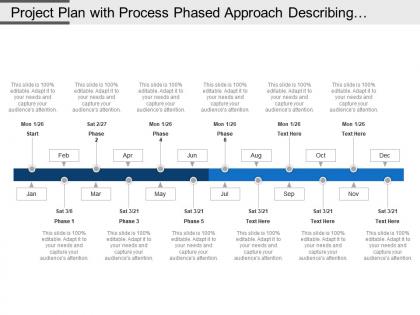
Project plan with process phased approach describing the duration of project timeline




Try Before you Buy Download Free Sample Product
 Impress Your
 Audience
 100%
100% Editable
 Save Hours
 of Time


Everyone will approach you for advice due to our Project Plan With Process Phased Approach Describing The Duration Of Project Timeline. You will emerge as a counseling hub.
People who downloaded this PowerPoint presentation also viewed the following :
Project plan with process phased approach describing the duration of project timeline with all 5 slides:
Brilliant backdrops are the essence of our Project Plan With Process Phased Approach Describing The Duration Of Project Timeline. Guaranteed to illuminate the minds of your audience.



FAQs for Project plan with process phased approach describing the duration
Key components of a project timeline include project milestones, task dependencies, resource allocation, deliverable deadlines, and critical path identification. These elements work together by establishing clear sequencing, enabling efficient resource management, and providing stakeholder visibility, with many organizations finding that well-structured timelines ultimately reduce project delays and enhance team coordination across departments.
**INPUT**: How do you determine the appropriate phases for your project timeline? **OUTPUT**: Determining project timeline phases involves analyzing project scope, deliverables, resource requirements, dependencies, and stakeholder milestones to create logical work segments. These phases streamline project management by establishing clear checkpoints, enabling better resource allocation, and facilitating progress tracking, with many organizations finding that well-defined phases ultimately enhance team coordination and project success rates. [Word count: 54]
**INPUT**: What tools are available for creating project timelines effectively? **OUTPUT**: Project timeline tools include Microsoft Project, Gantt charts, Asana, Trello, Monday.com, and Smartsheet, each offering unique scheduling and collaboration capabilities. These platforms streamline project management by enabling real-time updates, resource allocation, and milestone tracking, with many organizations finding that strategic tool selection ultimately delivers improved team coordination and faster project completion rates.
Ensuring project timeline alignment requires comprehensive stakeholder mapping, regular communication cadences, realistic milestone setting, and collaborative expectation management from project initiation. Through structured review meetings, transparent progress reporting, and proactive risk communication, project managers deliver enhanced stakeholder satisfaction, reduced scope creep, and improved project success rates, with many organizations finding that early alignment prevents costly timeline revisions.
Duration estimation requires analyzing task complexity, resource availability, team expertise, stakeholder dependencies, and potential risk factors throughout each phase. Organizations should evaluate historical project data, account for approval cycles, consider seasonal constraints, and build in buffer time, with many finding that collaborative estimation workshops ultimately deliver more accurate timelines and better stakeholder alignment.
Incorporating flexibility requires building buffer time into critical milestones, establishing contingency plans for high-risk activities, and implementing regular checkpoint reviews throughout the project lifecycle. Many organizations find that allocating 10-15% additional time for complex phases, maintaining flexible resource pools, and using agile methodologies enables rapid response to delays while preserving overall project delivery dates.
Stakeholder feedback serves as a critical input for refining project scope, identifying potential risks, and validating phase deliverables throughout the timeline. This collaborative approach enables project managers to adjust timelines proactively, incorporate essential requirements early, and secure stakeholder buy-in, ultimately delivering projects that meet expectations while minimizing costly revisions.
Visual project timeline representation includes Gantt charts, milestone roadmaps, Kanban boards, timeline infographics, and interactive dashboards. These tools enhance project clarity by displaying task dependencies, resource allocation, and progress tracking simultaneously, with many organizations finding that visual timelines reduce miscommunication, accelerate decision-making, and ultimately deliver improved stakeholder alignment and project success rates.
Common pitfalls include underestimating task durations, overlooking dependencies between phases, inadequate resource allocation, failing to build in buffer time, and insufficient stakeholder communication. These issues frequently derail projects across industries, with many organizations finding that realistic timeline planning, regular milestone reviews, and proactive risk assessment ultimately deliver smoother project execution and better outcomes.
Effective timeline communication involves immediate transparent notification through multiple channels, detailed explanation of change impacts on deliverables and dependencies, revised milestone documentation, and collaborative discussion of adjusted responsibilities. Through structured team meetings, updated project dashboards, and clear stakeholder messaging, organizations streamline change management, maintain team alignment, and minimize project disruption, ultimately delivering better outcomes.
Progress metrics include milestone completion rates, budget variance, resource utilization, quality indicators, and schedule adherence percentages. These measurements enable project managers to identify bottlenecks, optimize resource allocation, and maintain stakeholder alignment, with many organizations finding that consistent tracking across phases delivers improved project outcomes and enhanced strategic decision-making capabilities.
Project scope significantly affects timeline phases by determining resource requirements, task complexity, and deliverable specifications across each phase. A broader scope extends planning, execution, and testing phases, while requiring additional stakeholder coordination and quality assurance checkpoints, with many organizations finding that well-defined scope parameters ultimately streamline phase transitions and enhance project predictability.
Project milestones serve as critical checkpoints within timeline phases, marking completion of major deliverables, phase transitions, and key decision points that validate progress before advancing. These strategic markers enable project managers to assess phase completion, identify potential delays, and maintain stakeholder alignment, with many organizations finding that well-defined milestones significantly enhance project visibility and success rates.
Task prioritization within project phases involves evaluating critical path dependencies, resource availability, stakeholder impact levels, and deliverable urgency to sequence work optimally. Project managers typically use frameworks like MoSCoW method or impact-effort matrices, with many organizations finding that early identification of bottlenecks and cross-functional dependencies ultimately streamlines execution and enhances project delivery timelines.
Effective strategies include regular milestone reviews, proactive risk management, clear communication protocols, resource buffer allocation, and stakeholder alignment checkpoints. These approaches streamline project execution by identifying bottlenecks early, maintaining team coordination, and ensuring adequate resource availability, with many organizations finding that consistent monitoring and adaptive planning ultimately deliver projects on schedule while minimizing costly delays.
-
Perfect template with attractive color combination.
-
Informative design.