


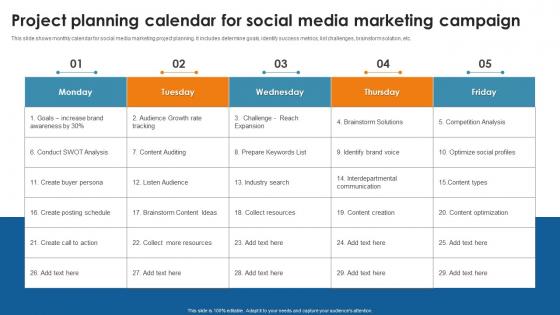
Project Planning Calendar For Social Media Marketing Campaign




Try Before you Buy Download Free Sample Product
 Impress Your
 Audience
 100%
100% Editable
 Save Hours
 of Time


This slide shows monthly calendar for social media marketing project planning. It includes determine goals, identify success metrics, list challenges, brainstorm solution, etc.
People who downloaded this PowerPoint presentation also viewed the following :
Project Planning Calendar For Social Media Marketing Campaign with all 6 slides:
Use our Project Planning Calendar For Social Media Marketing Campaign to effectively help you save your valuable time. They are readymade to fit into any presentation structure.





FAQs for Project Planning Calendar For Social
Key components include project milestones, task deadlines, resource allocation schedules, team member assignments, and critical path dependencies. These elements work together by ensuring timeline visibility, preventing resource conflicts, and maintaining accountability across phases, with many project managers finding that comprehensive calendars reduce delays by 30% while enhancing team coordination and stakeholder communication.
Deadlines significantly enhance project planning calendar effectiveness by creating structured timelines, establishing accountability measures, and enabling efficient resource allocation across project phases. They provide clear milestones that help teams prioritize tasks, identify potential bottlenecks early, and maintain momentum, with many organizations finding that well-defined deadlines ultimately deliver improved coordination and successful project completion rates.
**INPUT**: What tools or software can enhance the creation of a project planning calendar? **OUTPUT**: Project planning calendar tools include Microsoft Project, Asana, Trello, Monday.com, and Smartsheet, each offering scheduling, resource allocation, and progress tracking capabilities. These platforms streamline project timelines by automating task dependencies, enabling real-time collaboration, and providing visual dashboards, with many organizations finding that integrated calendar systems ultimately deliver enhanced productivity and improved project delivery rates. **Word count: 58 words**
A project planning calendar accommodates unexpected changes through built-in buffer time, flexible milestone scheduling, resource reallocation protocols, and regular review cycles. These frameworks enable project managers to adjust timelines, redistribute tasks, and maintain critical path visibility, with many organizations finding that proactive contingency planning ultimately delivers improved project outcomes and stakeholder confidence.
Visualizing project timelines in calendar format delivers enhanced clarity, improved resource allocation, better deadline management, streamlined team coordination, and reduced scheduling conflicts. This approach enables project managers to identify overlapping tasks, anticipate bottlenecks, and optimize workflows more effectively, with many organizations finding that calendar-based planning significantly improves project completion rates and stakeholder communication.
A centralized project planning calendar improves team collaboration by providing unified visibility into deadlines, dependencies, and resource allocation, enabling real-time updates and eliminating scheduling conflicts. Through shared platforms, teams streamline communication, coordinate cross-functional initiatives more effectively, and maintain accountability across projects, with many organizations finding that centralized scheduling reduces project delays by up to 30%.
Task prioritization techniques include the Eisenhower Matrix, MoSCoW method, weighted scoring models, critical path analysis, and resource-based ranking. These approaches streamline project workflows by categorizing tasks by urgency and importance, identifying dependencies, and aligning activities with business objectives, ultimately enabling teams to deliver projects faster while maximizing resource efficiency and strategic outcomes.
Project planning calendars should be updated weekly for routine progress tracking, with additional updates triggered by significant milestones, scope changes, or resource shifts. This strategic combination of regular and event-driven updates enables project managers to maintain accurate timelines, anticipate bottlenecks, and communicate effectively with stakeholders, ultimately delivering better project outcomes and enhanced team coordination.
A project planning calendar supports long-term goals by establishing clear milestones, tracking progress against strategic objectives, identifying potential bottlenecks, and ensuring resource allocation aligns with project phases. Through visual timeline management, organizations can maintain momentum across extended project lifecycles, anticipate dependencies, and adapt strategies proactively, ultimately delivering complex initiatives on schedule while maintaining stakeholder alignment throughout development.
Color coding in project planning calendars enhances clarity by assigning distinct colors to different project phases, team responsibilities, priority levels, task categories, and milestone types. This visual system streamlines project tracking, enables quick status identification, and facilitates resource allocation across departments, with many organizations finding that color-coded calendars significantly reduce scheduling conflicts and improve team coordination.
Stakeholder input provides critical insights into resource availability, timeline constraints, dependencies, and business priorities that directly shape realistic project schedules. Through collaborative planning sessions, stakeholders help identify potential conflicts, seasonal considerations, and operational requirements, while ensuring the calendar aligns with organizational goals, ultimately delivering better project outcomes and stronger buy-in across teams.
A project planning calendar enhances resource allocation by visualizing task timelines, identifying resource conflicts, and enabling strategic workforce distribution across multiple projects simultaneously. Through timeline mapping and capacity planning, organizations streamline scheduling processes, minimize resource bottlenecks, and optimize team utilization, ultimately delivering improved project efficiency and reduced operational costs.
Creating project planning calendars for remote teams presents challenges including time zone coordination, communication gaps, varying work schedules, technology platform integration, and limited visibility into team member availability. While these obstacles can complicate scheduling and milestone tracking, many organizations find that implementing centralized digital tools, establishing clear communication protocols, and building buffer time into project timelines ultimately enhances coordination and delivers more realistic project outcomes.
Lessons learned from past projects significantly enhance future calendar planning by identifying realistic timeframes, potential bottlenecks, and resource allocation patterns that proved effective or problematic. Through systematic analysis of previous project timelines, organizations can better predict task durations, buffer periods, and critical dependencies, while avoiding recurring scheduling pitfalls, ultimately delivering more accurate project estimates and improved on-time completion rates.
A well-structured project planning calendar significantly enhances team morale and productivity by establishing clear timelines, reducing uncertainty, and enabling better workload distribution across team members. This transparency streamlines collaboration, minimizes last-minute rushes, and delivers improved work-life balance, with many organizations finding that structured scheduling ultimately increases project success rates and employee satisfaction.
-
I didn’t expect such a good service for the money I am paying. But, they exceed my expectations. Great work SlideTeam.
-
Topic best represented with attractive design.