

Project Portfolio Activities Management Dashboard Stakeholders Involved In Project Coordination




Try Before you Buy Download Free Sample Product
 Impress Your
 Audience
 100%
100% Editable
 Save Hours
 of Time


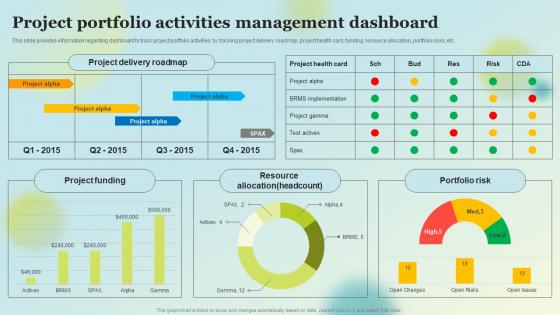
This slide provides information regarding dashboard to track project portfolio activities by tracking project delivery roadmap, project health card, funding, resource allocation, portfolio risks, etc.
People who downloaded this PowerPoint presentation also viewed the following :
Project Portfolio Activities Management Dashboard Stakeholders Involved In Project Coordination with all 7 slides:
Use our Project Portfolio Activities Management Dashboard Stakeholders Involved In Project Coordination to effectively help you save your valuable time. They are readymade to fit into any presentation structure.





FAQs for Project Portfolio Activities Management Dashboard Stakeholders Involved
Honestly, start with getting your governance structure sorted - like a steering committee that can actually make decisions. You'll need clear criteria for which projects get funding and visibility into what capacity your teams have. Portfolio governance, strategic alignment, resource management, performance tracking - those are your main pillars. Risk management at the portfolio level is where I see companies screw up constantly, they just don't think big picture enough. Oh, and you need standardized intake processes plus regular reviews to keep things moving. Build the governance piece first though, everything else falls into place after that.
Honestly, just throw everything into a simple spreadsheet first - score each project on impact, resources needed, and timeline. Map them against your main goals and be brutal about cutting the pet projects that won't actually move things forward (this part's always harder than it sounds). Factor in ROI, risk, and what resources you actually have available. Dependencies between projects matter too, so don't ignore those. I'd say pick your top 3-5 and nail those before spreading yourself too thin. Review quarterly since priorities shift constantly anyway.
Portfolio risk management is like your safety net for everything you're juggling. You'll spot threats across all projects and figure out which gambles are worth it. Instead of just looking at individual risks, you see how problems cascade through your whole setup. Map out your biggest cross-project dependencies first - honestly, that's where the worst surprises always lurk. It's like diversifying investments, but with actual deadlines breathing down your neck. The real trick? Identifying which projects could tank everything else if they go sideways.
Honestly, portfolio management software is a total game-changer. You get this bird's-eye view of everything happening at once, which makes spotting problems way easier. Like, you can see which projects are just burning cash without results, or where you've got resource conflicts brewing. The dashboards are pretty solid for comparing ROI across different projects too. I'd start by dumping all your current project data into one place - you'll probably notice patterns you completely missed before. Way better than going with your gut on these decisions, trust me.
Track both money stuff and strategic metrics - ROI, NPV, budget variance for financials. Strategic alignment scores show if projects actually match your business goals. Time-to-market matters too because nobody wants projects dragging on forever. Resource utilization and stakeholder satisfaction are big ones - trust me, unhappy sponsors will make their feelings known later. Honestly, pick maybe 4-6 metrics that actually matter to your company and stick with them. You don't want to drown in data you'll never use for real decisions anyway.
Honestly, you've gotta be ruthless about this - set up clear percentages for your project mix. I usually tell people to aim for like 60% quick wins and 40% long-term bets, but that totally depends on your situation. The trick is actually writing it down instead of just winging it. Check in every quarter and kill anything that's not performing in either bucket. Oh, and make sure you've got solid metrics for both sides so you're not just guessing if it's working. Trust me, without clear scoring you'll just end up with a mess of half-finished projects.
Honestly, most companies try to do way too much at once - they roll out these massive PPM systems that sit there collecting dust. Executive buy-in is huge too. Without it, people just pretend the new process doesn't exist. Oh, and don't get obsessed with fancy tools before you actually know your strategy. That's backwards thinking right there. Inconsistent data will kill you every time. Start with a small pilot instead. Get your leadership actually invested from day one, nail down your data quality, then think about scaling. Way less painful that way.
Okay so here's the thing - stakeholder engagement literally makes or breaks everything. These are the people who control your budget and approvals, so you want them on your side. When you involve them in decisions, projects get prioritized better and you avoid those awful surprise roadblocks. Engaged stakeholders will actually fight for your work instead of just putting up with it. Trust me, it's night and day. Without them? You'll be constantly begging for resources and explaining why stuff matters. I'd start by figuring out who your key players are, then set up regular check-ins. Oh and scope creep becomes way less of a nightmare too.
Honestly, you gotta get everyone's capacity visible in one place first - like actually see who's swamped vs sitting around. Build out a skills matrix so when stuff hits the fan, you know exactly who can jump in. The resource leveling thing helps smooth out those crazy busy weeks followed by dead zones. Set up regular meetings where PMs actually share info instead of hiding their star players (we've all been there). A simple dashboard showing real-time utilization works wonders. Oh, and always pad your timeline - there's always some "emergency" project that comes out of nowhere.
Honestly, you can't just do annual reviews anymore - everything changes too fast. I'd say quarterly check-ins are the minimum now. When stuff shifts (and it will), take a hard look at what's actually still worth doing versus what's become a money pit. Some projects that looked amazing last year? Total waste now. Be brutal about cutting them. Oh, and definitely keep maybe 15-20% of your budget free for when something new pops up - you'll thank me later. Map out what you've got running right now and see what still makes sense. Trust me on this one.
Think of continuous monitoring like having a smoke detector for your project portfolio. Problems always pop up - that's just reality - but you'll catch them early instead of watching everything burn down later. Track how projects are performing, where your resources are going, and whether stuff still makes strategic sense. Regular portfolio reviews and dashboards are clutch here. Without this visibility, projects turn into money pits or just wander off course completely. The best part? You get real data to decide what to keep funding, what to pause, or what to axe entirely.
Think of portfolio management as your excuse to experiment without getting fired! Map out your current projects first - you'll probably find you're doing way more safe stuff than you realize. I like the bucket approach: throw 70% at keeping the lights on, 20% at adjacent innovations, and 10% at the crazy transformational ideas. Honestly, most companies skip that last bucket entirely. This gives you permission to fail on some bets while still hitting your quarterly numbers. The whole point is making innovation intentional instead of just crossing your fingers and hoping something cool happens by accident.
Honestly, your company culture is probably the biggest factor in whether portfolio management actually works. Teams that share info and think strategically? Their portfolios crush it. But I've seen too many places where departments won't talk to each other - total nightmare for getting real project data. Risk-averse cultures are the worst though, they'll keep throwing money at dead projects forever. Oh, and if people are scared of getting blamed, forget about honest reporting. You can buy all the fancy software you want, but if the culture sucks, you're just wasting money. Fix that first.
You need to get everyone talking regularly - like weekly check-ins or monthly reviews where PMs can flag issues before they blow up. Honestly, I've watched this fail so many times because people just assume others know what's going on (they never do). Set up dashboards so portfolio managers see actual project health, not sugar-coated status updates. Figure out who makes what decisions when priorities inevitably shift - do this upfront or you'll hate yourself later. Oh, and schedule that first sync this week before you forget.
So project portfolio management is getting crazy with AI right now. Predictive analytics can actually spot risks before they blow up your timeline. Remote tools are pretty much mandatory now - especially if you've got teams scattered everywhere. Companies are finally ditching those rigid annual plans for agile approaches that pivot based on real data (which honestly makes way more sense). The whole mindset is shifting too - it's less about just finishing projects and more about delivering actual business value. Oh, and automated resource allocation is becoming huge. You should probably start checking out AI-powered PPM tools before everyone else jumps on it.
-
This visual representation is stunning and easy to understand. I like how organized it is and informative it is.
-
Innovative and creative templates with high-quality designs. Helped me with my presentation as the slides were easy to edit.