

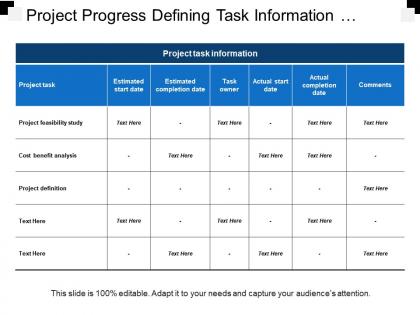
Project progress defining task information estimated completion date comments




Try Before you Buy Download Free Sample Product
 Impress Your
 Audience
 100%
100% Editable
 Save Hours
 of Time


Employing our Project Progress Defining Task Information Estimated Completion Date Comments is an excellent habit. They ensure you always deliver.
People who downloaded this PowerPoint presentation also viewed the following :
Project progress defining task information estimated completion date comments with all 5 slides:
Enlist the help of all around with our Project Progress Defining Task Information Estimated Completion Date Comments. Be able to involve individuals.
FAQs for Project progress defining task information estimated
Key metrics for effective project progress monitoring include schedule variance, budget utilization, milestone completion rates, resource allocation efficiency, and quality indicators like defect rates. These metrics enable project managers to identify potential delays, cost overruns, and resource bottlenecks early, while delivering enhanced visibility and control throughout project lifecycles, ultimately ensuring successful delivery within scope and timeline parameters.
Gantt charts enhance project progress tracking by providing visual timeline representation, real-time status updates, dependency mapping, and milestone monitoring across project phases. These visual tools streamline communication by displaying task completion percentages, resource allocation, and critical path analysis, with many project managers finding that teams achieve better coordination, faster issue identification, and ultimately improved delivery timelines.
Essential tools for real-time project progress updates include project management platforms like Asana and Monday.com, collaboration software such as Slack and Microsoft Teams, time tracking applications, dashboard analytics tools, and cloud-based reporting systems. These technologies streamline communication, automate status reporting, and provide instant visibility across teams, with many organizations finding that integrated platforms significantly enhance operational efficiency and accelerate decision-making processes.
Project progress tracks timeline advancement and milestone completion, measuring where a project stands against its scheduled plan, while project performance evaluates quality, efficiency, and resource utilization against predefined success criteria. Progress focuses on "how much is done," whereas performance assesses "how well it's being done," with many organizations finding that combining both metrics delivers comprehensive project oversight, enabling better decision-making and strategic adjustments.
Best practices for reporting progress to stakeholders include establishing regular communication schedules, using visual dashboards with key metrics, providing clear milestone updates, highlighting risks and mitigation strategies, and maintaining transparent budget tracking. These approaches streamline decision-making by delivering consistent visibility, enabling proactive problem-solving, and building stakeholder confidence, with many organizations finding that structured reporting ultimately enhances project success rates and strategic alignment.
Kanban boards improve visibility by displaying all project tasks, statuses, and bottlenecks in a centralized visual format, enabling real-time progress monitoring across teams. Through columns representing workflow stages, project managers can immediately identify delays, resource constraints, and completion rates, while stakeholders gain transparent access to project health, ultimately streamlining communication and accelerating decision-making processes.
Agile methodology transforms project progress tracking through iterative sprints, daily standups, burndown charts, retrospectives, and continuous stakeholder feedback loops. These frameworks enable teams to identify bottlenecks early, adapt to changing requirements seamlessly, and maintain transparent communication, with many organizations finding that agile approaches deliver faster project completion and enhanced team accountability.
Effective milestone setting involves defining measurable deliverables, aligning timelines with resource availability, establishing clear success criteria, and building in buffer time for contingencies. Regular milestone reviews enable project managers to assess progress, identify bottlenecks early, and make strategic adjustments to scope or timelines, with many organizations finding that flexible milestone frameworks significantly improve project success rates and stakeholder satisfaction.
Teams face challenges including inconsistent data updates, manual reporting errors, lack of real-time visibility, siloed information across departments, and subjective progress assessments. These issues often result in delayed decision-making and resource misallocation, with many organizations finding that implementing automated tracking systems and standardized reporting protocols significantly enhances project transparency and delivery outcomes.
Feedback loops enhance project tracking by enabling continuous communication between stakeholders, identifying potential issues early, and facilitating real-time course corrections throughout the project lifecycle. Through regular check-ins and structured review processes, teams can streamline decision-making, minimize delays, and optimize resource allocation, with many organizations finding that systematic feedback ultimately delivers improved project outcomes and enhanced stakeholder satisfaction.
**INPUT**: What are the benefits of using a centralized dashboard for tracking progress? **OUTPUT**: Centralized dashboards deliver real-time visibility, streamlined communication, enhanced accountability, improved resource allocation, and faster decision-making across project teams. These systems enable organizations to minimize delays, reduce miscommunication, and optimize performance through consolidated data insights, with many companies finding that centralized tracking ultimately enhances operational efficiency and competitive advantage. *[Word count: 52 words]*
Project tracking aids risk management by providing early warning systems through milestone monitoring, resource utilization analysis, budget variance detection, and timeline deviation alerts. Through real-time dashboards and automated reporting, project managers can identify potential bottlenecks, resource constraints, and scope creep before they escalate, ultimately enabling proactive mitigation strategies that protect project outcomes and organizational investments.
Team collaboration tools facilitate better project progress tracking by centralizing communication, providing real-time visibility into task completion, and enabling seamless file sharing across distributed teams. Through integrated dashboards and automated updates, organizations streamline workflow coordination, minimize reporting delays, and enhance transparency, with many project managers finding that these platforms ultimately deliver faster decision-making and improved accountability.
Progress tracking delivers mixed psychological impacts, enhancing motivation through visible achievements, clear goal alignment, and recognition opportunities, while potentially creating stress from constant monitoring and performance pressure. Many organizations find that transparent, collaborative tracking approaches boost team engagement and accountability, with regular milestone celebrations and constructive feedback ultimately delivering stronger collective motivation and sustained performance momentum.
Progress tracking aligns with project objectives by establishing clear key performance indicators, mapping deliverables to strategic goals, and implementing regular milestone reviews that measure actual outcomes against planned targets. Through integrated project management systems, organizations streamline reporting processes, enhance stakeholder visibility, and enable real-time course corrections, ultimately delivering improved project success rates and strategic alignment.
-
Great product with highly impressive and engaging designs.
-
Good research work and creative work done on every template.