


Project task list with priority and completion date




Try Before you Buy Download Free Sample Product
 Impress Your
 Audience
 100%
100% Editable
 Save Hours
 of Time


Initiate the implementation with our Project Task List With Priority And Completion Date. Convince folks you are determined to get it done.
People who downloaded this PowerPoint presentation also viewed the following :
Content of this Powerpoint Presentation
Description:
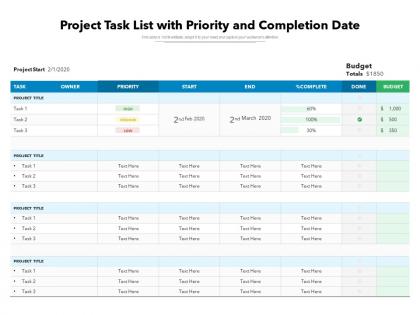
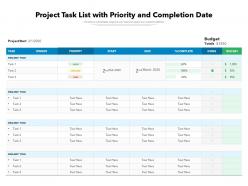
The image displays a slide titled "Project Task List with Priority and Completion Date," intended for project management purposes. The slide is a template that enables project managers to outline project tasks, assign ownership, set priorities, define start and end dates, monitor completion percentages, and allocate budget for each task.
Starting at the top, there's a header that clearly states the slide's purpose. Below this, the "Project Start" date is specified as "2/1/2020," indicating when the project initiates.
The main body consists of a table with several columns: TASK, OWNER, PRIORITY (with visual priority levels: HIGH - red, MEDIUM - yellow, LOW - green), START, END, %COMPLETE (with a progress bar visualization), DONE (represented by a green check mark indicating completion), and BUDGET (listed in dollars).
The first project title has been filled in with sample tasks to demonstrate how the template might be used. Task 1 shows a HIGH priority level and is 60% complete with a $1,000 budget. Task 2, marked with MEDIUM priority, is fully complete (100%) with a budget of $500, and Task 3, designated as LOW priority, is 30% complete with a budget of $350. Totals are presented at the end of the budget column, summing to $1,850.
The subsequent sections "PROJECT TITLE" with Task 1, Task 2, and Task 3 are placeholders for additional project data entry.
Use Cases:
This template is versatile and can be applied in various industries for project management and tracking purposes. Below are seven industries and specific use cases:
1. Construction:
Use: Tracking the progress and budget of construction tasks
Presenter: Construction Manager
Audience: Project Stakeholders
2. Software Development:
Use: Managing software release cycles and developer assignments
Presenter: Lead Software Engineer
Audience: Development Team
3. Event Planning:
Use: Coordinating event logistics, timelines, and financials
Presenter: Event Coordinator
Audience: Event Planning Committee
4. Marketing:
Use: Organizing marketing campaigns and asset creation
Presenter: Marketing Manager
Audience: Marketing Department Staff
5. Manufacturing:
Use: Overseeing the manufacturing process and inventory control
Presenter: Production Supervisor
Audience: Manufacturing Team
6. Healthcare:
Use: Planning and implementing healthcare initiatives and services
Presenter: Healthcare Administrator
Audience: Healthcare Staff
7. Education:
Use: Administering educational program development and milestones
Presenter: Program Director
Audience: Educational Staff and Stakeholders
Project task list with priority and completion date with all 2 slides:
Convince folks you are determined to get it done with our Project Task List With Priority And Completion Date. Be able to initiate the implementation.
FAQs for Project task list with priority
Okay so you need five main things sorted out. Scope first - figure out exactly what you're building and what's definitely not happening. Timelines come next with real milestones, not wishful thinking ones. Resource mapping is huge - who's free when and what they're actually good at. Risk planning too, though honestly most people skip this until something goes wrong. Communication strategy rounds it out so nobody's confused about what's happening. Oh and leave room to adjust because nothing ever goes exactly as planned anyway. These cover the basics without getting too crazy detailed upfront.
Honestly, just figure out who needs what info and how they want it first. Some people love detailed reports, others just want a quick text. I'd rather send too many updates than have someone blindsided later - learned that the hard way. Listen when they complain about something and tweak your approach. Short check-ins work better than those marathon meetings nobody wants to sit through. Oh, and write down your communication plan somewhere so people can't say "I didn't know" later.
Okay so risk management is like having a crystal ball for your project - except it actually works. You basically make a list of everything that could go sideways and plan for it ahead of time. I always think of it as the weather app thing - you might not need an umbrella, but you'd rather have one than get soaked, right? The trick is catching problems while they're still small instead of waiting for disaster to strike. Start by brainstorming what could go wrong (honestly, the weirder scenarios are sometimes the ones that happen). Then focus on the risks that would really mess you up and figure out your backup plans.
Honestly, Agile just makes everything way less stressful. You get feedback constantly instead of building something for months only to find out it's totally wrong. Daily standups keep everyone on the same page - though they can get a bit repetitive sometimes. The best part? When your boss inevitably changes their mind about requirements (because they always do), you can actually roll with it instead of scrapping everything. Two-week sprints work well for most teams. Your stakeholders stay involved the whole time too, so no nasty surprises at launch. Just start small and see what clicks.
Honestly, the biggest thing that's helped me is chunking everything into smaller milestones and adding buffer time. Work backwards from your deadline, then tack on like 20% extra because stuff always breaks. I'm obsessed with Gantt charts but even a basic spreadsheet works if you're not into fancy tools. Weekly team check-ins are a must - you'll catch problems way earlier that way. Oh, and don't be that person who waits until the last minute to tell stakeholders about delays. Nobody likes surprises, especially the bad kind.
Honestly, you need a solid change management process or things get messy fast. Document scope changes with those annoying change request forms (trust me, the paperwork sucks but saves your butt later). Before anything moves forward, assess timeline/budget impact and get stakeholder sign-off. Communication is huge here - keep everyone in the loop about what's changing and why. Never just wing it when changes pop up, that's how projects completely derail. Oh, and set up regular check-ins to catch scope creep early. Way easier than dealing with it after it snowballs into chaos.
Honestly, team size matters more than you'd think here. Asana and Trello are solid for visual stuff - Monday.com too. I've watched so many teams get stuck researching tools for weeks instead of just picking one and going with it. Microsoft Project handles complex dependencies well if you need that level of detail. Jira's basically what everyone uses for agile, though the interface is... let's say it takes getting used to. Pick whatever your team will actually stick with rather than the shiniest option. Grab free trials of maybe 2-3 and test drive them. Better to use a simple tool consistently than abandon something fancy after two weeks.
Honestly? Start with making people feel safe to mess up - nobody collaborates when they're scared of getting thrown under the bus. Do regular check-ins where everyone actually shares their roadblocks (not just the fake "everything's great!" updates). Pair people up on tasks, let different folks run meetings, and shout out wins publicly. The collaboration thing doesn't just magically happen - you've got to be deliberate about it. Oh, and try this: next meeting, have everyone say one thing they need help with from someone else. Works pretty well in my experience.
Honestly, nail down a solid agenda first - cover objectives, timeline, deliverables, all that stuff. Get everyone's roles crystal clear from the start. Don't skip inviting key stakeholders either, not just your core team. I always make sure to go over contact info and how decisions get made. Oh, and definitely plan for how you'll handle changes (spoiler: there will be many). Keep people engaged so they can actually ask questions upfront. Then send a recap afterwards with the main decisions and next steps. Trust me, you'll reference that summary constantly when people "forget" what was agreed on!
Honestly, global teams can be tricky - different communication styles will catch you off guard. Some people are super direct, others hint at problems instead of saying them outright. Time zones suck but aren't the worst part. What really gets messy is when team members won't speak up in meetings because of hierarchy stuff from their culture. I learned this the hard way on my last project. Before you start, just have everyone talk about how they prefer to work. Set up communication rules that actually make sense for your specific group. Trust me, it saves so much drama later.
So there's the obvious stuff - did you hit your budget, timeline, and deliver what you promised? But that's just scratching the surface honestly. Quality matters too, like how many bugs you shipped or whether customers are actually happy. Team morale is huge - I've seen "successful" projects leave everyone totally burned out, which feels pretty hollow. Business impact is the real test though: did it actually move the needle? Oh, and stakeholder satisfaction can make or break future projects. My advice? Figure out what success means before you start, then pick maybe 4-5 metrics that actually matter for your specific situation.
Okay so definitely document your lessons learned after each project - but here's the thing, actually READ them before starting new work. Most teams just file them away and never look back (drives me crazy). Set up a simple spot to capture what worked, what bombed, and process tweaks. Then - and this is crucial - make reviewing past similar projects part of your kickoff routine, not some afterthought. Seriously, spending like 30 minutes looking at old project notes can save you weeks of pain later. Use what you find to update templates and planning stuff. It's such a game changer.
Honestly, you've gotta talk way more than you think you need to. Daily check-ins are a lifesaver - keeps everyone on the same page when you can't just peek over at their screen. Get something like Asana or Trello so people know what's actually happening (seriously, nobody reads their email anymore). Be super clear about when you expect responses and which apps to use for what. Oh, and those random virtual coffee breaks? They're not just fluff - people need that connection. Start simple with one good routine, then add more structure as you figure out what works.
Dude, stakeholder engagement can totally make or break your project. You'll catch scope creep way earlier when people stay in the loop. Buy-in becomes so much easier too. The thing is, engaged stakeholders turn into advocates instead of those people who block everything you're trying to do. They'll actually help you get resources and deal with office politics - which honestly can be half the battle sometimes. I've watched perfectly good projects crash because someone didn't talk to the right person early enough. Map everyone out upfront and do regular check-ins, even when it feels excessive.
Oh man, scope creep will be your biggest nightmare - stakeholders always think adding "one tiny feature" won't mess anything up. Wrong. Set super clear boundaries from day one and write everything down. Unrealistic deadlines are brutal too, so push back with actual data when timelines are insane. Communication usually falls apart (shocking, right?), so make sure everyone knows how to share updates. Resource constraints will bite you eventually. Always pad your timeline because trust me, something weird will break at the worst possible moment.
No Reviews