


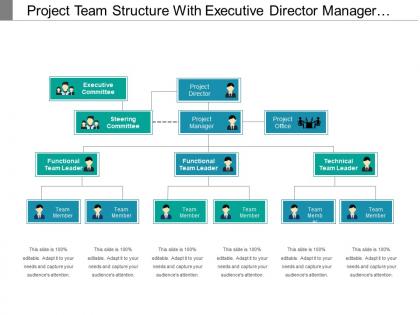
Project team structure with executive director manager officer leaders and members




Try Before you Buy Download Free Sample Product
 Impress Your
 Audience
 100%
100% Editable
 Save Hours
 of Time


Establish common ground with our Project Team Structure With Executive Director Manager Officer Leaders And Members. Your thoughts will engender consensus.
People who downloaded this PowerPoint presentation also viewed the following :
Project team structure with executive director manager officer leaders and members with all 5 slides:
Get acquainted with associated aspects due to our Project Team Structure With Executive Director Manager Officer Leaders And Members. Be aware of areas beyond your expertise.



FAQs for Project team structure with executive director manager officer
A typical project team hierarchy includes project managers, team leads, subject matter experts, developers or specialists, and stakeholders or sponsors. These roles work together by establishing clear accountability, streamlining communication channels, and ensuring efficient resource allocation, with many organizations finding that well-defined hierarchies accelerate project delivery and minimize bottlenecks.
A well-defined project team hierarchy enhances project success by establishing clear accountability, streamlining decision-making processes, and reducing communication bottlenecks across all project phases. This structured approach enables faster issue resolution, minimizes role confusion, and ensures efficient resource allocation, with many organizations finding that hierarchical clarity ultimately delivers improved project timelines and stakeholder satisfaction.
Flat project team structures deliver enhanced collaboration, faster decision-making, improved communication flow, increased team autonomy, and reduced bureaucratic delays compared to traditional hierarchies. While flat structures enable organizations to accelerate project timelines and foster innovation through direct team member interactions, they also require strong self-management skills, with many companies finding this approach particularly effective for agile development and creative initiatives.
Team dynamics improve through clear role definition, open communication channels, regular feedback sessions, and collaborative decision-making processes that respect hierarchical boundaries while encouraging input from all levels. Strategic approaches like cross-functional workshops, mentorship programs, and transparent project updates enable teams to leverage diverse expertise, minimize conflicts, and enhance coordination, ultimately delivering improved project outcomes and stronger team cohesion.
Communication serves as the backbone of effective project team hierarchy by ensuring clear role definition, seamless information flow, and coordinated decision-making across all organizational levels. Through regular status updates, structured reporting channels, and transparent feedback mechanisms, project managers streamline task delegation, minimize bottlenecks, and enhance team accountability, with many organizations finding that strong communication protocols ultimately deliver faster project completion and improved stakeholder satisfaction.
Leadership styles significantly influence project team hierarchy effectiveness by shaping communication patterns, decision-making speed, and team engagement levels throughout organizational layers. Transformational leaders enhance cross-hierarchical collaboration and innovation, while directive styles streamline urgent project phases, with many organizations finding that adaptive leadership approaches, switching between collaborative and authoritative methods based on project complexity, ultimately deliver improved team performance and faster project outcomes.
Effective strategies include establishing cross-functional teams, implementing regular inter-level meetings, creating mentorship programs, utilizing collaborative digital platforms, and encouraging open communication channels. These approaches streamline information flow by breaking down silos, enhancing knowledge sharing, and building trust across organizational levels, with many companies finding that structured collaboration ultimately delivers faster project outcomes and stronger team cohesion.
Project managers effectively navigate hierarchical conflicts by establishing clear communication channels, facilitating cross-level dialogue, and implementing transparent decision-making processes that respect organizational structure while promoting collaboration. Through strategic mediation and stakeholder alignment techniques, successful project managers bridge departmental gaps, streamline reporting relationships, and foster consensus-building approaches, ultimately delivering smoother project execution and enhanced team productivity across all organizational levels.
Remote work flattens traditional project hierarchies by reducing formal barriers, enabling more direct communication across levels, and shifting focus from position-based to contribution-based leadership. This transformation enhances collaboration through digital platforms, accelerates decision-making processes, and ultimately delivers greater agility, with many organizations finding that remote teams achieve higher engagement and productivity outcomes.
Cultural factors influence project team hierarchy perception through varying attitudes toward power distance, authority respect, and decision-making styles across different societies. Organizations with diverse teams find that high power distance cultures expect clear hierarchical structures, while low power distance cultures prefer collaborative approaches, ultimately requiring adaptive leadership strategies that balance cultural expectations with project efficiency and team cohesion.
Rigid project team hierarchies often create communication bottlenecks, stifle innovation, slow decision-making processes, and reduce team adaptability to changing requirements. These structural limitations can lead to decreased employee engagement, missed opportunities for creative problem-solving, and delayed project deliverables, with many organizations finding that overly hierarchical approaches ultimately hinder agility and competitive responsiveness.
Agile environments adapt hierarchy through flexible role definitions, cross-functional collaboration, servant leadership approaches, and iterative responsibility sharing while maintaining clear accountability structures. Teams increasingly implement rotating leadership models, empowered decision-making at multiple levels, and transparent communication channels, with many organizations finding that this balanced approach delivers faster project outcomes and enhanced team engagement.
**INPUT**: What tools can support the visualization of project team hierarchies? **OUTPUT**: Visualization tools include organizational chart software like Lucidchart, Microsoft Visio, OrgChart, SmartDraw, and project management platforms with hierarchy features. These technologies streamline team communication, enhance role clarity, and facilitate resource allocation across departments, with many organizations finding that visual hierarchies ultimately deliver improved project coordination and operational efficiency in increasingly complex business environments.
Feedback loops in hierarchical projects can be established through regular one-on-one meetings, structured team retrospectives, cross-functional reviews, anonymous suggestion systems, and milestone assessment sessions. These mechanisms enable upward communication from team members to leadership while facilitating downward strategic guidance, with many organizations finding that structured feedback cycles improve project outcomes, enhance team engagement, and ultimately deliver faster decision-making and reduced project risks.
Essential skills vary by hierarchy level, with senior managers requiring strategic planning, stakeholder management, and decision-making capabilities, while project managers need coordination, communication, and risk management expertise. Team leads focus on technical supervision and resource allocation, and individual contributors emphasize specialized technical skills, problem-solving abilities, and collaborative communication, with organizations finding that cross-functional competencies ultimately enhance project delivery and team effectiveness.
-
Really like the color and design of the presentation.
-
Unique design & color.