

Project timeline with construction deliverables construction project risk landscape ppt infographics





Try Before you Buy Download Free Sample Product
 Impress Your
 Audience
 100%
100% Editable
 Save Hours
 of Time


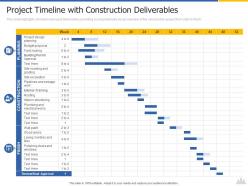
This slide highlights a timeline of project deliverables providing a comprehensive visual overview of the construction project from start to finish.
People who downloaded this PowerPoint presentation also viewed the following :
Project timeline with construction deliverables construction project risk landscape ppt infographics with all 2 slides:
Use our Project Timeline With Construction Deliverables Construction Project Risk Landscape Ppt Infographics to effectively help you save your valuable time. They are readymade to fit into any presentation structure.

FAQs for Project timeline with construction deliverables construction project risk
Key phases of a construction project timeline include pre-construction planning, design development, permitting and approvals, site preparation, foundation work, structural construction, systems installation, interior finishing, and final inspections. These phases streamline project delivery by establishing clear milestones, coordinating subcontractor schedules, and minimizing delays, with many construction firms finding that structured timelines reduce costs and enhance client satisfaction.
Gantt charts enhance construction project scheduling by providing visual timelines, identifying task dependencies, tracking progress against milestones, and enabling resource allocation optimization. Through these visual tools, construction managers streamline coordination between trades, minimize delays from scheduling conflicts, and improve communication with stakeholders, ultimately delivering projects on time and within budget while maintaining quality standards.
Duration estimation requires analyzing task complexity, resource availability, weather conditions, permit processing times, and material delivery schedules for each phase. These factors interconnect significantly, with many construction managers finding that buffer time allocation, crew expertise levels, and equipment accessibility ultimately determine project success, enabling more accurate scheduling and cost control.
Delays in one phase create cascading effects throughout construction projects, as most activities depend on completion of preceding tasks, materials delivery, and resource availability. When foundation work extends beyond schedule, framing, electrical, and plumbing phases shift accordingly, ultimately compressing later phases and potentially increasing costs, with many contractors finding that early delays require strategic resource reallocation to maintain project viability.
Common delays in construction projects include weather disruptions, permit approvals, material shortages, labor availability, and design changes. These challenges can be mitigated through proactive scheduling, early permit applications, strategic supplier relationships, and robust project management systems, with many construction firms finding that digital planning tools and contingency protocols ultimately deliver improved timelines and cost control.
Technology streamlines construction timeline management through project management software, real-time scheduling tools, mobile communication platforms, automated progress tracking, and integrated resource planning systems. These solutions enhance coordination by providing instant updates, predictive analytics, and centralized dashboards, with many construction firms finding significantly reduced delays, improved resource allocation, and ultimately faster project completion rates.
Stakeholder communication serves as the backbone for timeline adherence by ensuring alignment on expectations, facilitating rapid decision-making, and preventing costly delays through proactive issue resolution. Regular updates between contractors, clients, suppliers, and regulatory bodies enable swift problem-solving, resource coordination, and scope adjustments, with many construction firms finding that structured communication protocols reduce project delays by 20-30%.
Seasonal weather conditions significantly impact construction project scheduling by affecting material delivery, worker safety protocols, and equipment operation across different phases. Construction managers strategically plan concrete pours during moderate temperatures, roofing installations before winter storms, and excavation work during dry seasons, ultimately enabling projects to maintain momentum while minimizing weather-related delays and cost overruns.
Task prioritization techniques in construction include critical path analysis, resource-based scheduling, dependency mapping, milestone-driven sequencing, and risk-weighted prioritization matrices. These methods streamline project flow by identifying bottlenecks early, optimizing resource allocation, and minimizing delays, with many construction firms finding that strategic task prioritization reduces overall project duration while enhancing operational efficiency.
Critical metrics include milestone completion rates, resource utilization efficiency, budget variance tracking, quality control checkpoints, and weather impact assessments. These indicators enable project managers to identify potential delays early, reallocate resources strategically, and maintain stakeholder communication, with many construction firms finding that proactive monitoring ultimately delivers projects on schedule and within budget constraints.
Software tools assist project managers by providing real-time progress monitoring, automated milestone tracking, resource allocation optimization, and predictive analytics for potential delays. These platforms enable seamless collaboration between contractors, architects, and stakeholders while delivering instant visibility into critical path activities, ultimately helping construction teams identify bottlenecks early and maintain project schedules more effectively.
Not adhering to project timelines creates cascading budget overruns, resource allocation conflicts, and operational inefficiencies across construction projects. These delays trigger increased labor costs, extended equipment rentals, and penalty clauses, while disrupting subsequent project scheduling and contractor availability, ultimately compromising profitability and competitive positioning in an increasingly demanding construction marketplace.
Contingency plans should be integrated through buffer time allocation, risk-specific response protocols, and flexible resource scheduling at critical project phases. Successful construction managers build these safeguards directly into baseline timelines, with many large-scale projects finding that proactive contingency integration reduces delays by 20-30%, ultimately delivering better client satisfaction and protecting profit margins.
Best practices for revising construction timelines include conducting immediate impact assessments, reallocating resources strategically, implementing accelerated work schedules, updating stakeholder communications, and establishing revised milestone targets. These approaches streamline project recovery by minimizing delays, optimizing labor deployment, and maintaining budget controls, with many construction firms finding that proactive timeline revisions ultimately deliver enhanced project outcomes and client satisfaction.
Effective collaboration among contractors, subcontractors, and suppliers significantly accelerates project timelines by streamlining communication, coordinating resource delivery, and minimizing workflow disruptions. Through integrated project management platforms and regular coordination meetings, construction teams reduce delays by 20-30%, eliminate duplicate work, and ensure seamless handoffs between phases, ultimately delivering projects faster while maintaining quality standards.
-
I discovered this website through a google search, the services matched my needs perfectly and the pricing was very reasonable. I was thrilled with the product and the customer service. I will definitely use their slides again for my presentations and recommend them to other colleagues.
-
Unique research projects to present in meeting.
-
The content is very helpful from business point of view.
-
Out of the box and creative design.