

Managing delays occurring in construction project risk landscape ppt summary




Try Before you Buy Download Free Sample Product
 Impress Your
 Audience
 100%
100% Editable
 Save Hours
 of Time


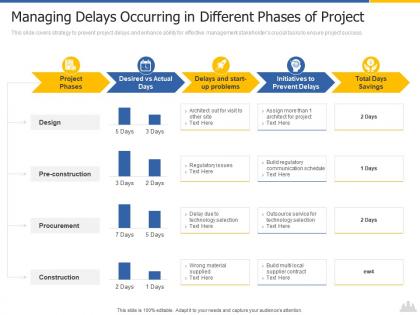
This slide covers strategy to prevent project delays and enhance ability for effective management stakeholders crucial tasks to ensure project success.
People who downloaded this PowerPoint presentation also viewed the following :
Managing delays occurring in construction project risk landscape ppt summary with all 2 slides:
Use our Managing Delays Occurring In Construction Project Risk Landscape Ppt Summary to effectively help you save your valuable time. They are readymade to fit into any presentation structure.

FAQs for Managing delays occurring in construction project risk
Primary factors contributing to construction project delays include poor planning and scheduling, supply chain disruptions, labor shortages, weather conditions, regulatory approvals, and change orders from clients. These challenges significantly impact project timelines by creating cascading effects across multiple work phases, with many construction companies finding that proactive risk management and enhanced communication between stakeholders ultimately streamlines operations and delivers better project outcomes.
Effective project management minimizes construction delays through detailed scheduling, resource allocation, risk assessment, stakeholder coordination, and proactive communication protocols. By implementing comprehensive planning tools, regular progress monitoring, and contingency strategies, construction teams can anticipate potential bottlenecks, streamline workflows, and maintain project timelines, ultimately delivering projects on schedule while reducing costly overruns and enhancing client satisfaction.
Communication serves as the central coordinating mechanism for preventing construction delays through real-time updates, proactive issue identification, transparent progress reporting, and immediate stakeholder alignment on schedule changes. Effective project communication systems enable construction teams, contractors, and clients to address potential bottlenecks before they impact timelines, ultimately delivering faster project completion and reduced cost overruns.
Weather conditions significantly impact construction timelines through work stoppages during storms, temperature-related material limitations, and seasonal accessibility challenges that can delay foundation work, concrete pouring, and exterior installations. These disruptions often extend project schedules by 15-30%, with many construction firms increasingly adopting weather monitoring systems and flexible scheduling strategies to minimize delays and maintain competitive project delivery timelines.
Legal implications of construction delays include contract penalties, liquidated damages, termination rights, warranty extensions, and potential litigation. These consequences vary by contract terms, with many construction companies finding that proactive delay mitigation through clear documentation, milestone tracking, and stakeholder communication ultimately minimizes legal exposure while maintaining project profitability and client relationships.
Technology mitigates construction delays by enabling real-time scheduling, automated progress tracking, resource optimization, and instant communication across teams. Project management software streamlines workflows through predictive analytics, equipment monitoring, and collaborative dashboards, with many construction firms finding that digital integration reduces project timelines by 15-20%, ultimately delivering faster completion and enhanced profitability.
Strategies include accelerating critical path activities, implementing parallel work sequences, extending working hours, deploying additional crews, and optimizing resource allocation through advanced scheduling techniques. These approaches enable contractors to compress timelines while maintaining quality standards, with many construction firms finding that strategic combinations of overtime scheduling and workforce augmentation ultimately deliver schedule recovery and competitive project completion.
Stakeholder engagement significantly accelerates construction timelines by ensuring clear communication, early issue identification, and streamlined decision-making processes throughout project phases. Effective engagement with property owners, contractors, and regulatory bodies minimizes costly revisions, reduces approval delays, and facilitates smoother permit processes, ultimately delivering projects on schedule while enhancing overall coordination and resource allocation efficiency.
Construction project delays create significant financial implications including increased labor costs, equipment rental extensions, material price escalations, penalty clauses, and cash flow disruptions for both parties. While contractors face reduced profit margins and potential legal liabilities, clients experience delayed revenue generation and additional financing costs, with many construction firms finding that proactive delay mitigation ultimately delivers better project outcomes and stronger client relationships.
Labor shortages significantly impact construction schedules by extending project timelines, increasing costs, and creating workflow bottlenecks across critical phases. Construction companies face delayed milestones, with many projects experiencing 20-40% timeline extensions, ultimately forcing contractors to prioritize resource allocation, explore automation solutions, and implement strategic workforce planning to maintain competitive advantage.
Supply chain disruptions significantly extend construction timelines through material shortages, delayed deliveries, and increased costs, often pushing projects months beyond scheduled completion dates. These disruptions force contractors to source alternative suppliers, adjust project sequencing, and manage workforce downtime, with many construction firms finding that proactive supply chain diversification and strategic material stockpiling help minimize timeline impacts.
**INPUT**: How can change orders be managed to prevent delays? **OUTPUT**: Change orders can be managed through clear approval workflows, detailed documentation requirements, real-time communication systems, and predefined cost impact assessments. These processes streamline decision-making by establishing transparent timelines, centralizing stakeholder communications, and maintaining comprehensive project records, with many construction firms finding that structured change management ultimately delivers faster approvals and minimized schedule disruptions. **Word Count**: 56 words
Key metrics include schedule performance index (SPI), critical path analysis, resource utilization rates, weather impact days, and permit approval timelines. These indicators enable project managers to identify potential bottlenecks early, optimize resource allocation, and implement corrective measures, with many construction firms finding that proactive tracking reduces delays by 20-30% while enhancing overall project delivery.
Local regulations and permits significantly influence project timelines by requiring compliance reviews, inspection schedules, and approval waiting periods that can extend construction phases by weeks or months. These regulatory requirements, while ensuring safety and environmental standards, create dependencies that smart contractors increasingly build into project planning, ultimately delivering more predictable timelines and avoiding costly delays.
Best practices for timely project completion include detailed project scheduling, proactive risk management, regular stakeholder communication, resource optimization, and milestone tracking systems. These approaches streamline construction workflows by identifying potential bottlenecks early, maintaining material supply chains, and facilitating real-time coordination between contractors, ultimately delivering reduced costs and enhanced project predictability.
-
Wonderful templates design to use in business meetings.