


Projected Income Statement For Insurance Business Building Insurance Agency Business Plan




Try Before you Buy Download Free Sample Product
 Impress Your
 Audience
 100%
100% Editable
 Save Hours
 of Time


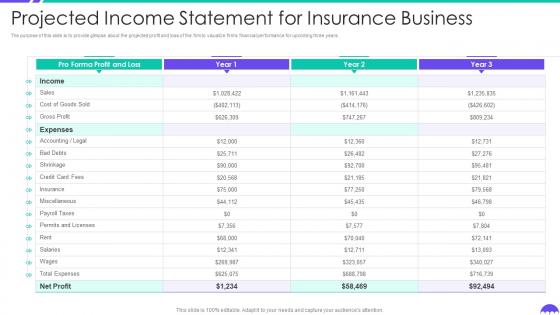
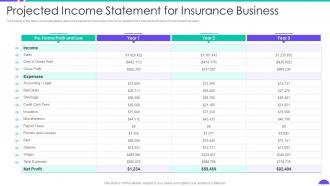
The purpose of this slide is to provide glimpse about the projected profit and loss of the firm to visualize firms financial performance for upcoming three years.
People who downloaded this PowerPoint presentation also viewed the following :
Projected Income Statement For Insurance Business Building Insurance Agency Business Plan with all 6 slides:
Use our Projected Income Statement For Insurance Business Building Insurance Agency Business Plan to effectively help you save your valuable time. They are readymade to fit into any presentation structure.





FAQs for Projected Income Statement For Insurance Business Building Insurance
Key components of a projected income statement include projected revenues, cost of goods sold, gross profit, operating expenses, operating income, interest expenses, and net income projections. These financial projections enable businesses to forecast profitability, plan resource allocation, and make strategic decisions, with many organizations finding that comprehensive income projections ultimately deliver better financial planning and enhanced investor confidence.
Fixed expenses remain constant regardless of business activity levels, including rent, insurance premiums, salaries, loan payments, and subscription services. Variable expenses fluctuate with production or sales volume, such as raw materials, commission payments, and shipping costs, with many organizations finding that clearly categorizing these expenses enables more accurate forecasting and strategic resource allocation.
Projected income statements typically cover one to five years, with most businesses using annual projections broken down into monthly or quarterly periods for the first year. This timeframe enables organizations to align financial forecasting with strategic planning cycles, budget development, and investor requirements, while providing sufficient detail for operational decision-making and performance tracking against actual results.
Startups benefit from creating projected income statements by establishing financial roadmaps, identifying potential cash flow issues, and demonstrating viability to investors and lenders. These projections enable founders to make informed decisions about resource allocation, pricing strategies, and growth investments, while helping secure funding through credible financial forecasting that showcases business potential.
Market research provides critical data on customer demand, pricing strategies, competitive landscape, industry trends, and market size, forming the foundation for realistic revenue forecasts. Through comprehensive market analysis, businesses can validate assumptions about sales volumes, pricing power, and growth trajectories, while identifying potential risks and opportunities, ultimately ensuring their projected income statements reflect genuine market conditions rather than optimistic speculation.
Seasonality in projected income statements is accounted for by analyzing historical sales patterns, adjusting revenue projections by month or quarter, and incorporating seasonal expense fluctuations like inventory buildup or marketing spend. Retail businesses, hospitality companies, and agricultural enterprises particularly benefit from this approach, as it enables more accurate cash flow planning, better resource allocation, and ultimately delivers realistic financial forecasts that support strategic decision-making.
Gross profit in a projected income statement reveals the fundamental profitability of core business operations before operating expenses, serving as a critical indicator of pricing strategy effectiveness, cost management efficiency, and competitive positioning. This metric enables businesses to assess product viability, optimize resource allocation, and make strategic decisions about scaling operations, with many organizations finding that consistent gross profit margins ultimately deliver sustainable growth and operational resilience.
Financial modeling software enhances projected income statements by automating calculations, integrating real-time data feeds, and enabling sophisticated scenario analysis with sensitivity testing. These platforms streamline forecasting processes through built-in templates, variance analysis tools, and collaborative features, with many financial institutions and corporations finding that automated modeling delivers faster, more accurate projections while minimizing manual errors and enhancing strategic planning capabilities.
When presenting a projected income statement, key assumptions should include revenue growth rates, pricing strategies, market conditions, cost structures, expense inflation rates, and competitive landscape changes. These assumptions enable stakeholders to understand the financial modeling foundation, assess risk factors, and evaluate strategic scenarios, with many investors and management teams finding that transparent assumption disclosure ultimately enhances credibility and facilitates informed decision-making processes.
Effectively communicating projected income statements requires clear visual presentations, simplified language explaining key assumptions, and scenario-based discussions highlighting potential outcomes. Through structured presentations and interactive dashboards, organizations streamline stakeholder understanding by focusing on revenue drivers, cost implications, and profitability targets, while addressing questions transparently, ultimately building confidence and securing buy-in for strategic initiatives.
Common mistakes include overestimating revenues, underestimating expenses, ignoring seasonal variations, using unrealistic growth rates, and failing to account for market competition. These errors can mislead investors and stakeholders, with many businesses finding that conservative projections, thorough market research, and regular updates deliver more credible forecasts and stronger strategic planning outcomes.
Projected income statements should be updated quarterly for formal reviews, with monthly adjustments for significant operational changes, market shifts, budget variances, or strategic pivots. Many organizations find that regular quarterly updates, combined with monthly monitoring of key metrics like revenue trends and expense patterns, enable more accurate forecasting and strategic decision-making while maintaining financial agility.
Sales forecasts directly determine projection accuracy by establishing the foundation for revenue estimates, expense planning, operational scaling, and resource allocation decisions. While overly optimistic forecasts can lead to budget shortfalls and cash flow issues, conservative estimates may result in missed growth opportunities, with many businesses finding that regularly updated, data-driven forecasts enhance financial planning accuracy significantly.
Historical data informs projected income statements by analyzing revenue trends, expense patterns, seasonal fluctuations, and growth rates from previous periods. Through trend analysis, businesses can identify consistent patterns, seasonal variations, and cost relationships, while incorporating market changes and strategic initiatives, ultimately delivering more accurate forecasts that enhance financial planning and investor confidence.
Sensitivity analysis improves projection reliability by testing how changes in key variables like sales growth, costs, and market conditions affect financial outcomes, identifying potential risks and opportunities. This systematic approach enables businesses to create more robust forecasts, develop contingency plans, and make informed strategic decisions, with many organizations finding that scenario modeling significantly enhances their financial planning accuracy and stakeholder confidence.
-
I want to express my gratitude to SlideTeam’s presentation design services team for helping me create the best presentation of my life!
-
“Superb. What a great finding. Thankful for SlideTeam. We were paying people to make slides which went all in vain. We are so happy to have found you.”