


Property Management KPI Dashboard Real Estate Marketing Plan Sell Property




Try Before you Buy Download Free Sample Product
 Impress Your
 Audience
 100%
100% Editable
 Save Hours
 of Time


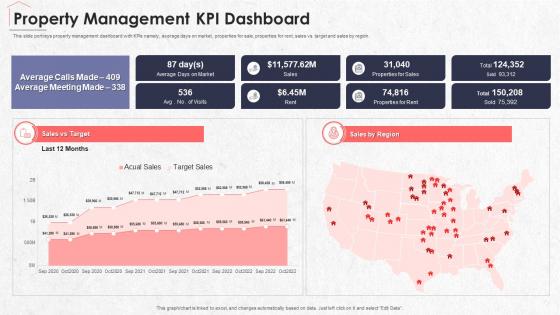
This slide portrays property management dashboard with KPIs namely, average days on market, properties for sale, properties for rent, sales vs. target and sales by region.
People who downloaded this PowerPoint presentation also viewed the following :
Property Management KPI Dashboard Real Estate Marketing Plan Sell Property with all 7 slides:
Use our Property Management KPI Dashboard Real Estate Marketing Plan Sell Property to effectively help you save your valuable time. They are readymade to fit into any presentation structure.






FAQs for Property Management KPI Dashboard Real Estate Marketing
Key property management KPIs include occupancy rates, rent collection efficiency, maintenance response times, tenant satisfaction scores, and operating expense ratios. These metrics streamline decision-making by identifying revenue opportunities, optimizing maintenance workflows, and enhancing tenant retention, with many property managers finding that consistent KPI tracking delivers improved cash flow and competitive advantage in increasingly dynamic real estate markets.
A KPI dashboard enhances property management decision-making by providing real-time visibility into occupancy rates, maintenance costs, tenant satisfaction scores, and revenue performance across multiple properties. This centralized data enables property managers to identify underperforming assets, optimize resource allocation, and respond quickly to emerging trends, ultimately delivering improved operational efficiency and stronger investment returns.
Key metrics for residential property management KPI dashboards include occupancy rates, rent collection efficiency, tenant turnover rates, maintenance response times, and net operating income. These indicators enable property managers to optimize rental performance, minimize vacancy costs, and enhance tenant satisfaction, with many residential operators finding that comprehensive dashboards ultimately deliver improved cash flow and competitive positioning.
Occupancy rates serve as a foundational metric that influences virtually all other KPIs in property management, directly impacting revenue per unit, maintenance costs, marketing expenses, and tenant satisfaction scores. Higher occupancy rates typically enhance cash flow projections and operational efficiency, while lower rates trigger increased marketing spend and vacancy cost analysis, with many property managers finding that occupancy fluctuations create cascading effects across their entire dashboard performance.
Tenant satisfaction scores serve as critical predictive indicators for occupancy rates, lease renewals, and revenue stability in property management operations. These metrics enable property managers to identify service gaps, prioritize maintenance investments, and enhance resident experiences proactively, with many real estate portfolios finding that higher satisfaction scores correlate directly with reduced turnover costs and increased profitability.
Property management firms can utilize KPIs like average response time, first-call resolution rates, tenant satisfaction scores, and maintenance cost per unit to streamline operations and identify bottlenecks. By tracking these metrics through automated systems, firms enable faster work order processing, better resource allocation, and proactive maintenance scheduling, with many organizations finding that data-driven approaches reduce response times by 30-40% while enhancing tenant retention.
Financial metrics serve as the foundation of property management KPI dashboards, tracking rental income, operating expenses, vacancy rates, maintenance costs, and profit margins to provide comprehensive performance visibility. These metrics enable property managers to optimize cash flow, reduce operational expenses, and maximize ROI across portfolios, with many real estate firms finding that integrated financial tracking delivers better tenant retention and significantly improved investment returns.
Technology and software improve property management KPI accuracy through automated data collection, real-time analytics, integrated reporting systems, and elimination of manual entry errors. Cloud-based platforms enable seamless integration across rent collection, maintenance tracking, and tenant management systems, while advanced analytics provide precise occupancy rates, financial metrics, and operational insights, ultimately delivering more reliable decision-making data for property managers.
Common pitfalls include overcrowding dashboards with excessive metrics, focusing on vanity metrics rather than actionable KPIs, poor data visualization choices, and neglecting mobile responsiveness for field teams. These design mistakes significantly reduce dashboard effectiveness by overwhelming users, obscuring critical insights like occupancy trends or maintenance costs, and limiting accessibility, with many property management companies finding that streamlined, mobile-optimized dashboards enhance decision-making speed and operational efficiency.
Property managers should update their KPI dashboards daily for operational metrics like occupancy rates and maintenance requests, weekly for financial performance indicators, and monthly for strategic metrics such as tenant satisfaction scores. This tiered approach ensures real-time responsiveness to urgent issues while maintaining comprehensive oversight, with many property management companies finding that automated daily updates combined with weekly analysis sessions significantly enhance decision-making speed and operational efficiency.
Effective property management KPI visualizations include gauge charts for occupancy rates, trend lines for rental income patterns, heat maps for maintenance response times, bar charts for tenant satisfaction scores, and geographic maps for portfolio performance. These visual formats enable property managers to quickly identify underperforming assets, track seasonal trends, and optimize operational efficiency, ultimately delivering faster decision-making and enhanced portfolio returns.
Property management companies can leverage KPIs like occupancy rates, tenant acquisition costs, lead conversion rates, and marketing ROI to refine their strategies by identifying high-performing channels and optimizing budget allocation. Through data-driven insights, companies streamline marketing spend, enhance tenant targeting, and accelerate lease-up times, with many finding that strategic KPI analysis ultimately delivers lower vacancy rates and improved competitive positioning.
Tenant turnover rates significantly impact property management KPI dashboards by affecting occupancy metrics, revenue forecasting, maintenance costs, and operational efficiency tracking. High turnover triggers cascading effects across multiple dashboard indicators, including vacancy periods, marketing expenses, and unit preparation costs, while lower turnover rates enhance predictable cash flows and operational stability, ultimately delivering improved portfolio performance and investor confidence.
Regulatory compliance metrics integrate into property management KPIs by tracking adherence to safety codes, environmental standards, tenant rights regulations, and financial reporting requirements. These metrics help property managers minimize legal risks, avoid costly penalties, and maintain operational licenses, while ensuring consistent tenant satisfaction and building long-term asset value through proactive compliance management.
A KPI dashboard fosters better communication among property management teams by providing shared visibility into performance metrics, standardizing reporting formats, and creating common reference points for discussions. Through centralized data access, teams can collaborate more effectively on occupancy rates, maintenance response times, and tenant satisfaction scores, while reducing information silos and ensuring everyone operates with consistent, real-time insights.
-
Great combination of visuals and information. Glad I purchased your subscription.
-
It is my first time working with them and that too on a friend's recommendation. I would say, I am not expecting such a worldly service at this low price.